
At a glance
Symptoms
- • Thick white ice on the back wall of the freezer (more than 1/4 inch)
- • Frost on packaging, frozen-over food bags, or icicles hanging from racks
- • Ice on the freezer ceiling or accumulated on the door gasket
- • Freezer is also getting warmer than 0°F as the frost grows
- • Compressor running constantly to compensate for the iced-over evaporator
- • Air vents inside the freezer are blocked with ice
- • Loud fan-blade-hitting-ice grinding noise from the back of the freezer
Common causes
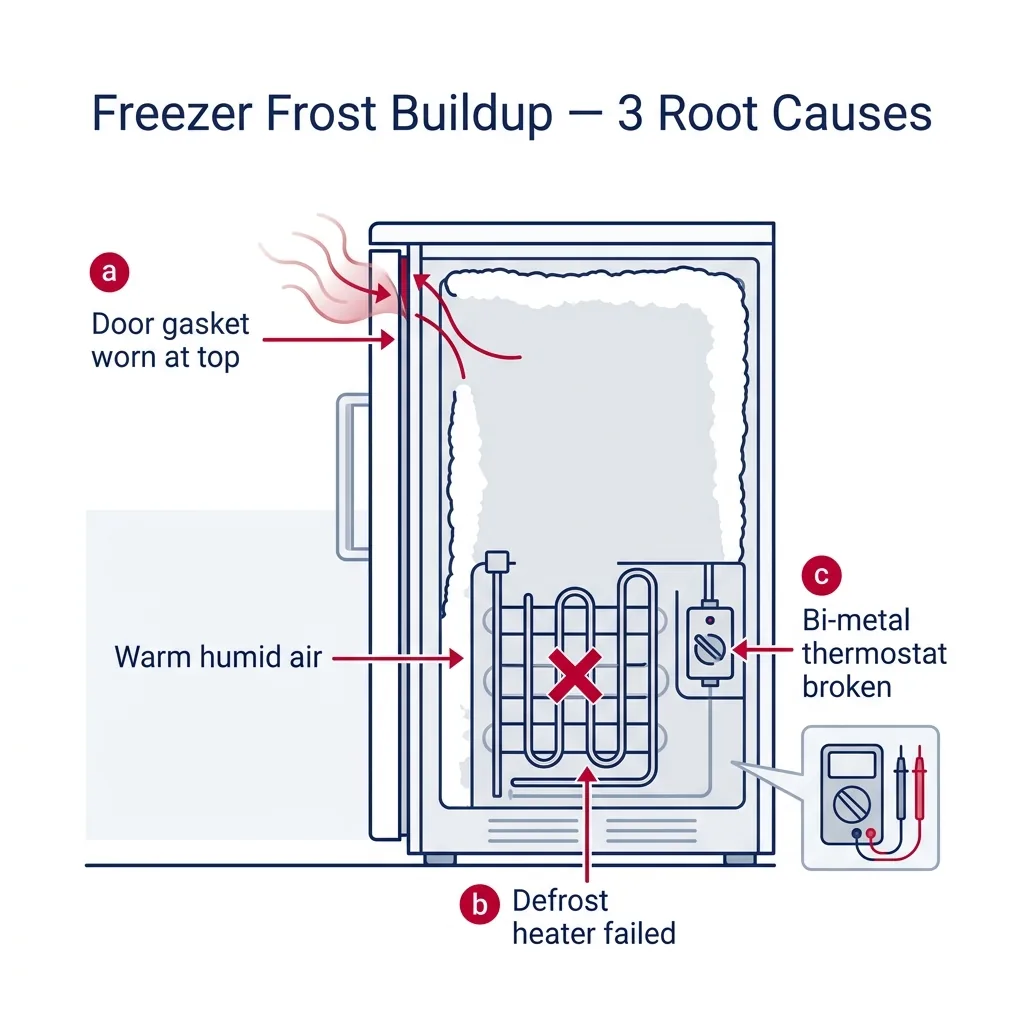
- • Auto-defrost: failed defrost heater (most common on units 5+ years old)
- • Auto-defrost: failed bi-metal defrost thermostat (cheapest part, very common failure)
- • Auto-defrost: failed defrost timer or main control board
- • Door gasket leaking warm humid air into the cavity
- • Door left ajar or not closing fully (kids, shifted boxes, stuck shelves)
- • Frequent door opening in a hot, humid environment (garage in summer)
- • Manual-defrost chest freezer simply needing seasonal defrost
- • Ice maker fill tube dripping onto the evaporator
Safety First — Read Before You Start
- •Unplug the freezer before removing the back panel inside the freezer or testing components.
- •Do not use a heat gun, open flame, or sharp object to chip ice from the evaporator coils — the tubing is thin copper and a puncture means a refrigerant leak.
- •A defrost heater carries 120V when energized — confirm power is off before touching it.
- •On chest freezers, never use a metal tool to chip ice off the cabinet walls. The cooling coils are bonded to the wall and can be punctured.
- •Move food to coolers if the repair will take more than 30 minutes — opened food in a freezer that warms above 40°F should be discarded if frozen state is lost.
Tools & supplies you'll need
- Phillips and flat-head screwdrivers
- 1/4-inch nut driver
- Multimeter
- Hair dryer (for thawing the evaporator)
- Coolers or insulated bags (to hold food during repair)
- Towels and a shop vacuum
- Replacement defrost components as identified
- Door gasket if needed
Step-by-step instructions
Identify auto-defrost vs. manual-defrost
First, know what kind of freezer you have. Upright freezers, refrigerator freezer compartments, and most modern French-door units are auto-defrost — they have a heater that melts frost from the evaporator coils every 6-12 hours of run time. Chest freezers and a few inexpensive uprights are manual-defrost — they have no heater, and frost accumulates on the cabinet walls until you defrost them yourself. The diagnosis path is completely different. If frost is accumulating on a manual-defrost unit, that is normal — just defrost it. If frost is accumulating on an auto-defrost unit, something has failed.
Tip: Not sure? Check the model on the manufacturer site, or look for a "frost-free" badge on the door interior. If your freezer has cold air vents on the back wall, it is auto-defrost.
Manual-defrost: defrost the cabinet
If you have a chest freezer or inexpensive upright with no fan inside, this is just maintenance. Move food to coolers, unplug the unit, prop the lid open, and place towels and a shallow pan inside to catch melt water. Allow 4-12 hours for full defrost. Wipe the cabinet dry, plug back in, and let the unit reach temperature for 4 hours before reloading food. Do this every 6-12 months on a chest freezer to keep efficiency up. Skip this step if you are sure your freezer is auto-defrost.
Tip: Speed it up by placing pots of warm (not boiling) water inside with the lid closed for 15-20 minutes at a time. Never use a hair dryer pointed at the cabinet walls of a chest freezer — the heat can warp the liner.
Auto-defrost: check the door gasket and door behavior
Before opening any panels, rule out the simplest cause: warm humid air leaking in. Run a dollar bill through the closed gasket all the way around — if it pulls out easily anywhere, the seal is leaking there. Replace the gasket ($40-80, peel-and-stick install) if it is hardened, torn, or deformed. Also check that the door closes fully and is not being held ajar by a shifted box or a sticky shelf. In coastal California humidity, a leaking gasket alone can produce visible frost on the back wall within a week.
⚠ Warning: Do not use a hair dryer on the gasket to "soften" it — that just hides the wear. A failing gasket needs replacement, not a temporary trick.
Inspect the evaporator and clear the ice
Empty the freezer (use coolers), unplug the unit, and remove the back panel inside the freezer compartment — usually 4-8 screws. Behind it you will find the evaporator coil, the defrost heater (a glass tube or rod near the coil), and the defrost thermostat (a small clipped-on disc). A normal evaporator has a thin even frost. A frozen-over evaporator is encased in solid white ice. Clear it completely with a hair dryer on low — usually 20-40 minutes. Save the melt water in towels. Do not attempt to chip the ice off; one slipped tool against a copper return line costs you the whole sealed system.
Tip: Take a picture of the wiring before disconnecting anything — it makes reassembly much faster.
Test the defrost thermostat
The bi-metal defrost thermostat is the small disc clipped to the evaporator coil with two leads. It closes (allows current through to the heater) only when the coil is below about 25°F, and opens once the coil warms up. With the unit unplugged and the coil ice-cold (which it should be if you have just thawed it and put it back in the freezer for an hour), test continuity across the two leads. No continuity at cold = failed thermostat. Replacement is $20-25 and is a clip-on swap. This single part is the most common cause of frost buildup on auto-defrost units.
Test the defrost heater
If the thermostat tests good, check the heater. With the unit unplugged, disconnect the heater leads and measure resistance across the heater. A good heater reads 20-50 ohms (varies by model). Open circuit (infinite resistance) means a burned-out heater — replace it. Visual inspection helps too — a heater with a visible burn-through or split is failed. Heaters run $30-60 and are usually a 4-screw, 2-wire swap. If the heater tests good, the issue is upstream at the defrost timer or main control board.
⚠ Warning: On older units with a separate mechanical defrost timer (often clicking inside a small panel near the cold-control), the timer can also fail. Manually advance the timer with a flat screwdriver to the defrost position and listen for the heater to come on — if it does, the timer needs replacement.
Reassemble and verify
Reinstall the back panel and any insulation, plug the unit in, and let it run for 24 hours. Check the back wall after a day, then again after a week. If frost reappears within a week, you missed a component — re-examine the gasket and the timer / control board next. If the freezer stays clean for two weeks, the repair is complete. Add a calendar reminder to inspect the gasket annually and to vacuum the condenser coils every 6 months — both prevent the issue from returning.
Brand-specific notes
Some brands have known design quirks worth knowing about before you start.
Frigidaire
Frigidaire uprights (FFFU and FFFH series) often have a defrost thermostat that fails after 5-7 years. The part is shared with several other brands and is one of the cheapest fixes in appliance repair. If your Frigidaire has frost on the back wall, start here.
Whirlpool / KitchenAid
Whirlpool and KitchenAid share a defrost system across most uprights and refrigerator-freezer combos. The bi-metal thermostat is the typical failure; the heater itself is robust and rarely fails until the unit is over 10 years old.
Samsung
Samsung French-door units (RF series) have ice formation patterns that often trace back to a defective drain in the evaporator pan or an ice-maker drip. Look for ice formations away from the evaporator — those point to a drain or ice-maker issue, not a defrost-system failure.
GE
GE side-by-side and bottom-freezer models often have main-board failures that present as defrost system failures. If you have replaced the heater and thermostat and the problem persists, the main board is the next suspect — and that is usually a tech-level diagnosis.
LG
LG French-door freezers have a tendency to ice over the rear evaporator wall when the drain heater fails — water from the defrost cycle freezes in the drain trough instead of running to the pan. The fix is the drain heater (a small tube along the bottom of the evaporator), $30-40 part.
Sub-Zero
Sub-Zero columns have a dual-evaporator system; frost in just one zone usually points to a defrost component specific to that zone. These are not user-serviceable on most models — call a Sub-Zero-trained tech to avoid voiding the sealed-system warranty.
What our techs see most often
Frost-buildup calls split cleanly into two groups. About 60% are auto-defrost failures with a failed bi-metal thermostat as the single most common part — a $25 piece. Another 25% are gasket failures, often on units in California garages where summer heat plus daily door opens stresses the seal. The rest are heater failures, control board issues, or simple manual-defrost units that the customer didn't realize need to be defrosted. We carry both the universal bi-metal thermostat and gasket adhesive on every truck.
When to call a professional
- → You have replaced the defrost thermostat and heater and frost still returns within a week
- → You suspect the main control board (intermittent defrost cycles, no defrost cycle ever)
- → The unit is a built-in (Sub-Zero, Thermador) where opening the back risks voiding the warranty
- → You see frost growing in places not associated with the evaporator (suggests drain heater or sealed-system issue)
- → You are not comfortable using a multimeter to test components
- → Frost has returned within days even though the gasket is good and the door closes properly — the defrost cycle is not running at all, which usually means the timer or main control board
Frequently asked questions
How much frost is normal in a freezer?
On an auto-defrost unit, you should see a thin even layer of frost on packages and a clean evaporator behind the back panel. Anything more than that — visible ice on the back wall, ice on the ceiling, frost on shelves — is abnormal. On a manual-defrost chest freezer, frost up to 1/4 inch on the walls is fine; beyond that, defrost the unit.
Will manually defrosting my auto-defrost freezer fix the problem?
It will solve the symptom for a few days. A full manual defrost (unplug, doors open, 24 hours) clears all the ice from the evaporator. But if the auto-defrost system itself is broken, the ice will rebuild within a week or two. So a manual defrost is a useful diagnostic — it confirms the cooling system is otherwise fine — but the underlying defrost component still needs replacement.
Why is there frost on the door gasket but nowhere else?
Frost on the gasket means warm humid air is condensing where the cold seal meets it — the gasket is leaking. Run a dollar-bill test around the entire seal and look for spots where it slides out easily. Replacement is straightforward and stops the frost from forming.
My freezer just got moved — is the frost related?
Possibly. Moving can shift the door alignment and cause the gasket not to seal properly. It can also disturb the drain line if the unit was tipped or laid down. Let the freezer sit upright and unplugged for at least 4 hours before plugging back in (longer if it was on its side). If frost appears in the days after a move, check the gasket and door seal first.
Is frost in my freezer making my electricity bill higher?
Yes. A frosted-over evaporator forces the compressor to run nearly continuously to compensate for poor heat exchange. Once frost is heavy enough to cover the coils, energy use can double. Fixing the underlying defrost issue typically pays for itself in 6-12 months on the electric bill alone.
Related Repair Guides
Freezer Not Freezing: Diagnose and Fix
When a freezer runs but the contents are soft or only partially frozen, the cause is almost always restricted airflow, a failed fan or defrost component, or a sealed-system issue. About 80% of cases are DIY-friendly. The remainder — refrigerant leaks, compressor failure — are EPA-certified-tech territory. This guide walks through the diagnosis in the order a service tech would.
Freezer Door Not Sealing: Fix Frost and Cold Loss
A freezer door that won't seal properly lets warm, humid air inside, leading to massive frost buildup and spoiled food. We'll show you how to diagnose gasket issues, fix hinge sag, and get your freezer sealing tight again.
Freezer Too Cold (Freezer Burn on Food): Fix Guide
A freezer that runs too cold doesn't just waste energy—it ruins your food with severe freezer burn. Learn how to diagnose and fix freezing issues from simple dial adjustments to replacing faulty temperature sensors.