
At a glance
Symptoms
- • Signs you need to do this: Doors fail to swing shut on their own or pop open easily when the opposite door is closed.
- • Signs you need to do this: The ice maker produces hollow, misshapen, or overly large ice cubes, or spills water into the ice bin.
- • Signs you need to do this: Water leaks or unexplained puddles appear on the floor near the front of the unit.
- • Signs you need to do this: The compressor or condenser fan makes excessive vibrating or rattling noises during operation.
- • Signs you need to do this: The refrigerator visibly leans to one side or rocks back and forth when you open the door.
- • Signs you need to do this: Heavy frost buildup occurs in the freezer due to warm air seeping past a twisted door gasket.
Common causes
- • Why this task matters: Proper sealing. An unlevel fridge causes the entire cabinet to twist slightly, preventing the magnetic door gaskets from sitting flush. In coastal areas like Ventura or San Diego, this pulls in heavy marine layer humidity, causing massive frost walls overnight.
- • Why this task matters: Defrost drainage. The internal drip pan relies on gravity. If the fridge is tilted forward or severely to one side, defrost water misses the drain hole and leaks inside the cabin or onto your floor.
- • Why this task matters: Ice maker function. The ice mold tray must be perfectly level side-to-side. If it sits at an angle, water pools to one side, spilling over the edge and freezing into a solid block in the bucket.
- • Why this task matters: Compressor longevity. Uneven weight distribution can cause the compressor's internal suspension springs to rattle, leading to irritating noise and premature mechanical wear.
- • Why this task matters: Convenience and safety. A proper slight back-tilt ensures the heavy doors close automatically, saving energy and preventing spoiled food if you accidentally leave a door ajar.
Safety First — Read Before You Start
- •Always exercise extreme caution when lifting or tilting a heavy refrigerator; use a helper to push back on the top of the fridge to take weight off the front legs while you adjust them.
- •Watch out for the copper or plastic water supply line connected to the back of the fridge. Pushing the fridge too far back or tilting it aggressively can pinch or snap the line, causing a flood.
- •If you have a built-in unit or a very tall, top-heavy refrigerator, ensure the anti-tip bracket is properly engaged before making major adjustments. California earthquake safety standards often require these brackets.
- •Never attempt to level the refrigerator by adjusting the rear wheels unless specified by the manufacturer; most modern fridges are leveled exclusively using the front adjustable legs.
Tools & supplies you'll need
- Standard carpenter's level (24-inch preferred, or a reliable smartphone level app)
- Adjustable wrench or pliers
- Flathead screwdriver (for removing the base grille)
- 1/4-inch or 5/16-inch nut driver (depending on your brand's leveling screw type)
- Hard plastic shims (if dealing with severely uneven floors)
- Flashlight to see under the appliance
Step-by-step instructions
Prepare the Area and Remove the Base Grille
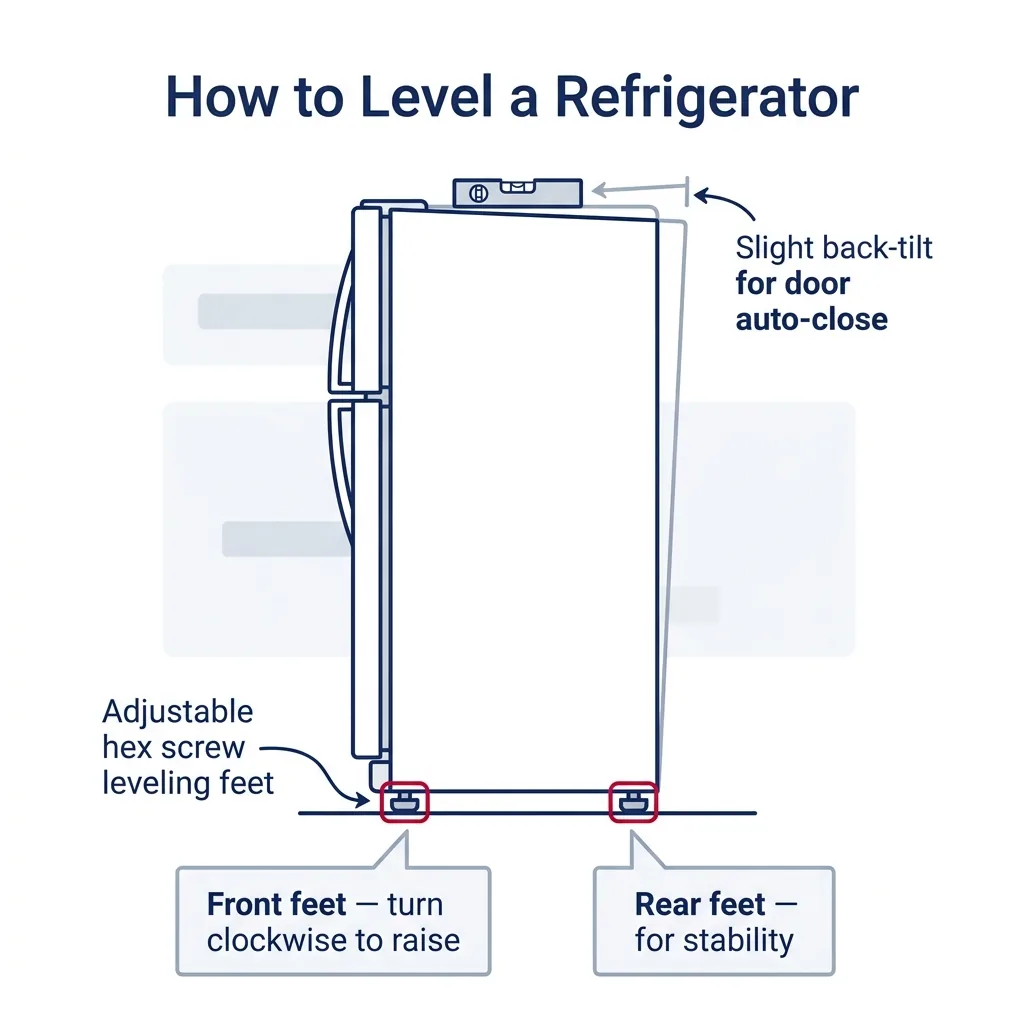
Start by clearing the area around the base of your refrigerator. Open both refrigerator doors to access the hinges or clips holding the bottom front kickplate (base grille) in place. Depending on your model, this grille may simply pull straight out, or it might require you to remove two screws with a Phillips or flathead screwdriver. Set the grille aside. Take a flashlight and inspect the leveling legs and rollers. If you live in an area with hard water like Los Angeles or Orange County, floor mopping over the years might have caused slight rust on the metal threads. If they look seized, apply a quick spray of WD-40 to the threads and let it sit for five minutes before attempting to turn them.
Tip: Place a piece of cardboard on the floor while you work to protect your knees and prevent your tools from scratching hardwood or tile surfaces.
⚠ Warning: Do not reach your bare hands deep under the refrigerator without looking first; the condenser coils and sheet metal edges can be extremely sharp.
Check the Side-to-Side Level
To ensure the ice maker fills evenly and the cabinet doesn't twist, the refrigerator must be perfectly level from left to right. Place your carpenter's level flat across the top of the refrigerator cabinet, right behind the door hinges. If the top of your fridge is rounded or inaccessible, open the doors and place the level on the main floor of the fresh food compartment or on a fixed, structurally sound glass shelf. Read the bubble. If the bubble is off-center, you will need to raise or lower one of the front legs to compensate. Note: Never place the level on the refrigerator doors themselves, as doors can sag independently of the main cabinet.
Tip: If you are using a smartphone leveling app, make sure your phone case doesn't have raised camera bumps that could throw off the measurement.
Establish the Proper Front-to-Back Tilt
Unlike the side-to-side measurement, a refrigerator should almost never be perfectly level from front to back. To ensure the doors close automatically and the defrost drain flows correctly, the front of the refrigerator needs to be approximately 1/4 to 1/2 inch higher than the back. Place your level on the top of the cabinet (or an interior shelf) pointing front-to-back. The bubble should rest slightly toward the front of the level's center lines. If the fridge is leaning forward, or if it is tilted too far back (causing the doors to slam violently), you will need to adjust both front legs equally to dial in the correct pitch.
Tip: A good rule of thumb: open the refrigerator doors to a 90-degree angle and let go. They should gently swing shut on their own. If they stay put or swing open further, the front needs to come up.
Adjust the Leveling Legs or Rollers
Have a helper gently push backward on the top front of the refrigerator. This takes the massive weight of the appliance off the front leveling legs, making them much easier to turn. Use an adjustable wrench, pliers, or the specific wrench provided with your fridge to turn the leveling legs. Turn the leg to the left (counterclockwise) to lower the foot and raise that side of the refrigerator. Turn the leg to the right (clockwise) to raise the foot and lower the refrigerator. Some models (like Whirlpool and KitchenAid) use an adjustment screw located at the top of the front roller assembly; use a 1/4-inch nut driver to turn this screw, which pushes the roller down to lift the fridge. Make small, incremental adjustments, checking your level frequently.
⚠ Warning: Do not unscrew the leveling legs completely out of their threaded housings, or the fridge could drop suddenly.
Address Severely Uneven Floors
In older California homes—especially hillside properties or historic craftsman homes in Pasadena—the kitchen floor itself might have a severe slope or sag. If you have unscrewed the leveling leg to its maximum safe limit and the fridge is still not level, you will need to use shims. Purchase hard plastic wedges (wood shims can compress or rot if exposed to kitchen spills) and carefully tap them under the rear rollers or the front leveling legs. Ensure the shim is wide enough to fully support the roller without creating a pressure point that could crack your flooring.
Tip: If the floor is structurally sagging under the weight of the fridge, placing a 1/4-inch piece of finished plywood under the entire footprint of the appliance can help distribute the weight evenly before leveling.
Verify Adjustments and Reassemble
Once you have achieved a perfect side-to-side level and the correct 1/4-inch front-to-back tilt, it's time to test your work. Open and close all doors to ensure they align properly and swing shut gently. Check that the refrigerator feels stable and does not rock when you push on the sides. If you have a French door model, check the gap between the two doors; if one door is higher than the other, you may need to use the specific door-alignment hex nuts located on the bottom hinges (refer to your owner's manual for this micro-adjustment). Finally, snap or screw the base grille back into place.
Tip: It may take 24 hours for your ice maker to return to normal production if it was previously frozen over due to being unlevel.
Brand-specific notes
Some brands have known design quirks worth knowing about before you start.
Samsung
Samsung French Door refrigerators are notorious for door alignment issues if the cabinet isn't perfectly level. They usually include a special C-shaped wrench in the manual packet specifically for adjusting the locking nuts on the front leveling legs, as well as snap-rings to micro-adjust the height of individual doors.
LG
LG models utilizing the Linear Compressor are particularly sensitive to vibration. If an LG fridge is not leveled correctly, the compressor can resonate against the chassis, creating a loud humming noise. Ensuring all four corners carry equal weight is critical for these models.
Whirlpool & KitchenAid
Many Whirlpool-built refrigerators do not use a standard threaded foot. Instead, they feature an adjustable front roller system. You will need a 1/4-inch nut driver or socket to turn the adjustment bolt located just above the wheel. Turning it clockwise pushes the wheel down, raising the fridge.
GE Appliances
GE Profile and Cafe series refrigerators often have drop-down leveling legs that sit just behind the front rollers. You must roll the fridge into place, then use an adjustable wrench or pliers to screw the legs down until they lift the front rollers completely off the floor to lock the unit in place.
Sub-Zero
Built-in units like Sub-Zero and Wolf require precise leveling before they are secured to the surrounding cabinetry. They utilize specialized rear leveling systems adjusted from the front via a long threaded rod. Because of their extreme weight and anti-tip bracket requirements, leveling a built-in should generally be left to professional installers.
What our techs see most often
Out here in the Hollywood Hills and older Pasadena craftsman homes, uneven floors are a daily battle. Nine times out of ten, when a customer complains about a brand-new fridge's doors not closing or the ice maker leaking, it just needs a quick leveling adjustment. It's the cheapest, fastest fix in the book.
When to call a professional
- → The leveling leg is stripped, severely rusted solid from hard water exposure, or physically snapped off the frame.
- → You have a built-in refrigerator (like a Sub-Zero or Thermador) that requires securing to cabinetry and complex anti-tip brackets.
- → The floor beneath the refrigerator is structurally sagging, rotting due to previous water damage, or feels soft when you step on it.
- → You need to move or adjust a fully loaded, extremely heavy refrigerator on soft flooring (like linoleum or soft pine) that might tear or dent easily.
- → You've leveled the refrigerator perfectly, but the doors are still visibly warped or the ice maker continues to leak heavily.
Related Refrigerator Troubleshooting
These troubleshooting guides cover problems this task can help solve.
Refrigerator Compressor Won't Stop Running: Causes and Fixes
Refrigerator Door Not Sealing Properly: How to Fix
Refrigerator Ice Maker Not Working: How to Fix It
How to Fix a Refrigerator That's Not Cooling
Refrigerator Making Strange Noises: What They Mean and How to Fix
Frequently asked questions
How much does it cost to replace a broken refrigerator leveling leg?
If you snap a leveling leg, the replacement part is very affordable, typically ranging from $15 to $45 depending on the brand. However, if you need a professional to safely lift the fridge, extract the broken threaded shaft, and install the new leg, expect a service call fee of $125 to $250.
Is it normal for my refrigerator to tilt backward?
Yes, absolutely. A refrigerator should lean backward slightly—about 1/4 to 1/2 inch higher in the front than in the back. This tilt ensures that defrost water flows properly into the drain pan and allows the heavy doors to swing shut automatically using gravity.
Can I use wood shims to level my fridge if my floor is uneven?
While you can use wood shims in a pinch, it is highly recommended to use hard plastic shims (which cost about $5 to $10 at any hardware store). Kitchens are prone to spills and mopping; wood shims can absorb water, rot, and compress under the 300+ pound weight of the fridge over time.
Will leveling my refrigerator fix my leaking ice maker?
Very often, yes. If the refrigerator leans too far forward or to one side, the water filling the ice mold will pool at the low end and spill over into the ice bucket or down the freezer wall. Leveling side-to-side and ensuring a slight back-tilt is the first step in diagnosing an ice maker leak.
Why does my fridge rock back and forth when I open the door?
This happens when the four points of contact (the two rear rollers and the two front leveling legs) are not sitting flush on the floor, similar to a wobbly restaurant table. Lowering one of the front leveling legs until it makes firm contact with the floor will eliminate the rocking.
Related Repair Guides
Refrigerator Door Not Sealing Properly: How to Fix
A loose or broken refrigerator seal lets cold air escape, leading to spoiled food and high energy bills. Learn how to diagnose, clean, and replace your door gasket to restore a tight seal.
Refrigerator Ice Maker Not Working: How to Fix It
A non-working ice maker is rarely a broken ice maker. In our experience, 8 out of 10 cases come down to a frozen fill tube, a water-supply problem, or a clogged filter — all fixable in 30-60 minutes.
Refrigerator Making Strange Noises: What They Mean and How to Fix
A refrigerator should hum quietly, but when it starts buzzing, grinding, or clicking, it is trying to tell you something is wrong. This guide will help you decode those strange noises by location and pitch, helping you determine if it is an easy DIY fix or a job for a professional.