
At a glance
Symptoms
- • Fresh-food compartment is warmer than 40°F (4°C)
- • Freezer is working but the fridge section is warm
- • Compressor runs constantly without cycling off
- • Frost building up on the back wall of the freezer
- • Food spoiling faster than usual
Common causes
- • Dirty condenser coils blocking heat dissipation
- • Failed evaporator fan motor (especially if freezer is cold but fridge is warm)
- • Defrost system fault (defrost heater, thermostat, or timer)
- • Faulty start relay or compressor
- • Thermostat set incorrectly or broken
- • Door gasket leaking warm air
Safety First — Read Before You Start
- •ALWAYS unplug the refrigerator before removing any panels or touching internal components.
- •Capacitors in the start relay can hold a charge — discharge before testing.
- •If you smell ammonia or hear a hissing sound, stop immediately — this indicates a refrigerant leak that requires a licensed EPA 608 technician.
- •Never bypass safety switches or the thermal fuse.
Tools & supplies you'll need
- Phillips and flat-head screwdrivers
- 1/4-inch nut driver or socket set
- Coil cleaning brush or vacuum with brush attachment
- Multimeter (for fan motor and thermostat testing)
- Flashlight
- Towel for any condensation
Step-by-step instructions
Check the basics first
Before opening any panels, confirm the temperature settings (fridge should be 37-40°F, freezer 0-5°F), make sure no vents inside are blocked by food, and verify the door is sealing properly. Hold a dollar bill in the door — if it slides out easily, the gasket needs replacement. Check that the fridge is at least 1 inch away from the back wall for ventilation.
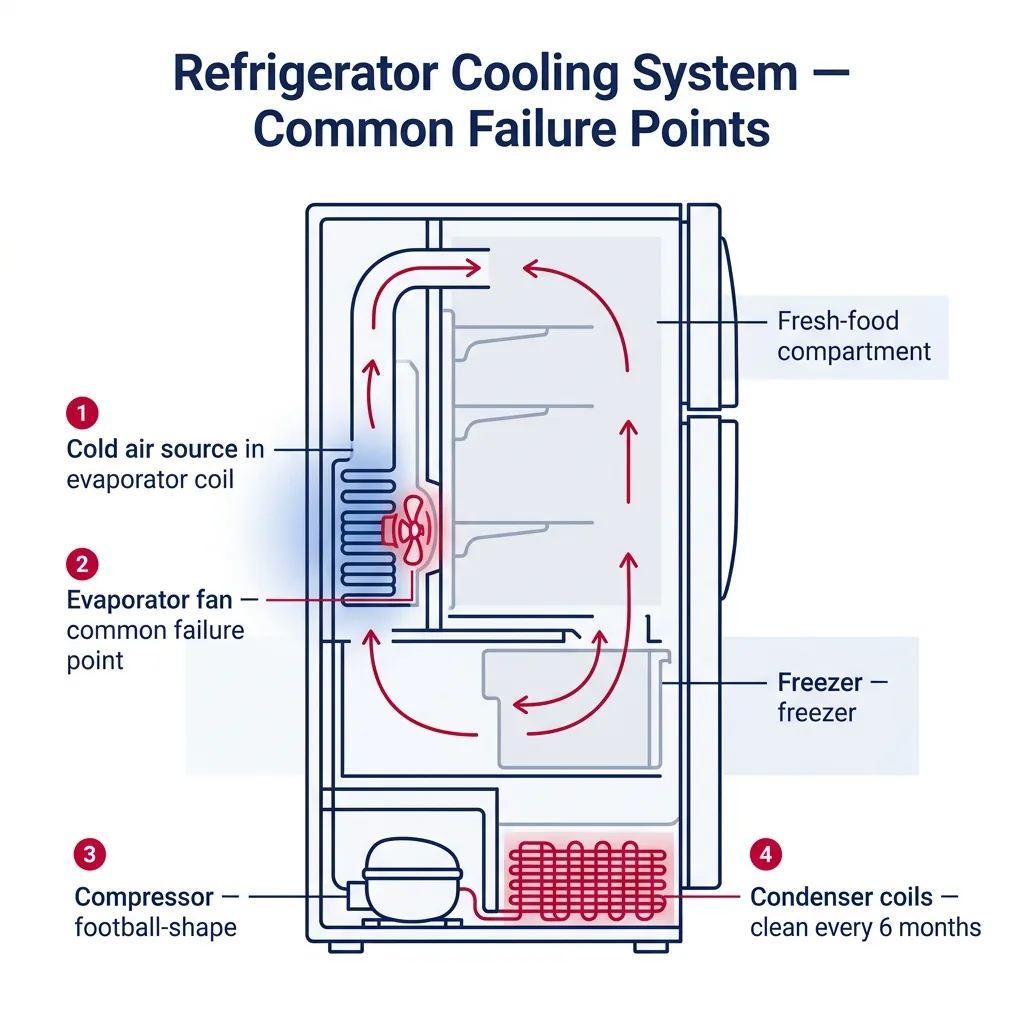
Tip: A refrigerator that has just been moved or recently restarted needs 24 hours to reach proper temperature. If yours was just plugged in, give it time before troubleshooting.
Clean the condenser coils
Coils are usually located at the bottom front (behind a kick-plate) or the back of the fridge. Unplug the unit, remove the kick-plate, and gently brush or vacuum off accumulated dust, pet hair, and lint. Heavily clogged coils can cut cooling performance by 30% or more — this is the #1 most overlooked fix.
Tip: Clean the coils every 6-12 months as preventive maintenance, especially if you have pets.
⚠ Warning: Do not bend or puncture the thin tubing — it contains refrigerant under pressure.
Listen for the evaporator fan
Open the freezer door and press the door switch (or hold it down). You should hear a fan running inside. If silent, the evaporator fan motor has likely failed — this is a $30-80 part and a common DIY repair. To access it, unscrew the back panel inside the freezer (typically 4-6 screws). The fan is mounted in the upper-back corner.
Tip: If the freezer is cold but the fridge section is warm, this is the single most likely cause.
Test the defrost system
If you see thick frost (more than 1/4 inch) on the back wall of the freezer, the defrost system has failed. Three components can cause this: the defrost heater (a glass tube next to the evaporator coils), the defrost thermostat, or the defrost timer/control board. Use a multimeter to test continuity on each. Common fix: replace the defrost heater (~$40) or the bi-metal thermostat (~$25).
Tip: A "manual defrost" — unplugging the unit for 24 hours with doors open — will temporarily restore cooling but is not a permanent fix.
Check the start relay (compressor not running)
If the compressor (the football-shaped pump on the back of the fridge) isn't running at all, listen for a clicking sound every few minutes — that's the start relay attempting to start a stalled compressor. Unplug the unit, pull off the relay (slips off with a small tug), and shake it. If it rattles, replace it (~$15-30). If the new relay clicks but the compressor still doesn't start, the compressor itself has failed and a tech is needed.
⚠ Warning: A stuck compressor can draw enough current to trip a circuit breaker. If your breaker is tripping, stop and call a pro.
Verify the temperature control thermostat
Inside the fridge section, locate the temperature dial or electronic control. Turn it to the coldest setting and listen — you should hear a click and the compressor should engage within a few minutes. If nothing happens at any setting, the thermostat may need replacement. On electronic models, the issue is more likely the main control board, which is usually best left to a technician.
Brand-specific notes
Some brands have known design quirks worth knowing about before you start.
Samsung
Samsung French-door models (RF series) commonly fail with a frozen evaporator fan or twin-cooling-system fault. The fan typically gets blocked by ice from a defective ice-maker drip or a clogged drain. Listen for grinding from the back of the freezer.
LG
LG bottom-freezer models often suffer from linear-compressor failures, which LG covers under a 10-year sealed-system warranty. If your LG fridge runs but does not cool and is less than 10 years old, contact LG Support before paying for any repair — the part and labor are usually covered.
Sub-Zero
Sub-Zero built-in units have condenser coils on top with two cooling fans. Lint and dust accumulate quickly in the grille. A dirty condenser is the #1 cause of warm-fridge calls on these high-end units. Clean every 6 months as the manual specifies.
GE
GE side-by-side and Profile models often have main-board failures masquerading as compressor issues. If you hear no clicks and no fan after a coil cleaning, the issue is likely the main electronic board — a tech can confirm with a quick voltage check.
Whirlpool / KitchenAid
Whirlpool and KitchenAid share the same defrost system on most models. A failed bi-metal defrost thermostat (~$20 part) is a frequent culprit when frost builds on the back wall. Do not replace the heater first — test continuity on the thermostat with the freezer door closed and unit at temperature.
What our techs see most often
In our service history, the most common refrigerator no-cool calls trace back to either dirty condenser coils on Sub-Zero and Viking built-ins (especially in older homes with limited ventilation behind the cabinet) or a stuck evaporator fan on Samsung and LG French-door models — both fixes a tech typically completes in under an hour.
When to call a professional
- → You smell ammonia, hear hissing, or see oily residue near the compressor (refrigerant leak — requires EPA-certified tech)
- → Circuit breaker trips repeatedly when the unit is plugged in
- → You've cleaned the coils, confirmed both fans run, and there's no frost — but it's still warm
- → Your refrigerator is under 10 years old and the compressor has failed (likely covered by manufacturer sealed-system warranty)
- → The unit is a built-in (Sub-Zero, Thermador, Viking) — incorrect repair can be expensive to undo
- → You aren't comfortable using a multimeter or removing electrical components
Refrigerator Maintenance & Replacement Tasks
Step-by-step guides for individual maintenance jobs related to this appliance.
How to Clean Refrigerator Condenser Coils (Step-by-Step)
How to Level a Refrigerator Properly
How to Manually Defrost a Refrigerator or Freezer
How to Replace a Refrigerator Door Gasket (DIY Guide)
How to Replace a Refrigerator Water Filter (All Major Brands)
Frequently asked questions
How long should a refrigerator last?
Most refrigerators last 12-15 years. High-end built-ins (Sub-Zero, Thermador) can last 20+ years with proper maintenance. If yours is over 12 and the compressor has failed, replacement is usually more cost-effective than repair.
Why is my freezer cold but the fridge warm?
This almost always means cold air is not circulating from freezer to fridge. The most common cause is a failed evaporator fan motor in the back of the freezer. Less commonly, a clogged air diffuser or a frosted-over evaporator coil is the issue.
How much does it cost to repair a refrigerator that's not cooling?
Typical repairs range from $150 (evaporator fan replacement) to $400+ (defrost system rebuild). Sealed-system repairs (compressor, refrigerant leak) range $600-1500 and require a certified tech. At Axis we charge a $90 diagnostic fee that applies toward the repair.
Can I just unplug my fridge for a day to fix it?
Unplugging for 24-48 hours can temporarily melt frost from a faulty defrost system, restoring cooling for a few days. This is not a fix — the underlying defrost component (heater, thermostat, or timer) still needs replacement, otherwise the problem returns within a week.
How often should I clean the condenser coils?
Every 6-12 months. If you have pets or the fridge is in a dusty area (garage, basement), every 3-6 months. Skipping this is the #1 reason refrigerators stop cooling efficiently — a 5-minute job that prevents an expensive repair.
Related Repair Guides
Refrigerator Ice Maker Not Working: How to Fix It
A non-working ice maker is rarely a broken ice maker. In our experience, 8 out of 10 cases come down to a frozen fill tube, a water-supply problem, or a clogged filter — all fixable in 30-60 minutes.
Refrigerator Leaking Water on the Floor: Causes and Fixes
A puddle under or behind your refrigerator usually traces to one of four sources: a clogged defrost drain (most common), a cracked ice-maker supply line, a leaking water inlet valve, or a worn door gasket letting in humid air. Here's how to identify and fix each.
How to Clean Refrigerator Condenser Coils (Step-by-Step)
Keep your refrigerator running efficiently and prevent expensive compressor failures by cleaning your condenser coils. This simple 20-minute task is the single most important maintenance step you can do for your fridge.