
At a glance
Symptoms
- • Thick ice buildup on the freezer walls or ceiling (more than 1/4 inch thick).
- • Freezer or refrigerator doors failing to close securely due to ice obstruction.
- • The refrigerator section is running warm while the freezer section is heavily frosted.
- • Loud buzzing, grinding, or clicking noises caused by the evaporator fan blades hitting ice.
- • Visible frost or snow-like buildup on the rear panel of the freezer or fridge interior.
- • Water pooling or a solid sheet of ice forming on the floor of a bottom-mount freezer.
Common causes
- • Restores proper airflow between the freezer and refrigerator compartments, which is essential for cooling both sections.
- • Prevents physical damage to the evaporator fan motor, which can burn out if restricted by solid ice.
- • Improves overall energy efficiency; thick ice acts as an insulator, forcing the compressor to work harder and increasing your electric bill.
- • Prevents food spoilage by ensuring the appliance can maintain safe, consistent temperatures.
- • Serves as a necessary first step or temporary reset if your automatic defrost system has failed, buying you time while awaiting replacement parts.
- • Clears out clogged defrost drains that commonly freeze over, especially in humid coastal California climates.
Safety First — Read Before You Start
- •NEVER use a hair dryer or heat gun to melt the ice. The plastic interior liners of modern refrigerators warp and melt very easily, causing irreparable damage that requires replacing the entire appliance.
- •NEVER use knives, screwdrivers, ice picks, or any metal tools to chip away ice. Puncturing the aluminum evaporator coils or refrigerant lines will release the gas and permanently ruin the refrigerator.
- •Always unplug the appliance from the wall outlet before beginning the defrost process to eliminate the risk of electrical shock.
- •Keep plenty of dry towels on hand to prevent slip-and-fall hazards on hard kitchen flooring, especially sensitive hardwood or laminate floors common in California homes.
Tools & supplies you'll need
- Coolers with ice or a backup garage refrigerator for food storage
- Thick, highly absorbent bath towels
- Baking pans, rimmed baking sheets, or shallow buckets to catch water
- Wooden or plastic spatula (NEVER use metal tools)
- A standard room fan for air circulation
- Large bowls or pots filled with hot water (optional accelerator)
- Baking soda and warm water for cleaning the interior afterward
Step-by-step instructions
Prep the Area and Empty the Appliance
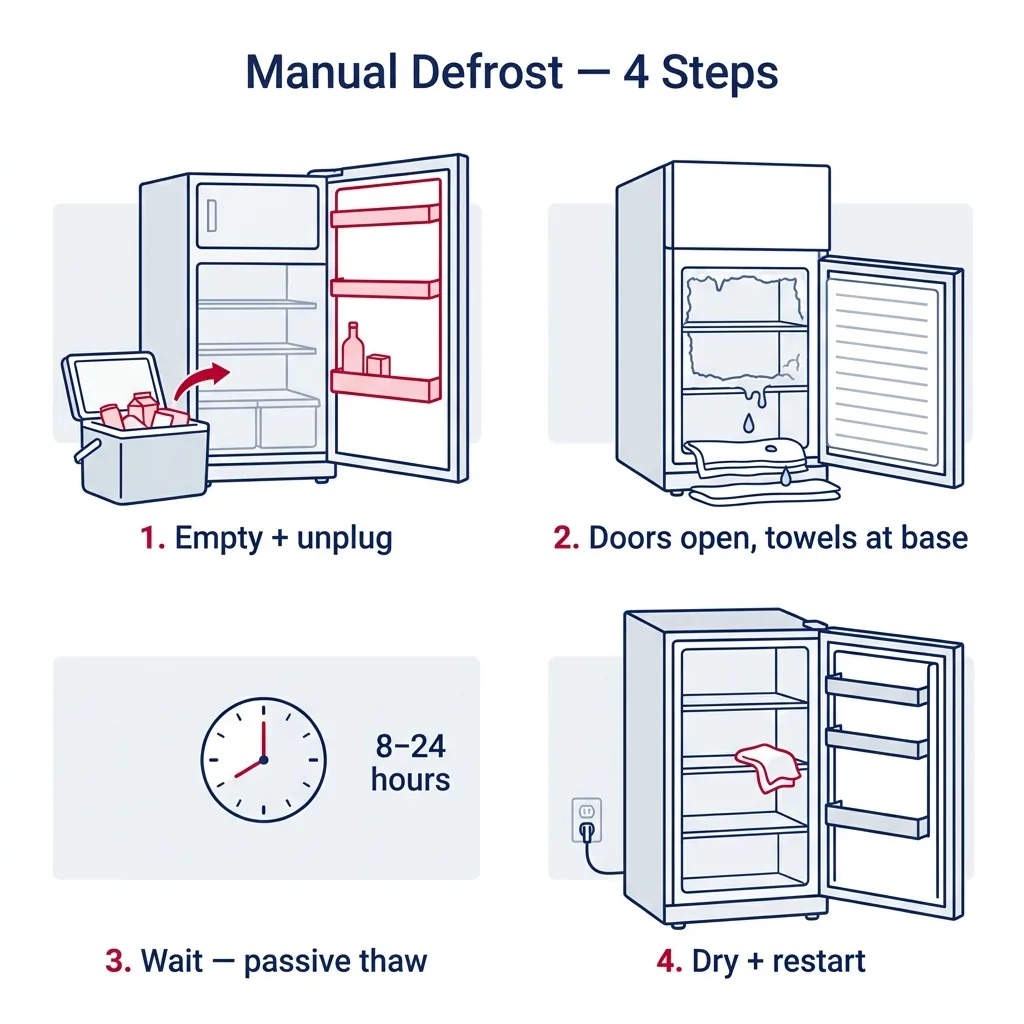
Start by completely emptying the refrigerator and freezer compartments. Place all perishable food into coolers packed with ice, or transfer it to a backup refrigerator if you have one in the garage. Do not attempt to leave food in the unit while defrosting, as the process takes many hours and foodborne bacteria will multiply rapidly. Once the food is removed, take out all removable shelves, drawers, and door bins. If they are frozen stuck, do not force them; leave them in place until the ice melts enough to remove them safely. Wash the removed components in the sink with warm, soapy water and set them aside to dry.
Tip: If you live in a hot area like the San Fernando Valley or Inland Empire, keep your coolers inside the air-conditioned house rather than the hot garage to maximize the life of the ice.
Unplug the Unit and Secure the Doors Open
Safety first: unplug the refrigerator from the wall outlet. If the plug is inaccessible, turn off the dedicated circuit breaker at your main electrical panel. Once the power is disconnected, prop the doors wide open. You can use a chair, a heavy box, or wedge a folded towel in the hinge area to prevent the doors from swinging shut. Continuous airflow is the primary mechanism for melting the ice safely.
⚠ Warning: Do not skip unplugging the unit. Leaving the refrigerator running with the doors open will cause the compressor to run continuously, potentially burning it out, and will actually generate more frost as humid ambient air hits the cold coils.
Protect Your Floors from Water Damage
As the ice melts, a significant amount of water will drain out of the unit. Place thick, absorbent bath towels directly inside the bottom of the freezer and refrigerator compartments. Next, lay down a barrier of towels on the floor directly in front of the appliance. Slide shallow baking pans or rimmed baking sheets just under the front edge of the refrigerator to catch any heavy runoff. Keep a mop or extra dry towels nearby, and check the area every hour to swap out saturated towels.
Tip: For built-in units or kitchens with expensive hardwood flooring, consider taping down a heavy-duty plastic drop cloth under the towels to guarantee no moisture seeps through to the wood.
Accelerate the Melting Process Safely
While you can simply wait 24 hours for the ice to melt naturally, you can safely speed up the process. Fill large bowls or cooking pots with steaming hot (but not boiling) water and place them on folded towels inside the freezer and fridge compartments. The steam will safely raise the ambient temperature inside the box. Alternatively, position a standard oscillating room fan outside the refrigerator, pointing directly into the open compartments to maximize air circulation. Replace the hot water every 30-45 minutes as it cools down.
⚠ Warning: We cannot stress this enough: NEVER use a hair dryer, heat gun, or space heater pointing into the appliance. The concentrated dry heat will warp the thin plastic liner in seconds, ruining the appliance forever.
Gently Remove Loosened Ice Chunks
After a few hours, the massive blocks of ice will begin to detach from the plastic walls and evaporator covers. Use a wooden spoon or a plastic spatula to gently nudge the ice. If a chunk is loose, pull it out by hand and toss it into the sink. If the ice is still firmly attached, leave it alone and let the hot water and fan do their work. Do not attempt to pry or forcefully wedge the spatula behind the ice, as you can easily crack the plastic liner or damage the hidden evaporator coils behind the panel.
Tip: Removing the large chunks as soon as they loosen significantly cuts down on the total defrosting time and reduces the amount of water that ends up on your floor.
Clean, Sanitize, and Dry the Interior completely
Once all the ice is completely melted and removed, it is crucial to dry the interior thoroughly. Use clean microfiber cloths or paper towels to wipe down every surface, nook, and cranny. Any remaining moisture will immediately turn back into frost the moment you turn the unit back on. Take this opportunity to clean the interior walls using a mixture of 1 tablespoon of baking soda dissolved in a quart of warm water. This neutralizes odors and removes sticky spills. Wipe it dry one final time.
⚠ Warning: Pay special attention to the rubber door gaskets. Dry them completely and check for tears or mold, as a leaking gasket is a primary cause of frost buildup.
Restart and Reload the Appliance
Slide the clean, dry shelves and drawers back into their correct positions. Plug the refrigerator back into the wall outlet (or flip the breaker back on). Close the doors securely. Do not put the food back in immediately. Allow the refrigerator to run empty for at least 2 to 4 hours so it can reach its target cooling temperatures (usually 37°F for the fridge and 0°F for the freezer). Once the unit is cold, transfer your food from the coolers back into the appliance.
Tip: Monitor the appliance over the next 5-7 days. If the heavy frost returns quickly, you have a mechanical failure (like a bad defrost heater or control board) and will need to diagnose the components or call a professional.
Brand-specific notes
Some brands have known design quirks worth knowing about before you start.
LG
LG French door models often freeze up behind the rear panel in the refrigerator section, leading to an 'Er rF' error code or warm fridge temps. A manual defrost for these dual-evaporator systems takes a full 24-48 hours to clear the hidden ice block completely. Don't rush it.
Samsung
Samsung is notorious for the 'ice maker freezing over' and twin cooling panel frost issues. If you're manually defrosting a Samsung, you must leave the doors open for at least 24 hours. The ice behind those rear panels is heavily insulated and takes forever to melt naturally.
Whirlpool
On Whirlpool, KitchenAid, and Maytag bottom-mount freezers, ice sheets on the freezer floor usually mean a clogged defrost drain. Once the main ice is gone, use a turkey baster to flush hot water down the drain hole at the back center of the freezer floor to clear the blockage.
GE
GE Profile and Cafe series units have robust evaporator fans, but if ice builds up, you'll hear a very loud buzzing like an airplane taking off. Do not try to unscrew and force the plastic rear covers off while frozen; the plastic tabs will snap off instantly. Let the ice melt first.
Frigidaire
Upright manual-defrost freezers by Frigidaire are incredibly popular in hot valley garages. You should plan to manually defrost these at least once a year, or whenever the ice gets thicker than 1/4 inch, to keep your electric bill from skyrocketing during the summer.
What our techs see most often
Out here in the coastal humidity of San Diego and OC, leaving a freezer door cracked even slightly will cause massive ice buildup overnight. A manual defrost is usually step one before we even roll a truck out to diagnose a cooling issue.
When to call a professional
- → If the unit frosts up again entirely within a week or two of manually defrosting, indicating a failed automatic defrost component.
- → If you accidentally puncture the interior wall with a tool and hear a hissing sound (turn the unit off immediately and open windows; the appliance is likely unrepairable).
- → If the refrigerator trips the circuit breaker immediately when plugged back in after defrosting.
- → If the unit has been defrosted and plugged in for 24 hours but fails to drop in temperature, pointing to a sealed system or compressor failure.
- → If you need to test the defrost heater, bimetal thermostat, or control board with a multimeter and are not comfortable working around live voltage.
Related Refrigerator Troubleshooting
These troubleshooting guides cover problems this task can help solve.
Refrigerator Compressor Won't Stop Running: Causes and Fixes
Refrigerator Door Not Sealing Properly: How to Fix
Refrigerator Ice Maker Not Working: How to Fix It
How to Fix a Refrigerator That's Not Cooling
Refrigerator Making Strange Noises: What They Mean and How to Fix
Frequently asked questions
Can I use a hair dryer to speed up defrosting?
Absolutely not. The plastic liners in modern refrigerators are very thin and will melt and warp quickly under the direct, dry heat of a hair dryer or heat gun. A warped liner cannot be replaced; you would have to buy an entirely new refrigerator. Use bowls of hot water instead.
How long does a manual defrost take?
A thorough manual defrost typically takes between 8 to 24 hours. If you have a brand like Samsung or LG with hidden evaporators behind plastic panels, the ice is heavily insulated and usually requires a full 24 hours with the doors open to melt completely.
Will a manual defrost permanently fix my broken fridge?
It depends on the cause. If the frost was caused by a door accidentally left ajar, a manual defrost will fix it permanently. However, if a defrost heater, bimetal thermostat, or control board has failed (typically a $150-$350 repair), the manual defrost will only temporarily restore cooling. The ice will return in 1 to 2 weeks.
Do I really need to empty the entire fridge to defrost it?
Yes. Leaving food in the unit while the doors sit open for 12+ hours will absolutely lead to spoilage and potential foodborne illness. You must move all perishable items to a cooler packed with ice or a backup refrigerator.
Why is there a solid sheet of ice on the bottom of my freezer?
A solid sheet of ice on the floor of a bottom-mount freezer usually indicates a clogged defrost drain rather than a failed defrost heater. During the automatic defrost cycle, the melted water has nowhere to go, so it overflows onto the floor and refreezes. You will need to manually defrost the unit and then flush the drain line with hot water to clear the clog.
Related Repair Guides
How to Fix a Refrigerator That's Not Cooling
A refrigerator that runs but does not cool is one of the most common appliance problems we see. Most cases come down to dirty condenser coils, a bad evaporator fan, or a defrost-system fault — and several are fixable in under an hour.
How to Clean Refrigerator Condenser Coils (Step-by-Step)
Keep your refrigerator running efficiently and prevent expensive compressor failures by cleaning your condenser coils. This simple 20-minute task is the single most important maintenance step you can do for your fridge.
Refrigerator Compressor Won't Stop Running: Causes and Fixes
A refrigerator compressor that never cycles off wastes energy, creates excessive noise, and will eventually burn itself out. Learn how to diagnose and fix the most common causes, from suffocating condenser coils to failing door gaskets.