
At a glance
Symptoms
- • No ice produced at all
- • Ice maker fills with water but does not freeze
- • Ice cubes are too small or hollow
- • Ice maker stuck in continuous fill / overflow
- • Cubes have a strange taste or smell
Common causes
- • Frozen fill tube blocking water supply
- • Failed water inlet valve at the back of the fridge
- • Clogged or expired water filter
- • Ice maker control module / motor module failure
- • Bail arm (wire shut-off) in the up/off position
- • Freezer temperature too warm (above 10°F / -12°C)
Safety First — Read Before You Start
- •Always shut off the water supply line before disconnecting any fittings.
- •Unplug the refrigerator before testing electrical components.
- •Do not use a heat gun or open flame near plastic refrigerator components — a hair dryer on low is sufficient.
Tools & supplies you'll need
- Hair dryer or warm towel (for thawing)
- Phillips screwdriver
- Multimeter (for valve testing)
- Towel and bucket (water shut-off)
- Replacement water filter (if old)
Step-by-step instructions
Check the bail arm and ice bin
The wire bail arm above the ice bin is a manual on/off switch. If it is in the UP position, the ice maker is OFF — push it down to ON. Also check that the ice bin is properly seated; many models have a sensor that disables ice making if the bin is removed or misaligned. Empty any compacted ice that might be jamming the bin.
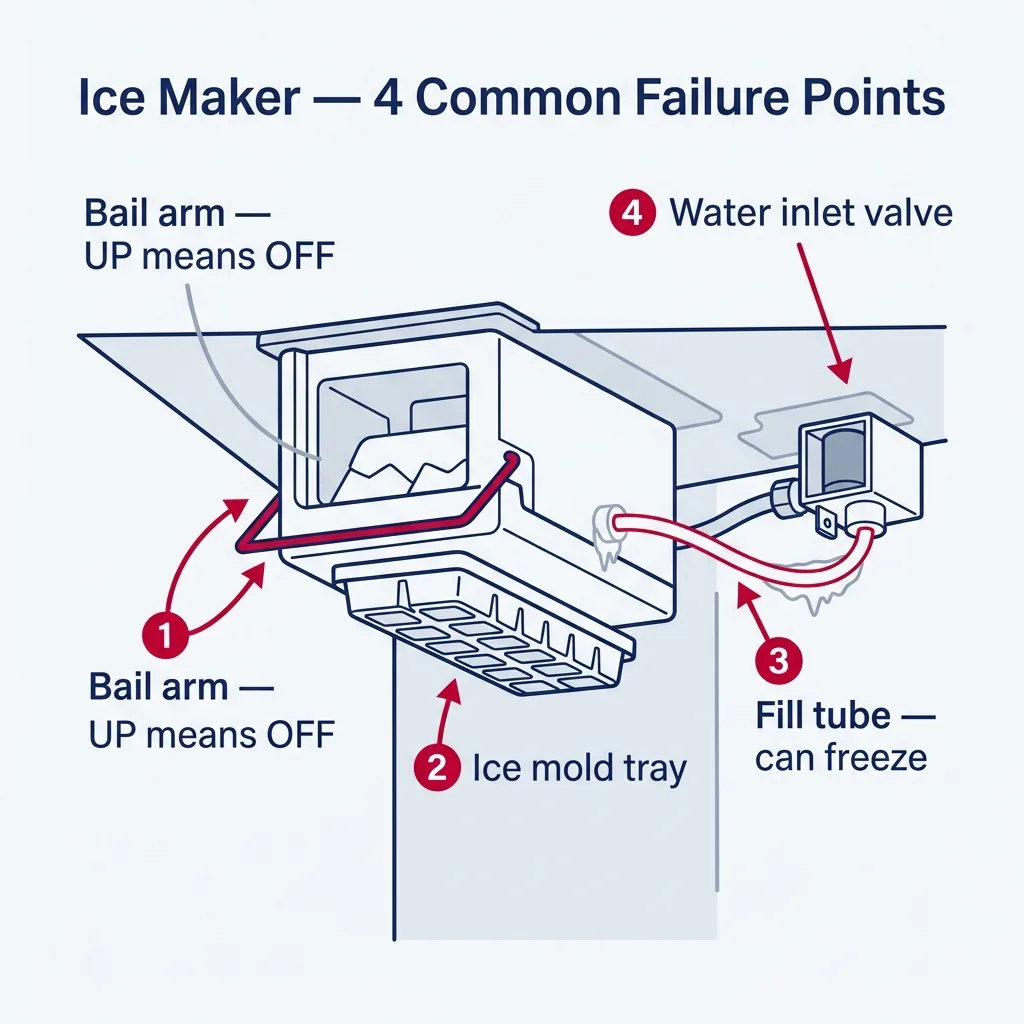
Tip: On electronic models (Samsung, LG), check the front control panel for an "Ice Off" or "Ice Maker" button — it may have been pressed accidentally.
Verify freezer temperature
Ice makers need a freezer temperature at or below 5°F (-15°C) to produce ice reliably. Use a separate thermometer (do not trust the display alone) and place it in the freezer for 15 minutes. If the freezer is warmer than 10°F, address the cooling issue first — the ice maker is fine, the freezer is the problem. See our "refrigerator not cooling" guide.
Replace the water filter
A clogged or expired water filter (typically 6-month replacement cycle) can restrict water flow enough to stop ice production while still letting the dispenser work slowly. Locate your filter (inside the fridge or in the bottom grille), twist out, and replace with the manufacturer-recommended part. After replacement, dispense 2-4 cups through the dispenser to flush air from the line.
Tip: If you have not replaced the filter in over 12 months, this alone often solves the problem.
Thaw a frozen fill tube
The white plastic fill tube delivers water from the back of the freezer to the ice maker mold. If frozen, water cannot reach the mold. Remove the ice maker (usually 1-2 screws and an electrical connector), and aim a hair dryer on LOW HEAT at the fill tube area for 5-10 minutes. You may also see a small ice plug that pops out. Reinstall and wait 3-4 hours for the first ice cycle.
Tip: A frozen fill tube usually means the water inlet valve is leaking slightly when off, or the freezer is too cold. Watch for repeat freezing.
⚠ Warning: Do not force a screwdriver or wire into the fill tube — you can puncture it and cause a permanent leak.
Test the water inlet valve
The water inlet valve is on the back of the fridge where the water supply line connects. With the unit unplugged, use a multimeter on the ice-maker solenoid terminals — you should read 200-500 ohms. Open circuit (OL reading) means the solenoid coil is dead and the valve must be replaced (~$25-60 part, 30 minutes). Also check that the saddle valve at the supply line is fully open and not clogged with sediment.
⚠ Warning: If your home has hard water, the valve filter screen often clogs with mineral deposits. Inspect and clean before assuming the valve is dead.
Cycle-test the ice maker module
Most modular ice makers (Whirlpool/KitchenAid/GE style) have a small motor module on the side with three test holes — labeled "T", "L", "N" or similar. With the unit running, you can short across the test holes (using a small wire jumper or paperclip) to force a fill-and-cycle. If it cycles correctly when forced but never starts on its own, replace the module ($30-70). If the cycle is incomplete or motor is silent, the entire ice maker assembly may need replacement.
Tip: On Samsung models, this test is done via the front display panel — look up the model-specific "Forced Test Mode" sequence in the manual.
Brand-specific notes
Some brands have known design quirks worth knowing about before you start.
Samsung
Samsung RF20/RF22/RF23/RF26/RF28 French-door models have a well-known design flaw where the ice room frosts over due to a defective seal. Symptoms include slushy ice, slow ice production, and a whining auger. Samsung has extended warranties on many models — check the service bulletin database before replacing parts.
LG
LG ice makers (especially Slim SpacePlus models) commonly fail because the optical sensor on the side of the bin gets dusty or the harvesting motor gears strip. Both are covered under LG's sealed-system warranty if the fridge is under 10 years old.
Whirlpool / KitchenAid
Whirlpool modular ice makers (the side-mounted style with the bail arm) are extremely common and parts are cheap and universal. Test points "T" and "H" on the front of the module force a harvest cycle. Replacement modules are about $40 and a 15-minute swap.
GE
GE Profile and Cafe series often have water inlet valve failures rather than ice maker failures. If the dispenser also fills slowly, the valve is the culprit. The valve is on the rear lower-left of most models.
Sub-Zero
Sub-Zero ice makers have a dedicated water filter and a separate "ice maker only" valve. If the dispenser works but no ice is made, check both the filter cartridge AND the ice-only valve — they're different on these high-end built-ins.
What our techs see most often
On Samsung French-door fridges, we frequently find ice makers covered in frost from a leaking grommet seal between the fridge and the ice compartment. Samsung extended the warranty on this issue for many RF series models — check Samsung's service bulletins before paying for the repair.
When to call a professional
- → You've replaced the filter, thawed the fill tube, and confirmed valve continuity, but still no ice after 24 hours
- → There is a water leak inside the freezer or on the floor that you cannot trace
- → Your refrigerator is a Sub-Zero, Thermador, or Viking — these have proprietary parts and complex assemblies
- → You suspect a control board issue (multiple electronics misbehaving)
- → Recurring frozen fill tube after thawing — indicates a deeper valve or freezer-temp problem
Refrigerator Maintenance & Replacement Tasks
Step-by-step guides for individual maintenance jobs related to this appliance.
How to Clean Refrigerator Condenser Coils (Step-by-Step)
How to Level a Refrigerator Properly
How to Manually Defrost a Refrigerator or Freezer
How to Replace a Refrigerator Door Gasket (DIY Guide)
How to Replace a Refrigerator Water Filter (All Major Brands)
Frequently asked questions
How long does it take an ice maker to start making ice after a fix?
Most ice makers need 3-4 hours after restoration to produce the first batch, and 24 hours to fill the bin. If you don't see ice in 24 hours, something is still wrong.
Why is my ice maker making small or hollow cubes?
Almost always low water pressure: a partially clogged filter, a kinked supply line, or a partially closed saddle valve. Replace the filter and check the supply line first.
Should I replace just the ice maker module or the whole assembly?
On modular Whirlpool-style designs, replacing the module ($40) usually fixes 70% of issues. On modern Samsung/LG bucket-style ice makers, the module is integrated and the entire assembly must be replaced ($150-250).
Is it safe to use ice from a fridge that's been off for days?
No — discard old ice after any extended outage. Bacteria can grow in melted-and-refrozen ice. Run a fresh cycle and discard the first batch as well.
How often should I replace my fridge water filter?
Every 6 months, or when the indicator light comes on. An expired filter is one of the top causes of slow or stopped ice production.
Related Repair Guides
How to Fix a Refrigerator That's Not Cooling
A refrigerator that runs but does not cool is one of the most common appliance problems we see. Most cases come down to dirty condenser coils, a bad evaporator fan, or a defrost-system fault — and several are fixable in under an hour.
Refrigerator Leaking Water on the Floor: Causes and Fixes
A puddle under or behind your refrigerator usually traces to one of four sources: a clogged defrost drain (most common), a cracked ice-maker supply line, a leaking water inlet valve, or a worn door gasket letting in humid air. Here's how to identify and fix each.
How to Clean Refrigerator Condenser Coils (Step-by-Step)
Keep your refrigerator running efficiently and prevent expensive compressor failures by cleaning your condenser coils. This simple 20-minute task is the single most important maintenance step you can do for your fridge.