
At a glance
Symptoms
- • Visible cracks, tears, or mold buildup on the rubber seal.
- • Condensation or frost accumulating inside the fridge or freezer compartment.
- • The dollar bill test fails (a dollar bill slips out easily when the door is closed).
- • The refrigerator runs constantly to maintain temperature.
- • Moisture pooling at the bottom of the fresh food section.
- • Increased electricity bills due to the compressor working overtime.
Common causes
- • Prevents warm, moist air (especially in humid coastal areas like Ventura or San Diego) from entering and causing frost.
- • Lowers your electricity bill by drastically reducing the compressor's workload.
- • Extends the lifespan of expensive sealed system components like the compressor and evaporator fan.
- • Keeps food fresher longer by maintaining a consistent internal temperature.
- • Prevents structural damage to the cabinet caused by chronic condensation and rust.
Safety First — Read Before You Start
- •Always unplug the refrigerator before starting to avoid electrical shock and to prevent the compressor from running continuously while the door is open.
- •If using a heat gun or hairdryer to soften the gasket, keep it moving and on a low/medium setting to avoid melting the rubber or warping the plastic door liner.
- •Be careful when loosening door liner screws; overtightening them later can easily crack the plastic inner door panel.
Tools & supplies you'll need
- New OEM replacement gasket ($45-$120 depending on brand)
- Hairdryer or heat gun (use cautiously on low/medium)
- Nut driver set (usually 1/4-inch) or Phillips screwdriver
- Putty knife (plastic is preferred to avoid scratching)
- Warm water and mild dish soap
- Petroleum jelly or food-grade silicone grease (optional)
Step-by-step instructions
Prepare and warm the new gasket
Unpack your new OEM gasket immediately upon arrival. Gaskets are often shipped folded or twisted to save space, which creates stubborn creases. To restore its proper shape, soak the entire gasket in a bathtub filled with warm (not boiling) water for 15-20 minutes. Alternatively, lay it flat in the warm California sun on your patio for an hour or two. This step is crucial; a cold, stiff gasket will not seat properly and will leave air gaps. Once pliable, dry it thoroughly before installation.
Tip: Always order your gasket using the exact model number found on the sticker inside your refrigerator compartment. Universal cut-to-fit gaskets rarely seal correctly.
Remove the old gasket
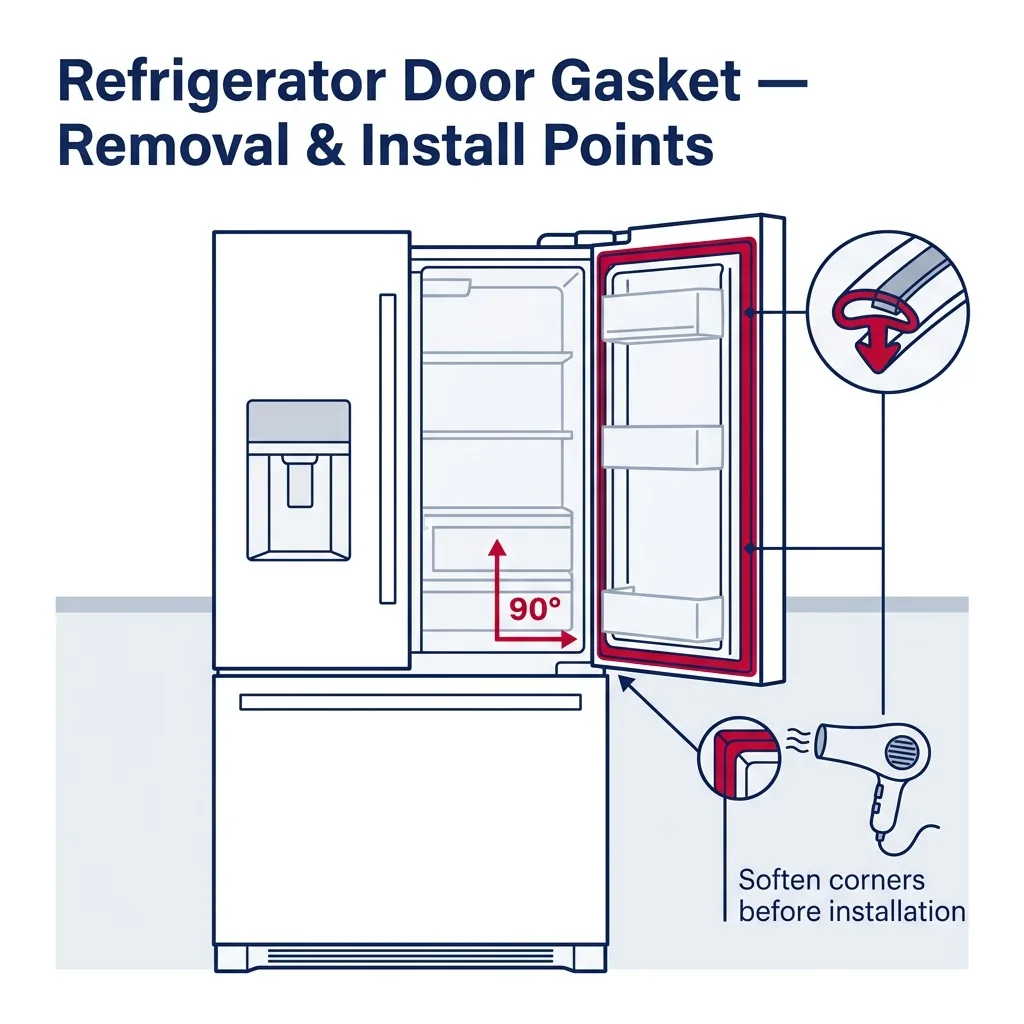
Unplug the refrigerator. Examine how your current gasket is attached. Most modern gaskets are 'push-in' styles that press into a groove in the door panel. Starting at a top corner, grab the inside lip of the gasket and pull firmly but gently outward. If your model uses screws under the gasket lip (common in older models), use a 1/4-inch nut driver to loosen—but do not fully remove—the screws around the perimeter. Once loose, slide the old gasket out from behind the plastic door liner.
⚠ Warning: Do not yank forcefully on screw-in style gaskets without loosening the screws first, or you risk breaking the inner plastic door liner.
Clean the door channel meticulously
With the old gasket out of the way, you will likely find years of sticky spills, crumbs, and possibly mildew (especially if you live near the coast). Take a damp cloth with warm water and mild dish soap to clean the track or the area behind the door liner. A plastic putty knife wrapped in a rag is excellent for scraping out stubborn grime in the narrow groove. A perfectly clean track ensures the new gasket's retaining lip can grip securely and sit completely flush.
Tip: Dry the track completely with a microfiber towel before attempting to install the new gasket.
Install the new gasket
Starting at one of the top corners, press the dart (the rigid ridge on the back of the gasket) into the door track. Work your way across the top, then down the sides, and finally across the bottom. You can use your thumbs to push it firmly into place. If your model uses a screw-in retainer, position the gasket lip behind the door liner and gently snug the screws back down. Do not overtighten, or you will crack the plastic liner. Ensure the gasket sits evenly without any twisting or bunching.
Seat the seal using the hairdryer trick
Close the refrigerator door and inspect the seal around the entire perimeter. You will almost certainly see small gaps where the magnetic strip isn't touching the cabinet. Take a hairdryer on medium heat and hold it about 4-6 inches away from the gap. Move it back and forth to soften the rubber. As it warms, the magnet inside the gasket will pull the rubber flush against the metal cabinet. You can also gently massage the gasket outward with your fingers to help it along.
⚠ Warning: Never hold the hairdryer in one spot for too long. If the rubber starts to look glossy, it is getting too hot and may melt.
Final lubrication and testing
If the hinge side of the gasket seems to bunch up or roll inward when the door closes, apply a very thin layer of petroleum jelly or food-grade silicone grease to the face of the gasket on the hinge side only. This allows it to slide smoothly against the cabinet without gripping. Finally, perform the 'dollar bill test' around the entire door. Close the door on a crisp dollar bill; you should feel moderate resistance when pulling it out. If the tension is good everywhere, plug the refrigerator back in.
Brand-specific notes
Some brands have known design quirks worth knowing about before you start.
Whirlpool
Many older Whirlpool and KitchenAid models (especially top-freezers) use a screw-in retainer system. Loosen the 1/4-inch hex screws just enough to slide the old gasket out. Modern French door models use a standard push-in dart system that is much easier to swap.
LG
LG French door refrigerators often have very tight door tracks. If the new gasket's dart won't press in, use the rounded handle of a screwdriver to firmly roll over the gasket, pressing it into the channel. Pay special attention to the mullion (the flapper on the left door)—if it's not sealing, the mullion spring itself might be broken, not the gasket.
Samsung
Samsung gaskets are notoriously prone to arriving with severe kinks. The hot water soak is absolutely mandatory for Samsung OEM gaskets (part costs usually range from $65 to $90). Also, check the bottom edge of the freezer door on bottom-mount units; crumbs easily accumulate there, tearing the gasket over time.
Sub-Zero
Sub-Zero gaskets are thick, high-quality, and secured by screws behind the door panel. Because Sub-Zero doors are incredibly heavy, replacing the bottom gasket on a built-in unit can be physically demanding. Ensure the unit is perfectly level—especially in older hillside homes in LA—otherwise, even a new gasket won't seal properly.
GE
GE Profile and Cafe series often use a rigid plastic backing on their push-in gaskets. If you hear a 'snap' as you push it in, that's normal. Be careful not to use too much heat on GE gaskets, as the plastic dart can warp easily, ruining the part.
What our techs see most often
Here in Southern California, we see a lot of garage refrigerators suffering from premature gasket failure due to the extreme summer heat baking the rubber. Customers often think their compressor is dying because the fridge runs 24/7, but 40% of the time, it's just a $70 torn gasket letting all the cold air escape.
When to call a professional
- → If the door itself is sagging or physically damaged, preventing a seal even with a new gasket (usually requires hinge replacement or shimming).
- → If you have a built-in unit (like a Sub-Zero or Thermador) and the door needs to be completely removed to access the bottom gasket screws.
- → If you have replaced the gasket and the refrigerator is still not cooling properly, indicating a potential sealed system or compressor issue.
- → If the plastic inner door liner is severely cracked around the retaining screws, requiring liner repair or door replacement.
- → If the mullion heater (the part between the doors that prevents condensation) is shorted out and causing electrical shocks.
Related Refrigerator Troubleshooting
These troubleshooting guides cover problems this task can help solve.
Refrigerator Compressor Won't Stop Running: Causes and Fixes
Refrigerator Door Not Sealing Properly: How to Fix
Refrigerator Ice Maker Not Working: How to Fix It
How to Fix a Refrigerator That's Not Cooling
Refrigerator Making Strange Noises: What They Mean and How to Fix
Frequently asked questions
How much does it cost to replace a refrigerator door gasket?
If you DIY, a genuine OEM gasket typically costs between $45 and $120, depending on the brand and size. If you hire a pro, expect to pay $150 to $250 for labor, bringing the total to $200-$370.
Can I use a universal 'cut-to-fit' gasket from the hardware store?
We strongly advise against it. Universal gaskets rarely have the correct magnetic strength, corner seams, or dart profile to seal properly. Always order the exact OEM part using your refrigerator's model number.
Why is my new gasket not sticking to the fridge?
New gaskets are often stiff from shipping. If it's not sticking, it likely has a crease or hasn't expanded fully. Use a hairdryer on medium heat to warm the rubber, allowing the internal magnet to pull it flush against the metal cabinet.
Can I glue a torn refrigerator gasket back together?
Super glue or silicone sealant is only a temporary band-aid for a minor tear and won't restore the structural integrity or insulation value. If the tear is larger than an inch or letting air escape, replacement is the only permanent fix.
Does it matter if my refrigerator is not perfectly level?
Yes, especially in older California hillside homes where floors settle. If the fridge leans too far forward or is twisted, the heavy doors won't align with the cabinet, causing gaps in the seal even with a brand new gasket. Adjust the leveling legs so the fridge tilts slightly backward.
Related Repair Guides
Refrigerator Door Not Sealing Properly: How to Fix
A loose or broken refrigerator seal lets cold air escape, leading to spoiled food and high energy bills. Learn how to diagnose, clean, and replace your door gasket to restore a tight seal.
How to Fix a Refrigerator That's Not Cooling
A refrigerator that runs but does not cool is one of the most common appliance problems we see. Most cases come down to dirty condenser coils, a bad evaporator fan, or a defrost-system fault — and several are fixable in under an hour.
Refrigerator Leaking Water on the Floor: Causes and Fixes
A puddle under or behind your refrigerator usually traces to one of four sources: a clogged defrost drain (most common), a cracked ice-maker supply line, a leaking water inlet valve, or a worn door gasket letting in humid air. Here's how to identify and fix each.