
At a glance
Symptoms
- • Water filter indicator light on the control panel is red or flashing
- • Ice tastes stale, metallic, or smells bad
- • Water dispenser flow is noticeably slower than usual
- • Ice maker produces smaller, hollow, or fewer cubes
- • It has been 6 months since your last filter replacement
- • Visible white scale buildup around the dispenser nozzle
Common causes
- • Prevents hard water scale buildup in the dispenser lines and inlet valves (crucial in high-TDS areas)
- • Removes chlorine, lead, rust, and trace pharmaceuticals from your drinking water
- • Maintains optimal water pressure for the ice maker to function correctly without freezing up
- • Prevents bacterial growth inside an old, saturated carbon filter cartridge
- • Ensures your refrigerator's warranty remains valid by performing required routine maintenance
Safety First — Read Before You Start
- •Always verify you have the exact filter model number for your fridge before forcing a new one into the housing.
- •Do not use excessive force to remove an old filter. If it is completely stuck, turning off the home water supply can relieve line pressure and make removal easier.
- •Discard the first 2-3 gallons of water after replacement to clear harmless but unpleasant carbon dust.
- •If you have a whole-home Reverse Osmosis (RO) system, do not use a standard fridge filter, as the double-filtration will drop water pressure too low for the ice maker.
Tools & supplies you'll need
- New OEM or high-quality aftermarket water filter ($35-$60)
- Towel or rag (to catch minor drips)
- Permanent marker (to date the new filter)
- Large pitcher or bucket (for flushing the lines)
- Food-grade silicone grease (optional, for stubborn O-rings)
Step-by-step instructions
Locate the Water Filter
Before you can replace the filter, you need to find it. Refrigerator manufacturers place water filters in a few common locations. For French door or side-by-side models, look in the upper right-hand corner of the fresh food compartment, often behind a small drop-down plastic door. On older models or specific side-by-sides, check the bottom base grille near the floor—you'll usually see a round cap or a push-button release. Finally, some modern units hide the filter between the crisper drawers or nestled inside the left refrigerator door behind a slim panel. If you can't find it, consult your owner's manual.
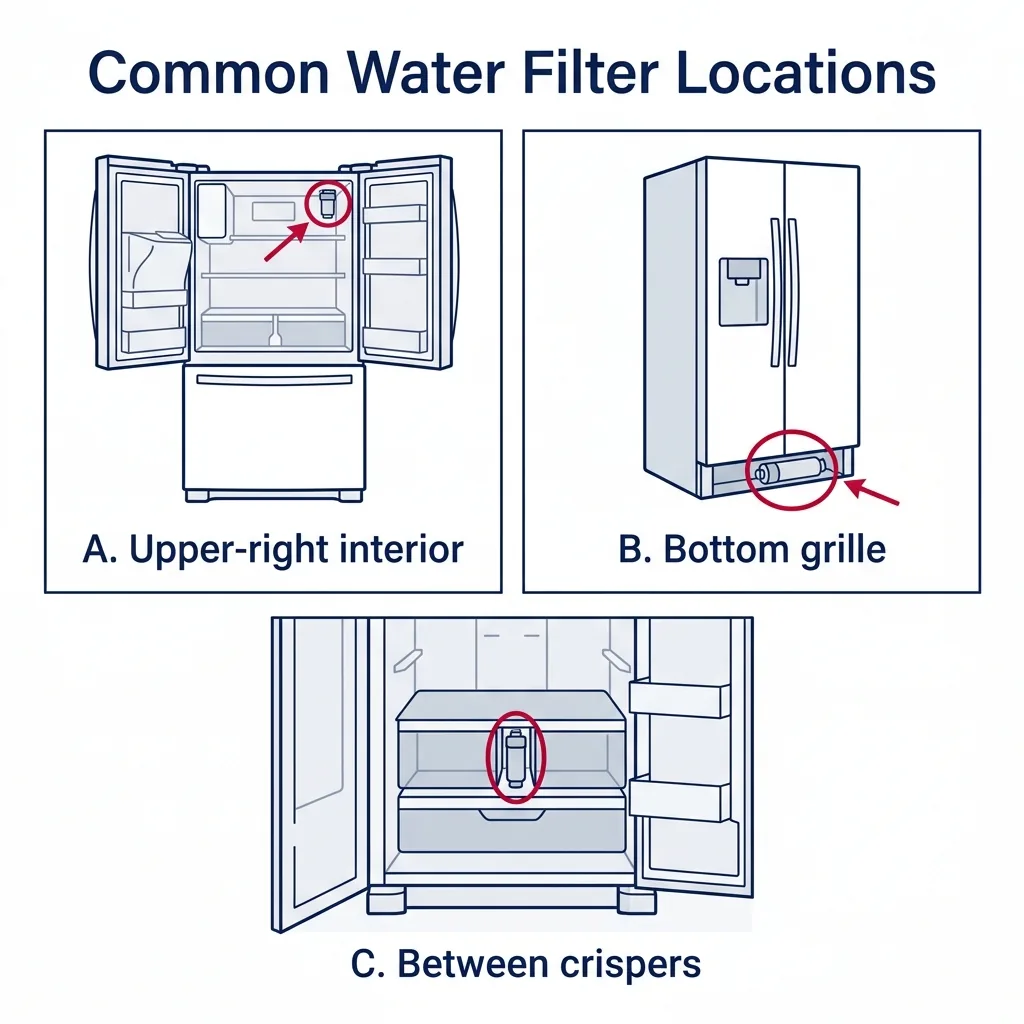
Tip: Take a photo of the old filter's label with your phone before you take it out. This guarantees you buy the correct replacement model.
Remove the Old Filter
The removal method depends on your filter housing. For 'Twist-and-Pull' filters (common in Samsung and LG), grasp the filter firmly, twist it a quarter-turn counterclockwise to unlock it, and pull straight out. For 'Push-Button' filters (common in Whirlpool and KitchenAid bottom-grille models), press the eject button firmly next to the filter, and it will pop out enough for you to grab. For 'Push-to-Release' models, push the filter straight in until it clicks, then let go, and it will spring outward. Have a towel ready, as a few drops of water will inevitably spill when the O-rings disengage.
⚠ Warning: If a twist-in filter is stuck, do not use pliers—you could crack the expensive plastic filter head. Turn off the water supply valve behind the fridge and dispense water from the door to relieve the line pressure, then try twisting again.
Prepare the New Filter
Take your new filter out of the packaging and remove any protective plastic caps or foil seals covering the O-rings at the top. Inspect the O-rings to ensure they are seated properly and not pinched. Use a permanent marker to write today's date, or the date 6 months from now, directly on the filter label. This gives you a foolproof visual reminder of when it needs to be changed next, even if the digital indicator light malfunctions or gets accidentally reset.
Tip: If your previous filter was incredibly hard to install or remove, apply a microscopic dab of food-grade silicone grease to the new filter's O-rings. Never use Vaseline or WD-40.
Install the New Filter
Align the new filter with the housing. Most filters have an alignment arrow or a specific groove that must match the track inside the refrigerator. For twist-in models, push the filter straight in until it stops, then twist it a quarter-turn clockwise until it locks securely into place. You should feel it seat firmly. For push-in models, insert the filter and push firmly until you hear a distinct click or until the eject button pops back out to its original position. Do not force it; if it won't seat, pull it out and check the alignment.
⚠ Warning: If the filter is not turned completely to the locked position, the internal water valve will not open, and your dispenser will not produce water.
Flush the Water System
This is a critical step that many homeowners skip. Place a large pitcher under the water dispenser and press the paddle. It may take 5-10 seconds for water to start flowing as the new filter fills up. Expect the water to sputter violently and shoot air pockets—this is completely normal. The first few cups of water will likely be dark gray or black. This is harmless, loose carbon dust from the new filtration block. Continue dispensing water until you have flushed about 2 to 3 gallons through the system. The water should now be running clear and steady.
Tip: Give the flushed water to your houseplants or pour it in the garden—carbon dust is actually great for soil!
Reset the Filter Indicator Light
Your refrigerator does not know you changed the filter; it operates on a simple 6-month or gallon-usage timer. You must manually reset the light. Look at your control panel. Often, there is a dedicated 'Filter Reset' button that you must press and hold for 3 to 5 seconds until the light turns green or disappears. If there is no dedicated button, look for secondary text under other buttons. Common combinations include holding 'Ice Type' and 'Child Lock' simultaneously, or holding 'Water' and 'Crushed Ice' together. Consult your manual if the light refuses to reset.
Brand-specific notes
Some brands have known design quirks worth knowing about before you start.
Samsung
Uses the HAF-CIN/EXP or DA29 series, usually located between the crisper drawers. These are notorious for getting stuck. If it won't twist counter-clockwise, shut off the water supply behind the fridge and hold the dispenser paddle to drain line pressure—it will twist out easily after that.
LG
Typically uses LT1000P or LT700P filters. You'll usually find them behind a drop-down door in the upper left or right ceiling of the fridge. Make sure to pull the filter completely downward before trying to pull it out, or you risk snapping the plastic bracket.
Whirlpool & KitchenAid
These use the EveryDrop series (numbered 1 through 6). Often located in the base grille. The push-button ejectors can get stiff over time. If the button is stuck, push the filter *in* slightly while pressing the button to release the latch.
GE
Modern GE fridges use XWFE filters which contain a proprietary RFID chip. You generally cannot use cheap aftermarket filters on these newer models; the fridge will detect the missing chip and completely disable the water dispenser until an OEM filter is installed.
Bosch
Uses the UltraClarity series. Usually a twist-in style in the upper right. Bosch housings are very sensitive to alignment. If the filter isn't twisted exactly 90 degrees to the lock icon, the internal bypass valve stays shut and you'll get zero water pressure.
Sub-Zero
Typically uses twist-in quarter-turn filters located behind the top louvered grille (Classic series) or inside the fridge (PRO series). Sub-Zero filters are highly pressurized; always turn off the unit at the control panel before swapping to prevent aggressive spraying.
What our techs see most often
Here in Southern California, especially the LA and Orange County areas, our municipal water averages around 250-400 ppm of hardness. We see ice makers fail constantly just because homeowners ignore that red filter light, letting calcium scale choke the water inlet valve. Changing a $50 filter saves you a $350 repair.
When to call a professional
- → The old filter is completely stuck and won't turn or eject, even after turning off the water supply.
- → Water leaks continuously from the filter housing inside the fridge after installing the new one.
- → The water dispenser won't work at all, even after confirming the new filter is properly locked in.
- → The plastic filter housing or the receiver head inside the fridge is visibly cracked or damaged.
- → You hear a loud hammering or knocking noise from the back of the fridge when dispensing water with the new filter.
Related Refrigerator Troubleshooting
These troubleshooting guides cover problems this task can help solve.
Refrigerator Compressor Won't Stop Running: Causes and Fixes
Refrigerator Door Not Sealing Properly: How to Fix
Refrigerator Ice Maker Not Working: How to Fix It
How to Fix a Refrigerator That's Not Cooling
Refrigerator Making Strange Noises: What They Mean and How to Fix
Frequently asked questions
Do I really need to use the expensive name-brand filter?
While tempting, cheap aftermarket filters ($15-$25) often lack proper carbon blocks, meaning they don't filter out heavy metals or pharmaceuticals. Worse, their O-rings are notoriously imprecise and frequently cause slow leaks that ruin hardwood floors. OEM filters ($40-$60) are NSF-certified and guaranteed to fit. Additionally, brands like GE use RFID chips, meaning knockoffs simply won't work.
Why is my water dispensing black after a filter change?
That is completely normal. The black color comes from loose carbon dust shedding from the new activated carbon block inside the filter. You need to flush 2 to 3 gallons of water through the dispenser to clear the dust and prime the filter. It is harmless, but tastes unpleasant.
How often should I really change my fridge water filter?
The industry standard is every 6 months. However, if you live in an area with very hard water (like San Diego, LA, or Ventura), or if you have a large family that uses the dispenser constantly, you may need to change it every 4 to 5 months. A noticeable drop in water pressure is your best indicator that the filter is clogged.
Why is my new filter leaking after I installed it?
Usually, this happens because the filter isn't pushed in or twisted all the way to the locked position. It can also happen if you forgot to remove the plastic shipping caps over the O-rings, or if one of the O-rings tore during installation. Remove the filter, inspect the rubber O-rings, and reinstall it firmly.
Can I bypass the fridge filter if I have a whole-home RO system?
Yes, and you absolutely should. Running a whole-home Reverse Osmosis system through a refrigerator filter drops the water pressure too low, which can cause the ice maker fill tube to freeze solid. Most manufacturers sell a 'bypass plug' ($15-$25) that takes the place of the filter, allowing water to flow freely without double-filtration.
Related Repair Guides
How to Fix a Refrigerator That's Not Cooling
A refrigerator that runs but does not cool is one of the most common appliance problems we see. Most cases come down to dirty condenser coils, a bad evaporator fan, or a defrost-system fault — and several are fixable in under an hour.
Refrigerator Ice Maker Not Working: How to Fix It
A non-working ice maker is rarely a broken ice maker. In our experience, 8 out of 10 cases come down to a frozen fill tube, a water-supply problem, or a clogged filter — all fixable in 30-60 minutes.
Refrigerator Leaking Water on the Floor: Causes and Fixes
A puddle under or behind your refrigerator usually traces to one of four sources: a clogged defrost drain (most common), a cracked ice-maker supply line, a leaking water inlet valve, or a worn door gasket letting in humid air. Here's how to identify and fix each.