
At a glance
Symptoms
- • Microwave powers on, display works, turntable spins, fan runs — but food stays cold
- • Faint humming or buzzing followed by silence after a few seconds
- • Strong burning smell on the first run after the issue started
- • Loud buzz that is noticeably louder than normal operation
- • Circuit breaker trips when you press start
- • Fuse on the back of the appliance has blown
Common causes
- • Failed magnetron — the tube that generates microwave energy ($80-150 part)
- • Burned-out high-voltage diode (rectifies AC to high-voltage DC for the magnetron)
- • Failed high-voltage capacitor (stores energy to drive the magnetron)
- • Broken door interlock switch — the microwave thinks the door is open and refuses to fire
- • Tripped thermal cutout / thermal fuse on the magnetron or cavity
- • Faulty control board failing to send the cook signal to the HV transformer
Safety First — Read Before You Start
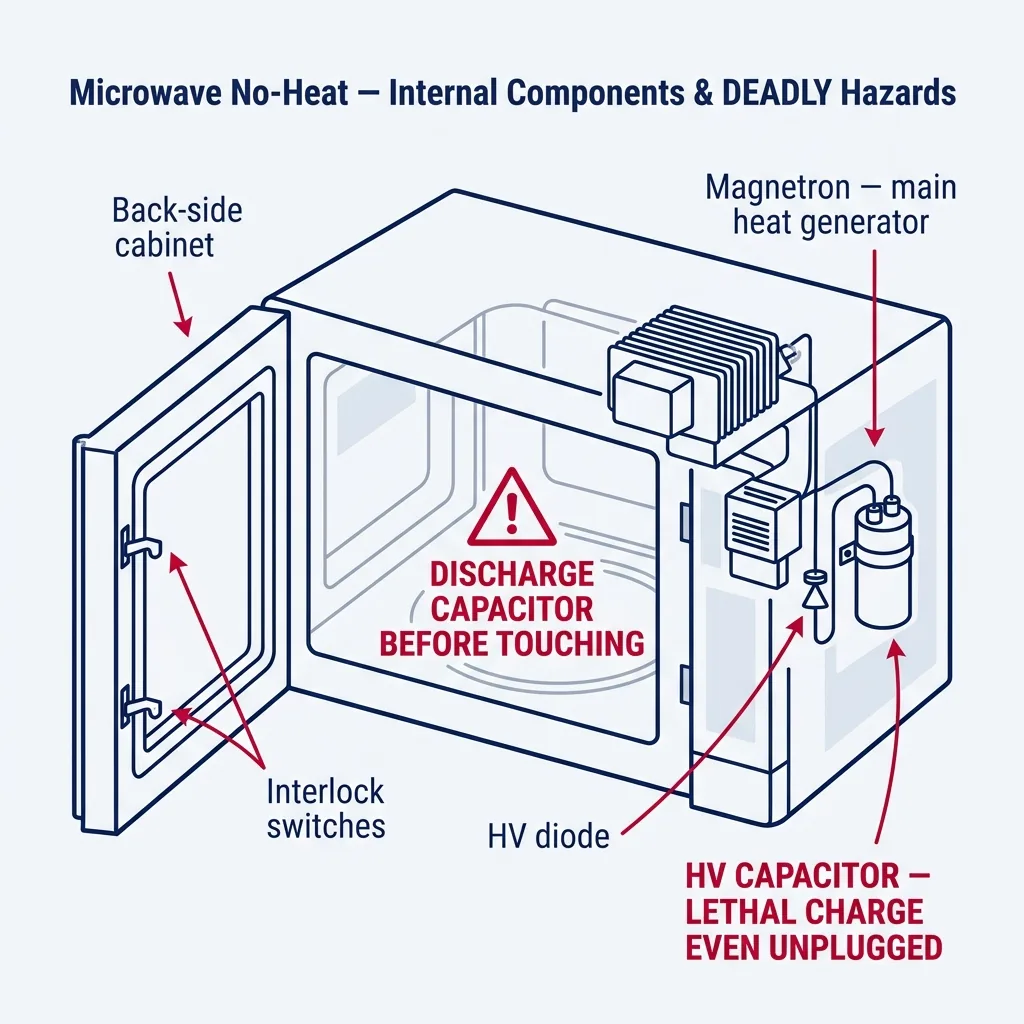
- •CRITICAL: A microwave high-voltage capacitor can store a LETHAL electrical charge for days or weeks after being unplugged. You must discharge it before touching any internal wiring. If you have not discharged a microwave capacitor before, stop and call a technician — this is not a beginner repair.
- •Always unplug the microwave AND wait at least 60 seconds before opening the case. Then discharge the capacitor across both terminals and from each terminal to chassis.
- •Never run a microwave with the case open or the door interlocks defeated. Microwave RF energy at close range can cause permanent eye and tissue damage.
- •Older magnetrons may contain beryllium oxide insulators. Do not break, sand, or grind a magnetron — dispose of failed units intact.
- •If the unit is over-the-range and mounted overhead, have a second person help support it during removal — they typically weigh 50-80 lbs.
Tools & supplies you'll need
- Phillips and flat-head screwdrivers
- 1/4-inch nut driver
- Multimeter with diode-test setting (and ideally a high-voltage probe for capacitor work)
- Insulated screwdriver with a plastic-handle and well-insulated shaft (for capacitor discharge)
- Heavy-duty rubber gloves
- Flashlight
- Replacement parts as identified by diagnosis
Step-by-step instructions
Confirm the symptom and isolate easy causes
Before opening anything, run a one-cup-of-water test for 60 seconds on high. If the water is cold and the microwave was loud or buzzing, that points to a magnetron or HV component. If the unit was silent during the test (no hum, no fan ramp-up under load), the failure is more likely a door switch or control board. Also check that the microwave is plugged into a dedicated 20-amp circuit — borderline voltage on a shared circuit causes the same symptoms.
Tip: Sensor-cook and inverter models behave differently. Inverter microwaves (most Panasonic and some GE Profile) can fail with a soft "no heat" mode that still spins the turntable — the inverter board itself is the part to replace, not a magnetron.
Test the door interlock switches
Most microwaves have three door switches: a primary, a secondary, and a monitor. If any one fails open, the unit will run lights and turntable but refuse to fire the magnetron — exactly the symptom in this guide. Unplug the unit, remove the cabinet (usually 4-6 screws on the back and top), and locate the switches near the door latch. With a multimeter on continuity, each switch should change state when the door closes. Replace any switch that fails to switch — they are typically $5-15 each and identical between brands.
⚠ Warning: The cabinet must be off to access switches. Even with the cabinet off, do not touch the large cylindrical capacitor near the magnetron until you have discharged it — see the next step.
Discharge the high-voltage capacitor
The capacitor is the silver or black cylinder roughly the size of a soda can, mounted near the magnetron. With the unit unplugged for at least a minute, place an insulated screwdriver across both terminals at the same time and hold for 5-10 seconds. You may hear a pop or see a small spark — that is stored energy releasing. Then short each terminal individually to the metal chassis. Only after this is it safe to test or replace HV components. If you skip this step, the shock can be fatal even with the unit unplugged.
⚠ Warning: Wear insulated gloves. Use a screwdriver with a fully insulated shaft, not just a plastic handle. If you are not 100% confident in this step, STOP and call a technician.
Test the high-voltage diode
With the capacitor discharged, disconnect one lead of the HV diode (a small black component wired between the capacitor and chassis). Set your multimeter to the diode-test or high-resistance setting. A good diode reads conductive in one direction and open in the other. A failed diode usually fails shorted, which often takes the magnetron with it. Replacement diodes are $10-20. Note polarity when reinstalling — the band marks the cathode.
Tip: A burned diode often has a visible split or scorch mark on its body. If you see this, just replace it without bothering to test.
Test the magnetron
The magnetron is the cube-shaped component with cooling fins, mounted to the side of the cavity. With the unit unplugged and capacitor discharged, disconnect the two filament wires. Set your multimeter to ohms (lowest range). Between the two filament terminals you should read less than 1 ohm. Between either terminal and the chassis you should read infinite (open). A magnetron that reads open between filaments, or reads continuous to chassis, is failed. Magnetrons run $80-150 and are the most expensive common failure.
Tip: On a microwave more than 10 years old, replacing a magnetron is rarely worth it once you factor in the diode (which often fails with it) and labor — pricing it against a new countertop unit is fair.
Check the thermal cutout / thermal fuse
Most microwaves have one or two thermal cutouts — a small disc-shaped device clipped to the cavity wall or magnetron. These open when the unit overheats and may not always reset. With the unit unplugged, disconnect both leads on each cutout and check continuity. An open cutout reads infinite ohms and must be replaced (~$10-15). If a cutout has tripped, address what caused the overheating first: a blocked vent, dirty grease filter (over-the-range models), or failed cooling fan.
⚠ Warning: Never bypass a thermal cutout by jumpering it. The cutout exists to prevent fires.
Reassemble and test
Reinstall the cabinet, plug the unit back in, and run the one-cup-of-water test again — 60 seconds on high should bring water to noticeably warm. If it is hot but the unit makes a louder-than-normal buzz, the new diode or capacitor may be slightly out of spec — confirm part numbers. If the symptom is unchanged after replacing one component, the failure is upstream (transformer, control board) and a tech is the right call.
Brand-specific notes
Some brands have known design quirks worth knowing about before you start.
Samsung
Samsung over-the-range models (especially the ME and SMH series) have a known weak point in the magnetron mounting bracket — the magnetron tends to fail at 5-7 years. If you replace one, also replace the HV diode at the same time — they fail in pairs more often than not.
Whirlpool
Whirlpool countertop and over-the-range models share a common door-switch assembly that fails after years of slamming the door. The whole switch pack is about $25 and snaps in. If your Whirlpool runs but does not heat, replace this assembly before suspecting the magnetron.
GE Profile
GE Profile inverter and Advantium models have a separate inverter board instead of a traditional transformer + capacitor. These boards fail with a no-heat symptom while the unit otherwise runs normally. The inverter board is $150-250 and is not user-friendly to swap. Have a tech confirm before ordering.
LG NeoChef
LG NeoChef inverter microwaves can fail with a no-heat condition that the smart-diagnosis app will sometimes flag as an inverter fault. LG covers the magnetron and inverter for 10 years on most models — check your serial number before paying out of pocket.
Frigidaire
Frigidaire countertop models (FFCE, FFMV, GMOS series) most often fail at the high-voltage diode — a $10-15 fix that is easy to miss because the magnetron looks fine on a meter test. Always check the diode before condemning the magnetron on a Frigidaire.
What our techs see most often
About a third of our 'microwave not heating' calls turn out to be a $10 door switch — the customer assumed the magnetron was dead. Another third are genuinely failed magnetrons on Samsung over-the-range units around the 5-7 year mark. The remainder split between HV diodes, thermal cutouts, and inverter boards on Panasonic / GE Profile inverter models. We always quote a flat diagnostic before opening one up.
When to call a professional
- → You are not 100% confident in your ability to safely discharge a high-voltage capacitor
- → The unit is an over-the-range model and you do not have a second person to help support it during removal
- → You replaced a magnetron, diode, or capacitor and the symptom is unchanged — the next part up the chain is the HV transformer or control board, both of which require more advanced diagnostic skills
- → The breaker trips when you press start, even briefly — this indicates a short in a high-current component
- → The unit is a built-in trim-kit installation (Wolf, Thermador, Miele, KitchenAid Architect) where reinstallation requires special handling
- → The microwave is part of a wall oven combo — these share a control board with the oven and misdiagnosis is expensive
Frequently asked questions
Is it worth repairing a microwave that does not heat?
It depends on the cost of the part and the age of the unit. A $15 door switch on a 3-year-old over-the-range Samsung is worth fixing. A $150 magnetron plus labor on a 12-year-old countertop microwave usually is not — a comparable new unit is $120-180. As a rule of thumb: if the part-plus-labor is more than 50% of replacement cost and the unit is over 8 years old, replace it.
Can a magnetron be safely replaced as a DIY job?
Yes, with two strict prerequisites. First, you must safely discharge the high-voltage capacitor before touching anything inside. Second, you must use the correct replacement magnetron — magnetrons are not universal. Match the part number on the original. The mechanical swap itself is straightforward: four screws, two filament wires, and a waveguide gasket.
Why does my microwave hum loudly but not heat?
A loud hum during a cook cycle followed by no heating almost always means a shorted high-voltage diode. The diode fails in a near-short condition that overloads the transformer, producing the loud hum. Replace the diode (and check the magnetron filament for collateral damage) and the symptom typically clears.
My microwave smells burnt and now will not heat — is it dangerous to use?
Stop using it. A burnt smell with loss of heating usually means an internal arc burned a wire or component. Continuing to run it risks a fire. Unplug it, let it sit overnight to be safe, and either repair or replace it. Open-the-cabinet diagnosis is the only way to know what burned.
How long should a microwave last?
Countertop microwaves typically last 7-10 years. Over-the-range and built-in models last 10-15 years because they are used less heavily. Inverter models generally last longer than transformer-based models. Heavy daily use cuts these numbers roughly in half.
Related Repair Guides
Microwave Sparking Inside: Causes and What to Do
Sparks inside a microwave are scary but usually not serious. The single most common cause is a burnt or food-soiled waveguide cover — that small mica panel on the side wall of the cavity. Other common causes are food splatter on the walls, accidental metal in the cavity, or a worn turntable hub. Most fixes are housekeeping; a few signal a deeper problem.
Microwave Buttons Not Working: Membrane and Control Board Diagnosis
When your microwave buttons stop responding, you're usually dealing with a failed membrane switch or a control board issue. Learn how to safely diagnose and replace these components to get your kitchen back in action.
Microwave Door Won't Close or Latch Properly: Fix Guide
A microwave door that won't latch is a major safety hazard and prevents the unit from running. This guide walks you through fixing broken latch hooks, sagging hinges, and misaligned door switches.