
At a glance
Symptoms
- • Clothes take multiple cycles to dry completely, especially heavy items like towels or jeans.
- • The dryer exterior gets dangerously hot to the touch during operation.
- • The laundry room feels excessively humid or smells like burning dust.
- • The exterior vent hood damper flap barely opens when the dryer is running.
- • It has been over 12 months since the vent was last professionally or thoroughly cleaned.
Common causes
- • Fire Prevention: Lint is highly flammable. Combined with restricted airflow and a hot heating element, it is a leading cause of house fires.
- • Energy Efficiency: A clear vent allows moisture to escape quickly, cutting run times and saving on your utility bills.
- • Appliance Lifespan: Restricted airflow forces the blower motor and heating element to work overtime, leading to premature thermal fuse or element failure.
- • Moisture Control: Trapped humid air can back up into your laundry room or wall cavities, causing mold issues, especially in damp coastal areas like Ventura or San Diego.
Safety First — Read Before You Start
- •Always unplug the dryer from the wall outlet (or turn off the breaker for hardwired units) before moving it or disconnecting the vent.
- •If you have a gas dryer, move the unit very carefully to avoid kinking, stretching, or damaging the flexible gas supply line. If you smell gas, stop immediately, open windows, and call the gas company.
- •Never use standard cloth 'duct tape' on dryer vents. It degrades quickly under heat and poses a severe fire risk. Always use UL-listed aluminum foil tape.
- •Avoid using a leaf blower to clear vents if your ductwork is old or made of flexible foil/vinyl in the walls, as the high pressure can blow apart the hidden seams.
Tools & supplies you'll need
- Flexible vent cleaning brush kit with connectable rods ($20-$40)
- Cordless power drill (optional, for use with the brush kit)
- Shop-vac or standard vacuum with a long hose attachment
- Screwdriver or nut driver (usually 1/4-inch or 5/16-inch)
- UL 181AP-M listed aluminum foil tape ($10-$15)
- Flashlight or headlamp
- Work gloves and a dust mask
Step-by-step instructions
Disconnect the Power and Move the Dryer
Start by unplugging your dryer from the electrical outlet. If you have a gas dryer, turn off the gas valve if it's easily accessible; otherwise, slide the dryer forward very slowly and carefully to avoid putting tension on the flexible gas line. Pull the unit out just enough to give yourself 2 to 3 feet of working clearance behind it. Use a flashlight to inspect the area behind the dryer, which is likely covered in stray lint.
Tip: If your dryer is installed in a tight closet or a garage pedestal setup, laying down a piece of cardboard can help slide the heavy unit forward without gouging your floors.
⚠ Warning: Never stretch a gas line tight. If the line is too short to allow you behind the dryer, you must safely shut off the gas and disconnect the line before proceeding.
Detach the Transition Duct
Locate the short transition duct connecting the back of your dryer to the wall exhaust port. Loosen the metal worm-gear clamps using a screwdriver or nut driver, or carefully peel away any foil tape holding it in place. Remove the transition duct entirely. Take your shop-vac and thoroughly vacuum the exhaust port on the back of the dryer, the inside of the transition duct, and the entry point on the wall. If the transition duct is made of white plastic vinyl or thin, easily crushable foil, discard it immediately—these are code violations and fire hazards.
Tip: Replace old transition hoses with semi-rigid aluminum ducting. It holds its shape better and resists crushing when the dryer is pushed back.
Prep and Insert the Brush Kit
Unpack your flexible vent brush kit. Attach the brush head to the first flexible fiberglass rod. Insert the brush into the wall duct. If you are using a cordless drill, attach the other end of the rod to the drill chuck. Turn the drill on at a medium speed, ensuring it is set to 'forward' (clockwise). Slowly push the spinning brush into the ductwork.
⚠ Warning: CRITICAL: Never run the drill in reverse (counter-clockwise). Doing so can unscrew the rod connections inside the wall, leaving the brush permanently stuck in your ductwork.
Ream the Ductwork
Continue feeding the brush into the wall, adding one rod at a time as you go deeper. Move the spinning brush back and forth in a plunging motion to scrub the walls of the duct. You will likely see large clumps of lint falling out. Keep a vacuum running near the opening to catch the debris. Continue adding rods until you feel the brush reach the exterior hood or you have cleared the entire length of the run.
Tip: If you live in a hillside home or have a laundry room on an interior wall, your vent might run vertically through the roof. Gravity makes vertical runs harder to clean from the bottom up, so you may need to snake the brush down from the roof (only if you can do so safely).
Clean the Exterior Hood
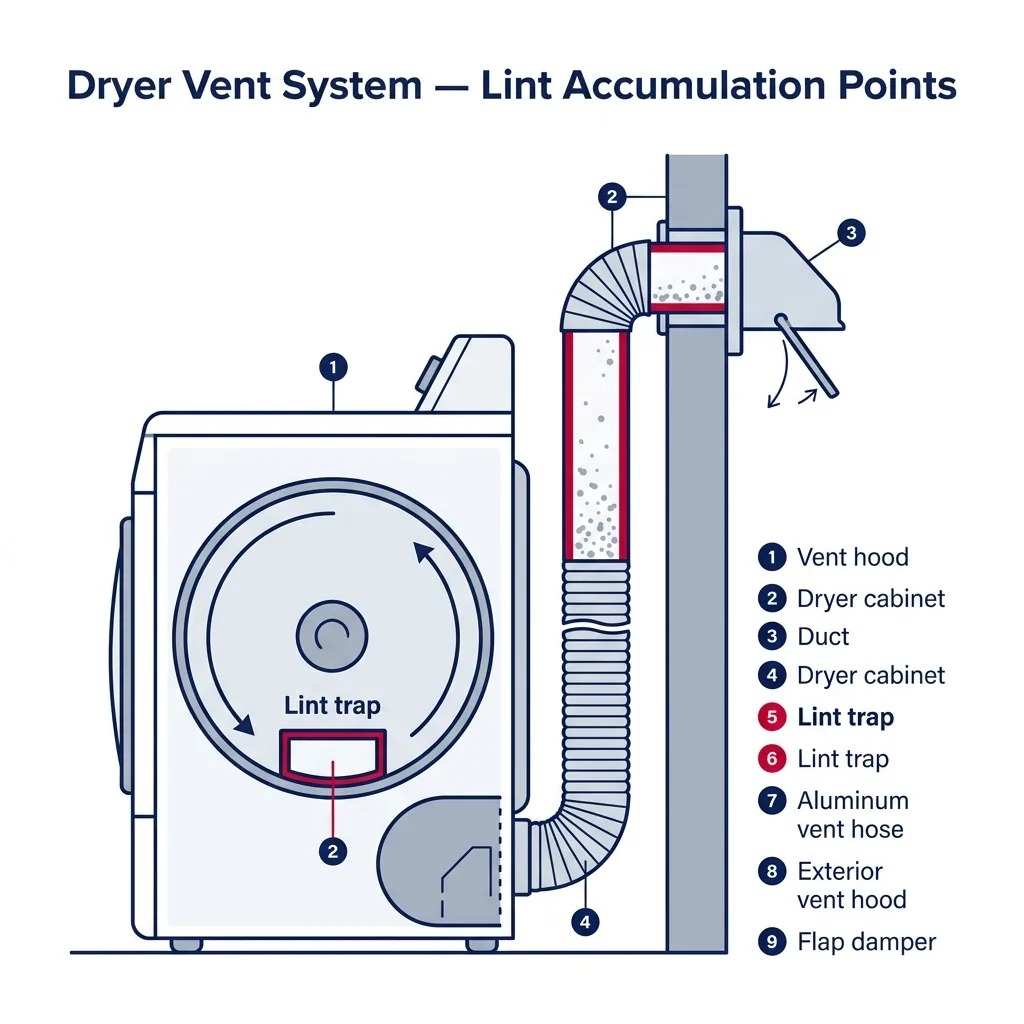
Go outside and locate the exterior vent hood. This might be on the side of your house, under an eave, or on the roof. Open the damper flap and pull out any lint the brush pushed through. Ensure the flap moves freely on its hinges. If the flap is stuck open, cold air and pests can enter your home; if it's stuck closed, the dryer can't exhaust. Clean the louvers or flap thoroughly.
⚠ Warning: Dryer vents should NEVER have a mesh pest screen installed over them. Screens trap lint instantly and will cause a dangerous blockage within weeks. If your hood has a screen, cut it out or replace the hood.
Reassemble and Seal
Go back inside and vacuum up the massive pile of lint you've just excavated. Reattach the semi-rigid transition duct to the wall port and the back of the dryer. Secure the connections using the metal worm-gear clamps. For an airtight seal, wrap the joints with UL-listed aluminum foil tape. Carefully slide the dryer back into position, ensuring you do not crush or kink the transition duct against the wall.
Tip: Leaving about 4 to 6 inches of clearance between the back of the dryer and the wall is usually necessary to prevent crushing the duct.
Test the Airflow
Plug the dryer back in (and turn the gas back on, checking for leaks with soapy water if you disconnected it). Turn the dryer on using an 'Air Fluff' or 'No Heat' cycle. Go outside to the exterior vent hood and verify that the damper flap is blowing open forcefully. The exhaust air should feel like a strong breeze. If the airflow is strong, the job is complete.
Brand-specific notes
Some brands have known design quirks worth knowing about before you start.
LG
LG dryers are notorious for throwing a 'd80', 'd90', or 'd95' error code when the vent is clogged. This Flow Sense system is highly sensitive; even a partially crushed transition hose behind the dryer can trigger it. Clearing the vent usually clears the code automatically.
Samsung
Many Samsung models will display an 'HC', 'hE', or 'tC' code, or the vent blockage indicator light on the panel will illuminate. If the vent isn't cleaned promptly, Samsung heating elements are prone to grounding out and failing completely due to the trapped heat.
Whirlpool
Older Whirlpool and Maytag models lack sophisticated airflow sensors, meaning they will just keep running hot until the thermal fuse blows. If your Whirlpool suddenly has no heat at all or won't start, a clogged vent likely killed the $15 thermal fuse on the blower housing.
Bosch
Bosch compact condensation dryers (often found in apartments or condos) don't have a traditional exhaust vent. Instead, they have a heat exchanger (condenser) at the bottom front that needs to be pulled out and rinsed in the sink monthly. Don't go looking for a vent hose on a 500 or 800 series condensation unit!
GE
GE models often have a very low-to-the-ground rear exhaust port. When pushed back into a tight laundry closet, the standard 4-inch aluminum duct gets crushed instantly. Consider installing a rigid 90-degree 'close clearance' periscope vent if your GE is in a tight space.
What our techs see most often
Out here in LA and Orange County, we see tons of dryers stuffed into tight garage corners or interior closets where the vent run goes straight up to the roof. That vertical climb combined with heavy use means lint falls right back down into the blower wheel—if you've got a vertical run, you really need to clean that vent every 6 to 8 months, not just once a year.
When to call a professional
- → Your vent run exceeds 20 feet or has more than two 90-degree elbows, making it too difficult for standard DIY brush kits to navigate.
- → The exterior vent hood is located on a steep roof or a second/third-story exterior wall that you cannot safely reach.
- → You discover the ductwork inside the wall is made of white vinyl or flexible foil (a massive fire hazard) and needs to be replaced with rigid galvanized steel.
- → You smell gas when moving the dryer or do not feel comfortable working around the flexible gas supply line.
- → You pull out wet, sludgy lint, which indicates a serious condensation issue or a disconnected duct leaking moisture into your crawlspace or attic.
Related Dryer Troubleshooting
These troubleshooting guides cover problems this task can help solve.
Dryer Drum Not Spinning: Causes and Fixes
Dryer Making Loud Noises: Identify Squeaks, Thumps, and Grinding
Dryer Not Heating: How to Diagnose and Fix
Dryer Overheating and Stopping Mid-Cycle: How to Fix
Dryer Takes Too Long to Dry: Fix Guide
Frequently asked questions
How much does it cost to have a professional clean my dryer vent?
In Southern California, professional dryer vent cleaning typically ranges from $125 to $250, depending on the length of the run, the severity of the clog, and whether specialized roof access is required.
Can I just use a leaf blower to clean my dryer vent?
While tempting and popular on the internet, using a leaf blower is risky. If your wall duct has any loose joints or uses tape that has degraded, the high pressure can blow the duct apart inside your walls or ceiling, venting hot, moist lint directly into your home's structure.
Why is the lint inside my vent wet and sticky?
Coastal humidity in areas like San Diego or Ventura can contribute, but wet lint usually means the airflow is so restricted that the moisture from your clothes is condensing inside the duct before it can escape. This requires immediate cleaning to prevent mold and rusting inside the ductwork.
Are those flexible plastic or foil transition hoses safe?
No. Building codes and appliance manufacturers now strictly prohibit white vinyl or thin foil hoses. You should only use semi-rigid aluminum or rigid galvanized steel ducting for the transition hose between the dryer and the wall.
I cleaned the vent, but my dryer still takes two hours to dry. What's next?
If the vent is 100% clear (including the outside hood) and airflow is strong, the dryer itself may have a failing heating element, a blown thermal fuse, or a clogged internal blower wheel. At this point, the appliance requires internal diagnosis and repair.
Related Repair Guides
Dryer Takes Too Long to Dry: Fix Guide
When your dryer technically works but a single load takes two or three cycles to come out dry, you are not dealing with a broken part — you are dealing with restricted airflow. Lint, kinked vents, and a dirty moisture sensor are responsible for the vast majority of slow-drying complaints, and almost all of them are 30-minute fixes with no parts at all.
Dryer Overheating and Stopping Mid-Cycle: How to Fix
An overheating dryer is more than just a nuisance—it is a serious fire hazard. If your dryer gets blazing hot to the touch and shuts off mid-cycle, here is how to find the airflow blockage or faulty thermostat causing the issue.
Dryer Not Heating: How to Diagnose and Fix
A dryer that tumbles but produces no heat is almost always one of three problems: a clogged exhaust vent, a blown thermal fuse, or a failed heating element (electric) or igniter (gas). The vent is the most common cause and the most dangerous to ignore — restricted airflow is the #1 trigger for dryer fires in U.S. homes.