
At a glance
Symptoms
- • Dryer powers on, control panel lights up, but pressing Start does nothing
- • You hear a humming sound from the motor but the drum does not turn
- • Drum spins by hand with no resistance (belt is broken or off the pulley)
- • Drum is hard to spin by hand or makes a thumping sound when turned
- • Loud rumbling, squealing, or thumping just before the drum stopped turning altogether
- • Burning rubber smell from the dryer (belt slipping on a frozen idler or roller)
Common causes
- • Broken drive belt — the most common cause, and audible: motor hums, drum free-spins by hand
- • Worn or seized idler-pulley tensioner — the spring-loaded pulley that keeps tension on the belt
- • Worn drum support rollers or front glides causing the motor to overheat and shut off on thermal overload
- • Failed drive motor (humming sound, no movement, motor hot to the touch and clicking on thermal protector)
- • Broken or misaligned door switch — the dryer thinks the door is open and refuses to start
- • Failed start switch on the control panel — push-to-start button is dead
- • Seized drum bearing on rear bulkhead (especially on Whirlpool 27" platforms) — drum binds against rear felt
- • Foreign object (coin, underwire bra) lodged between drum and front bulkhead, jamming the drum
Safety First — Read Before You Start
- •ALWAYS unplug the dryer before removing any panel. On gas dryers, also close the gas shutoff valve at the wall before pulling the front panel off — the gas line attaches near the burner assembly.
- •The drive motor and burner housing stay hot for 20-30 minutes after a cycle. Wait before reaching inside.
- •Dryers are awkward and front-heavy when the front panel is off. Have a partner stabilize the cabinet, or rest the drum on a folded blanket so it does not fall when the belt is slack.
- •Never bypass the door switch. The drum spinning at 50+ RPM with the door open can entangle hands or hair and cause serious injury.
- •Sharp edges inside the cabinet — wear gloves when reaching around the blower housing or rear bulkhead.
Tools & supplies you'll need
- Phillips and flat-head screwdrivers
- 1/4-inch and 5/16-inch nut drivers or socket set
- Putty knife or trim tool (for releasing top-panel clips on Whirlpool/Maytag platforms)
- Multimeter (for switch and motor continuity testing)
- Flashlight
- Channel-lock pliers
- Replacement drive belt (have on hand before starting — a $25 belt that fits 90% of 27" Whirlpool/Maytag dryers)
- Optional: drum-roller tool for Whirlpool platforms ($10) — saves 30 minutes of cursing
Step-by-step instructions
Quick triage: spin the drum by hand
Open the door and try to spin the drum by hand. Three possible results, each pointing to a different fix. (1) Drum spins freely with zero resistance and you hear nothing — the drive belt is broken. (2) Drum spins but feels gritty, makes a thumping sound, or is hard to start moving — drum rollers or rear bearing are worn. (3) Drum will not move at all even with significant force — something is jammed (bra wire, coin) or the rear bearing has seized completely. This 30-second check tells you which of the next steps to focus on.
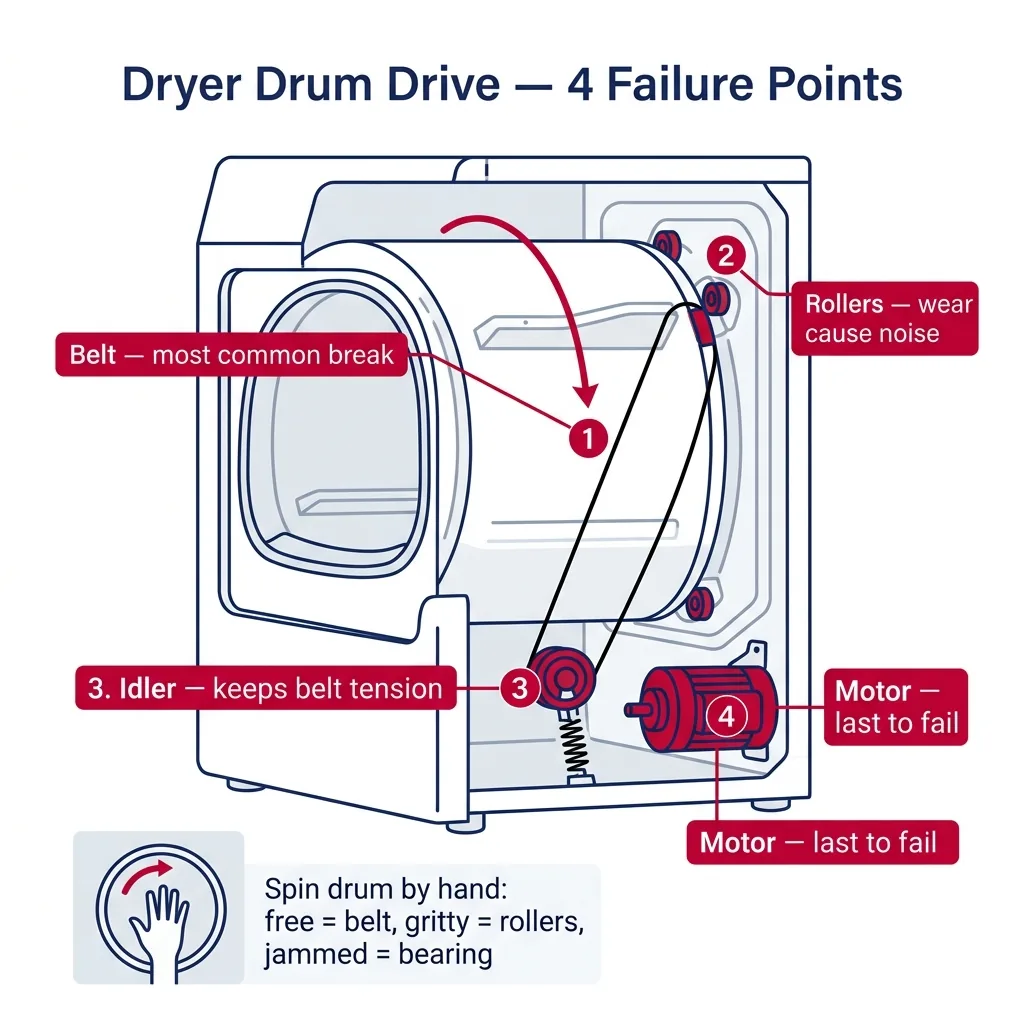
Tip: If you hear a clicking sound from the back when you press Start, that is the drive motor trying to engage but unable to start under load — most often a broken belt or seized idler.
Verify the door switch and start switch
Before opening the dryer, make sure it is even getting the start signal. Open and firmly close the door — many dryers will not start if the door switch plunger is misaligned. If you hear a faint click when the door closes, the switch is at least mechanically active. If silent, unplug the dryer, access the switch (usually behind the top panel), and test for continuity with a multimeter while pressing the plunger. Switches are $15-25 and easy to swap. While you have the top off, also test the push-to-start button on the control panel — it should show continuity only when pressed.
Tip: On front-load dryers, the door is held closed by a magnetic strike, not a latch. If the strike on the door has fallen out (you'll see a small empty pocket where a magnet used to sit), the dryer will think the door is open. The magnet is a $5 part.
Open the cabinet to inspect the belt
On most 27" Whirlpool/Maytag/Kenmore dryers: remove the lint screen, then the two ¼" screws inside the lint chute. Pop the top panel up with a putty knife at the front corners. Disconnect the door-switch harness, then remove the two screws at the top of the front panel. Tilt the front panel forward and lift it off — the drum will rest forward; support it on a folded towel. You now have full visibility of the drum, belt, idler, and motor. On LG, Samsung, and GE platforms, access is through the rear panel — remove 8-10 screws and pull the entire back off.
⚠ Warning: On gas dryers, the gas line passes through the bottom rear of the cabinet. Be careful not to flex or kink it when shifting the cabinet around.
Replace the drive belt
If the belt is broken, you will see it draped at the bottom of the cabinet or wrapped around the motor shaft. The belt is a thin (¼" wide on most models) flat belt that wraps around the drum, then routes under the motor pulley and idler. To install: route the new belt around the drum (grooved side touching the drum), then snake the free end under the idler pulley arm and around the motor pulley. Push the idler arm toward the motor with one hand to add slack, slip the belt over the motor pulley, and release — the spring keeps tension automatically. Spin the drum by hand once or twice to seat the belt. The whole job is 20 minutes once you've done it once.
Tip: Most 27" Whirlpool/Maytag/Kenmore dryers from 1985 to today use the same belt: part number 341241 (also sold as 8066065). Buy two — they are cheap and the second one will save you a future service call.
Inspect the idler pulley and drum rollers
While the front is off, spin the idler pulley with your finger. It should turn smoothly with no grinding or wobble. If it squeaks, drags, or has play in the bearing, replace it ($15-25). Then check the two drum rollers on the rear bulkhead — they support the back of the drum. Spin each by hand. Smooth = good. Rough, gritty, or no rotation = worn. Replace both as a pair ($25-40). Worn rollers cause the motor to overheat from the strain, and a motor that thermal-overloads is the #2 reason a dryer that 'just had a belt replaced' stops spinning again.
⚠ Warning: Do not just replace the belt and skip the idler/rollers. The most common reason a freshly-replaced belt breaks again within 90 days is a frozen idler that wears the new belt at one spot.
Test the drive motor (humming but not spinning)
If the belt and idler are fine but the motor only hums and the drum will not move (and spins freely by hand), the motor itself has likely failed — most often a seized start-winding capacitor or a worn brush on the start switch internal to the motor. Unplug the dryer, remove the belt entirely, and try to spin the motor pulley by hand. If it rotates smoothly with no grinding, the bearings are fine and the issue is electrical inside the motor — replace the motor ($120-180 part). If the pulley is rough or seized, definitely a motor replacement.
Tip: Before condemning the motor, check the thermal overload protector. After a stuck-belt event the motor's internal thermal switch can stay open for hours. Let the dryer sit unplugged for 60 minutes, then test again before buying a $150 motor.
Reassemble and test
Once the belt is on, idler is good, and rollers spin smoothly: reseat the front panel, reconnect the door-switch harness, drop the top panel back onto its clips, and reinstall the lint-chute screws. Plug the dryer in (open the gas valve on gas units), close the door, and press Start. The drum should turn smoothly with no thumping, squealing, or rubbing. Run an empty 5-minute cycle and listen carefully. Any new noise means a belt routing issue or a panel screw catching the drum — open it back up immediately rather than running a full load.
Tip: A correctly running dryer makes a low rumble plus the motor hum. Squealing = idler bearing. Thumping every revolution = bad rear bearing or off-balance drum. Scraping = front glide worn through to metal contact.
Brand-specific notes
Some brands have known design quirks worth knowing about before you start.
Whirlpool / Maytag / Kenmore (27" platform)
These three brands share the same chassis and belt (P/N 341241). Front-access design — pop the top, remove front panel, and the entire drum lifts out. Drum rollers, idler, and belt are all visible at once. This is the easiest dryer to repair in the entire industry, and parts are universally available. If you do not own a 27" Whirlpool, this is the brand to buy next.
LG (DLE/DLG)
LG dryers use a different belt (P/N 4400EL2001A) and rear-access design. Pull the back panel; the motor and belt are visible there. LG drum bearings are notably long-lived but the drive motor itself fails more often than competitors — symptoms are humming with the belt off and a hot motor casing. LG's 10-year warranty does NOT cover belts or rollers but DOES cover the inverter direct-drive motor on some models — check before buying parts.
Samsung (DV series)
Samsung DV dryers are notorious for blower-wheel set screws coming loose and seizing the impeller, which then locks the motor and prevents drum rotation. Symptom: humming sound + drum will not turn, but the belt is intact. Pull the rear panel, check the blower wheel for play. A drop of thread locker on the set screw at install time prevents this entirely. Samsung also uses a ribbed multi-V belt rather than a flat belt — installation is fussier and the belt costs about $35.
GE Profile
GE dryers use a unique 'rear drum bearing' design where the entire drum is supported on a single rear shaft and bearing rather than two rollers. When that bearing fails, drum rotation gets stiff and the motor overloads. Replacement is a 90-minute job and the bearing kit runs about $50. Check by spinning the drum slowly by hand from cold — gritty resistance is the bearing. GE drive belts are also model-specific; bring the model number when ordering.
Maytag Bravos top-load
Bravos top-load dryers (the round-window pedestal style) have a different access path — the entire top hinges open like a clamshell. The belt routes around a much larger drum and there is a separate splutch (a clutch-like coupling) that wears over time. Replacement parts cost about double what a standard 27" dryer costs. If your Bravos is past 8 years old, weigh the cost of repair vs. replacement carefully.
What our techs see most often
On 27" Whirlpool, Maytag, Kenmore, and Amana dryers we carry a 'spin kit' on every truck: belt, idler pulley, and a pair of drum rollers, plus front glides — total parts cost about $70. We replace all four together regardless of which one technically failed, because by the time one of them gives out, the other three are 80% worn. Customers sometimes push back on replacing parts that are not broken yet, but coming back in 6 months for a $200 service call when a $30 part was right there is the worst outcome for everyone. On LG and Samsung dryers we see motor failures more often than belt failures — the belts on those are heavier-duty and the motors run hotter.
When to call a professional
- → You've replaced the belt and the new belt broke again within a few cycles (indicates a deeper alignment or rear-bearing issue)
- → The drum will not turn at all by hand (seized rear bearing or jammed foreign object) and you cannot identify what is locking it
- → The motor hums and is hot to the touch even with the belt removed (bad motor — replacement is $120+ and a 2-hour job)
- → Your dryer is a heat-pump or ventless condenser model where the drum is integrated with the heat-pump assembly
- → You smell burnt rubber and see scorched belt residue on the drum (high-friction failure that can damage the drum surface)
- → You are not comfortable removing the front panel of a gas dryer with the burner assembly attached
Dryer Maintenance & Replacement Tasks
Step-by-step guides for individual maintenance jobs related to this appliance.
How to Clean a Dryer Exhaust Vent (Fire Prevention)
How to Deep-Clean a Dryer Lint Trap Housing (Beyond the Screen)
How to Replace a Dryer Drive Belt
How to Replace an Electric Dryer Heating Element
How to Replace a Dryer Thermal Fuse
Frequently asked questions
My dryer hums but the drum will not turn — what does that mean?
A hum without rotation almost always means the motor is trying to start but cannot overcome the load. Most common cause: broken or off-track drive belt (drum will spin freely by hand). Second most common: seized idler pulley or drum bearing creating too much friction (drum is hard to spin by hand). Third: failed motor start winding (motor pulley itself will not turn even with the belt off).
How much does it cost to replace a dryer drive belt?
DIY: the belt itself is $20-35 depending on brand. Tools you probably already have. Total time: 60-90 minutes for your first one. Professional repair: $150-220 including parts, labor, and diagnostic. We strongly recommend replacing the idler pulley and drum rollers at the same time — adds $40 in parts and 15 minutes of labor while you are already in there.
How long does a dryer drive belt last?
8-12 years on average for a Whirlpool/Maytag flat belt with normal use. Belts wear faster on dryers with bad idler pulleys (rough surface chews up the belt at one spot), overloaded dryers (excess strain), or units with worn drum rollers (the drum runs slightly off-axis and stresses the belt). When you replace a belt, replacing the idler at the same time roughly doubles the life of the new belt.
Is it safe to run a dryer with worn drum rollers for a few weeks?
Not really. Worn rollers make the motor work much harder, which causes the thermal overload protector inside the motor to trip more often, which weakens the motor windings over time. What started as a $30 roller job can become a $180 motor replacement if you ignore it for too long. The thumping and squealing sounds will also get progressively worse. Fix it the same week you notice the sound.
Can I replace just the belt without removing the entire front panel?
On Whirlpool/Maytag/Kenmore 27" dryers, no — the belt routes around the drum and the drum has to come out (or at least come forward) to install it. There is no shortcut. On LG and Samsung rear-access platforms, you can sometimes route a new belt without pulling the drum, but it is fiddly. Plan on a full disassembly your first time. The good news is that once the panels are off, the entire job takes 20 minutes.
Related Repair Guides
Dryer Not Heating: How to Diagnose and Fix
A dryer that tumbles but produces no heat is almost always one of three problems: a clogged exhaust vent, a blown thermal fuse, or a failed heating element (electric) or igniter (gas). The vent is the most common cause and the most dangerous to ignore — restricted airflow is the #1 trigger for dryer fires in U.S. homes.
Dryer Takes Too Long to Dry: Fix Guide
When your dryer technically works but a single load takes two or three cycles to come out dry, you are not dealing with a broken part — you are dealing with restricted airflow. Lint, kinked vents, and a dirty moisture sensor are responsible for the vast majority of slow-drying complaints, and almost all of them are 30-minute fixes with no parts at all.
How to Clean a Dryer Exhaust Vent (Fire Prevention)
A clogged dryer vent is a major fire hazard and the number one reason your clothes take forever to dry. This step-by-step guide walks you through deep-cleaning your exhaust duct from the back of the dryer all the way to the exterior wall hood.