
At a glance
Symptoms
- • You hear the motor running and humming normally, but the drum stays completely still.
- • The drum spins far too easily by hand with absolutely no resistance.
- • A loud snapping, popping, or slapping sound occurred right before the dryer stopped tumbling.
- • Clothes are taking forever to dry because they aren't tumbling through the hot air.
- • You hear a repetitive thumping noise while it runs, indicating a frayed belt that is about to break.
Common causes
- • Restores the tumbling action essential for actually drying your clothes efficiently.
- • Prevents the heating element from overheating and burning out due to a lack of airflow through tumbling clothes.
- • Saves you from running the motor continuously under a zero-load condition, which can cause premature motor wear.
- • Allows you to deeply clean the cabinet interior and inspect the idler pulley and drum rollers while the machine is open, preventing future breakdowns.
Safety First — Read Before You Start
- •Always unplug the dryer from the wall receptacle before beginning. The 240V power in electric dryers is highly lethal.
- •If you have a gas dryer, turn off the gas supply valve before moving the unit. Do not over-stress or kink the flexible gas line.
- •The internal sheet metal edges of a dryer cabinet are incredibly sharp. Always wear heavy-duty work gloves when reaching inside, especially during the blind threading step.
- •If you have a stacked washer/dryer unit, have a helper available. Never attempt to unstack heavy appliances alone.
Tools & supplies you'll need
- Phillips and flathead screwdrivers
- 1/4-inch and 5/16-inch nut drivers or socket set
- Stiff putty knife (for popping top panel spring clips)
- Heavy-duty work gloves (dryer cabinet edges are razor sharp)
- Replacement drive belt (OEM recommended, usually $15-$35)
- Shop vacuum (for cleaning out lint while the cabinet is open)
- Headlamp or flashlight
Step-by-step instructions
Disconnect Power and Open the Top Panel
Start by unplugging the dryer from the wall. If it is a gas dryer, shut off the gas valve. Pull the dryer away from the wall just enough to give yourself room to work. For most modern dryers, you will need to remove the top panel first. Remove the lint screen if it pulls out from the top. Use a stiff putty knife to slide into the seam between the top and front panels to depress the spring clips (usually located about 4 inches in from each corner). Lift the top panel up and hinge it backward. If your dryer is installed in a hot California garage, be gentle—the plastic retaining clips can become brittle over time and snap easily.
Tip: Tape the top panel to the wall behind it or have a helper hold it so it doesn't slam down on your hands while you work.
⚠ Warning: Never skip unplugging the machine. Even if the dryer is off, live voltage is present at the terminal block.
Remove the Front Panel and Door Switch
With the top panel lifted, look down at the inside of the front panel. You will see screws securing the front panel to the side cabinet walls. Before removing these, locate the wire harness for the door switch and carefully unplug it. Once the wiring is disconnected, use your nut driver to remove the mounting screws. Tilt the top of the front panel toward you, lift it off the bottom retaining clips, and set it aside safely. The drum is now exposed and may drop slightly since it was resting on the front bulkhead.
Tip: Take a photo of the door switch wiring harness before disconnecting it so you know exactly how it aligns during reassembly.
Remove the Old Belt and Vacuum the Interior
Reach in and pull out the broken belt. If the belt isn't broken but has simply jumped off the pulley, you'll need to slip it off the front of the drum. Now that the cabinet is completely open, take advantage of the access. Grab your shop vacuum and thoroughly clean out all the lint and dust accumulated on the motor, baseplate, and heating element housing. Excessive lint is a major fire hazard and causes the motor to run hot, which bakes the rubber drive belt and causes it to snap prematurely.
Tip: While you are in here, spin the idler pulley wheel with your finger. If it feels stiff, grinds, or wobbles, replace it now. A bad pulley will destroy your new belt in weeks.
Position the New Drive Belt
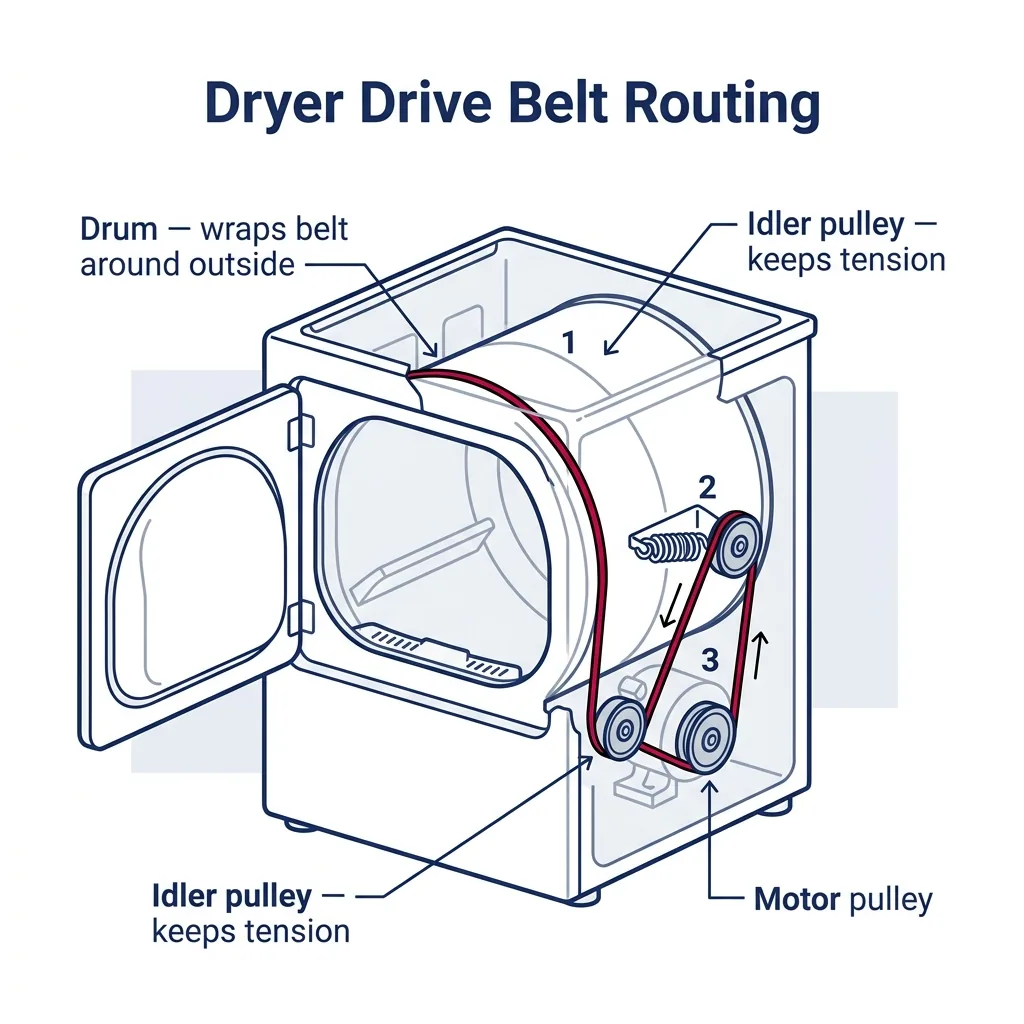
Take your new drive belt and slide it over the front of the drum. Position it so it rests approximately in the middle of the drum. You will usually see a faint wear mark or discoloration line on the drum where the old belt used to ride—use this as your alignment guide. Ensure the ribbed or grooved side of the belt is facing inward against the drum, while the smooth side faces outward. If the drum slipped off the rear support rollers when you removed the front panel, lift it slightly and push it back onto the rollers now.
⚠ Warning: Installing the belt inside-out (smooth side against the drum) will cause severe slipping, burning rubber smells, and poor tumbling.
Thread the Belt Through the Idler Pulley
This is the most challenging step, as it must often be done by feel. Reach underneath the drum with both hands. Locate the motor shaft pulley and the spring-loaded idler pulley next to it. Push or pull the idler pulley arm to release the spring tension. Loop the belt under the idler pulley wheel, and then stretch it over the grooved motor pulley. The belt should form a zig-zag shape. Once the belt is seated on the motor pulley, slowly release the idler arm so the spring applies tension to the belt, pulling it tight against the drum.
Tip: If you are struggling to visualize the zig-zag threading path, look for a belt routing diagram. It is often printed on a sticker attached to the back of the dryer's front panel or inside the cabinet.
Reassemble the Cabinet
With the belt tensioned, manually spin the drum counter-clockwise for two full rotations. This helps the belt align itself perfectly on the drum and ensures it isn't pinched or twisted. Lift the front panel back into place, seating it on the bottom clips first. Reconnect the door switch wire harness, then secure the front panel with its mounting screws. Lower the top panel and press down firmly on the front corners until you hear the spring clips snap back into place. Replace the lint filter if you removed it.
⚠ Warning: Forgetting to reconnect the door switch is the most common DIY mistake. If you forget, the dryer will remain completely dead when you try to start it.
Test the Dryer
Plug the dryer back into the wall outlet and turn the gas valve back on (if applicable). Open the door and ensure the drum is empty. Select a normal drying cycle and press start. The dryer should immediately begin tumbling with a smooth, consistent sound. Let it run for about two minutes to ensure the belt tracks correctly and there are no thumping or squealing noises. If everything sounds normal, your repair is complete.
Tip: If you hear a loud thump every second, the belt may have a twist in it. You will need to open the top panel, relieve the tension, and straighten the belt.
Brand-specific notes
Some brands have known design quirks worth knowing about before you start.
Whirlpool
On 29-inch Whirlpool and Maytag dryers (particularly those with the lint filter on the top panel), the belt threading is notoriously tricky. You'll need to reach under the drum completely blind to thread the idler pulley. Take a picture of the old setup if it's still intact before removing it.
Samsung
Samsung dryers often require removing the top control panel console before you can take off the front panel. Be very careful with the delicate ribbon cables connecting the user interface board to the main control—they tear easily and are expensive to replace.
LG
LG uses a very specific multi-ribbed belt. Make sure the grooved side is facing down against the drum. LG drums also rest heavily on the front bulkhead, so you might need to support the drum with your knee or a block of wood while threading the belt underneath.
GE
Older GE models have a unique setup where the front panel and sides are one continuous piece of sheet metal. This means you access the belt by removing the top and reaching down from above, or by pulling the entire drum out the front. Newer GE models follow standard front-panel removal.
Bosch
Bosch compact dryers (often found in LA condos and apartments) are tightly packed. Replacing the belt usually means taking the entire side panels off, not just the front. Given their complex European engineering and tight clearances, take plenty of photos during disassembly.
What our techs see most often
Here in Southern California, we see a huge spike in broken dryer belts during the winter months when families are washing heavier blankets and jeans. Overloading is the number one belt-killer we see out in the field—if you have to force the door shut, you're stressing that belt to its breaking point!
When to call a professional
- → You smell gas after reconnecting your gas dryer or feel unsure about the integrity of the flexible gas line.
- → The dryer is stacked in a tight laundry closet and cannot be safely unstacked without risk of injury or property damage.
- → You replace the belt, but the motor just hums loudly and trips the breaker (this indicates a seized motor, not just a belt issue).
- → The idler pulley bracket has sheared completely off the motor base plate, which requires welding or a full base replacement.
- → You are uncomfortable working blindly around sharp sheet metal to thread the motor pulley.
Related Dryer Troubleshooting
These troubleshooting guides cover problems this task can help solve.
Dryer Drum Not Spinning: Causes and Fixes
Dryer Making Loud Noises: Identify Squeaks, Thumps, and Grinding
Dryer Not Heating: How to Diagnose and Fix
Dryer Overheating and Stopping Mid-Cycle: How to Fix
Dryer Takes Too Long to Dry: Fix Guide
Frequently asked questions
How much does a replacement dryer belt cost?
OEM (Original Equipment Manufacturer) drive belts typically cost between $15 and $35. Generic aftermarket belts might be cheaper (around $10), but they tend to stretch and snap much faster under heavy loads. Always opt for the OEM belt for longevity.
How do I know if the belt is broken or if the motor is dead?
If you press start and hear the motor humming or running normally, but the drum isn't moving, the belt is likely broken. If you press start and hear absolutely nothing, or a loud buzzing followed immediately by a click, it's an electrical or motor issue.
Do I need to replace the idler pulley at the same time?
It's highly recommended. The idler pulley (usually a $15-$25 part) maintains tension on the belt. If the old pulley is stiff, squeaky, or has a worn bearing, the friction will burn through your brand new belt in a matter of weeks.
My new belt feels way too tight and won't reach the motor pulley. Did I buy the wrong one?
Dryer belts are meant to be under high tension. You have to push or pull the spring-loaded idler pulley quite far to get enough slack to loop the belt over the motor shaft. If it's still physically impossible after fully extending the idler arm, double-check your model number.
Which side of the belt goes against the drum?
The grooved or ribbed side of the belt should always face inward, gripping the drum. The smooth side faces outward. Installing it backward will result in severe slipping and a burning rubber smell.
Related Repair Guides
Dryer Drum Not Spinning: Causes and Fixes
When a dryer powers on, hums, or even heats up but the drum just sits there, the problem is almost always mechanical — a broken drive belt, a seized idler pulley, or a worn drum roller. The drive belt alone is responsible for over half the no-spin calls we run, and at $25 for the part it is one of the most cost-effective DIY repairs you will ever do.
Dryer Making Loud Noises: Identify Squeaks, Thumps, and Grinding
Is your dryer sounding like a freight train or a flock of angry birds? Learn how to identify the source of squeaks, thumps, and grinding noises, and fix the underlying issues like worn rollers or a bad idler pulley.
How to Clean a Dryer Exhaust Vent (Fire Prevention)
A clogged dryer vent is a major fire hazard and the number one reason your clothes take forever to dry. This step-by-step guide walks you through deep-cleaning your exhaust duct from the back of the dryer all the way to the exterior wall hood.