
At a glance
Symptoms
- • Drum spins normally but clothes stay cold and damp at the end of the cycle
- • Dryer runs for a full cycle but laundry is barely warmer than room temperature
- • You feel weak or no airflow at the exterior vent hood when the dryer is running
- • Burning, scorched, or hot-plastic smell during operation
- • Gas dryer cycles on but you never hear the burner whoosh-ignite
- • Lint builds up unusually fast in the lint screen, or the screen is hot to the touch
Common causes
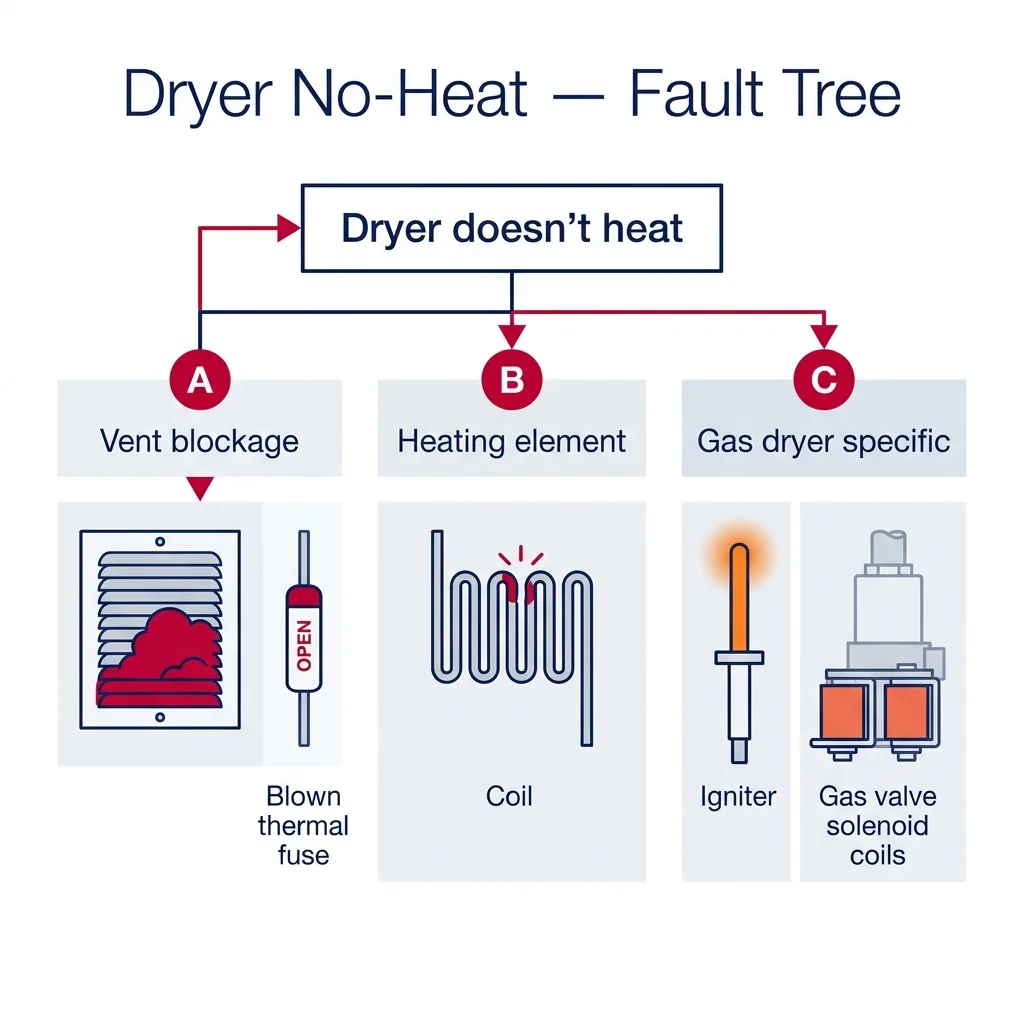
- • Clogged dryer vent restricting airflow and tripping the high-limit thermostat or thermal fuse
- • Blown thermal fuse — almost always a downstream symptom of a vent blockage, not a random failure
- • Failed heating element on electric dryers (open coil, sagging into the housing, or shorted to ground)
- • Bad igniter or gas-valve solenoid coils on gas dryers (igniter glows but valve never opens)
- • High-limit thermostat or cycling thermostat stuck open after an overheat event
- • Interrupted gas supply, closed shutoff valve, or empty propane tank on LP-converted dryers
- • Power-supply issue: only 120V instead of 240V reaching an electric dryer (one tripped breaker leg)
Safety First — Read Before You Start
- •ALWAYS unplug the dryer before removing any panel, and on hardwired models shut the breaker off and verify with a non-contact tester.
- •For gas dryers, close the gas shutoff valve at the wall before disconnecting any line near the burner assembly. After reconnecting, leak-test every joint with soapy water — never with an open flame.
- •Lint dust is highly flammable. Do not work near the burner assembly with a hot soldering iron, lit cigarette, or open flame, and vacuum lint out before any electrical testing.
- •A blown thermal fuse means the dryer overheated. Replacing it without clearing the vent will simply blow the new fuse, or worse, cause a fire next cycle. Always clean the vent first.
- •Heating elements and burner housings stay scalding hot for 20-30 minutes after a cycle. Let the unit cool before reaching inside.
Tools & supplies you'll need
- Phillips and flat-head screwdrivers
- 1/4-inch and 5/16-inch nut drivers or socket set
- Multimeter (continuity and 240V check)
- Vent-cleaning brush kit and shop vac (24-foot brush minimum)
- Flashlight
- Putty knife or trim tool to release the top panel clips
- Adjustable wrench (for gas-line shutoff and reconnection)
- Soap solution in a spray bottle for gas-leak test
Step-by-step instructions
Confirm the dryer actually has no heat (and check the basics)
Run a 5-minute timed-dry cycle on the highest heat setting with an empty drum. Place your hand at the exterior vent hood outside — you should feel strong, hot airflow within 60 seconds. Weak warm air or cool air confirms the heat problem. Also confirm the cycle selection is not Air Fluff or No Heat, that the lint screen is clean, and that the breaker has not half-tripped (electric dryers need both 120V legs of a 240V breaker — one leg tripped means the drum spins but no heat).
Tip: On electric dryers, use a multimeter at the outlet: measure 240V between the two hot legs and 120V between each hot and neutral. If you only get 120/0 between the hots, reset the breaker fully (push to OFF, then back to ON).
⚠ Warning: Never run a dryer with the lint screen removed — lint will bypass the trap and pack the blower housing.
Clean the entire vent run (the most important step)
Disconnect the flexible duct from the back of the dryer. Pull the dryer 2-3 feet from the wall. Vacuum out the lint trap housing and the cavity behind it — flashlight inside; you will likely be shocked by what you find. Then push a vent-cleaning brush all the way through the rigid duct to the exterior hood, rotating as you go. Outside, remove the hood cover and clear any bird nests, dryer-sheet film, or compacted lint at the flapper. Reconnect with a fresh foil-tape seal (never duct tape — it fails at high heat).
Tip: A properly working vent run should be no longer than 25 equivalent feet. Subtract 5 feet for every 90-degree elbow and 2.5 feet for every 45. If your run is longer, install a booster fan or move the dryer.
⚠ Warning: Never use plastic or vinyl flexible duct (the white ribbed kind). Code requires rigid metal or semi-rigid aluminum. Plastic duct is responsible for thousands of dryer fires every year.
Test the thermal fuse
The thermal fuse is a one-time safety device that blows when the blower housing exceeds about 196°F. On most dryers it sits on the side of the blower housing or the exhaust duct inside the cabinet, not on the heater itself. Unplug the unit, remove the back panel (or front panel on Whirlpool/Maytag designs), find the small white or beige cylindrical fuse with two wire leads, disconnect it, and test for continuity with a multimeter. Zero ohms = good. Open circuit (OL) = blown. A blown fuse is a $10-15 part. Replace it only AFTER you've cleared the vent.
Tip: Some dryers have two thermal devices on the housing — one is the resettable high-limit thermostat (round bi-metal, ~$15) and one is the thermal fuse (plastic-bodied one-shot, ~$10). Test both.
Diagnose an electric heating element
The element is a coiled nichrome wire inside a metal housing on the back or bottom of the cabinet. Unplug the dryer, remove the access panel, and disconnect both element terminals. Set your multimeter to ohms — a healthy element reads 8-30 ohms (model-dependent). Open circuit means a broken coil; replace the element ($40-90 part). Also touch one probe to the element terminal and the other to the metal housing — any continuity to ground means the coil is shorted and arcing, which is exactly what blew the thermal fuse. Inspect for visible breaks: a sagging loop touching the housing is the dead giveaway.
Tip: When you replace the element, also replace the high-limit thermostat mounted on the same housing ($15). It almost always weakens after the overheat event that killed the original element.
Diagnose a gas dryer (igniter, coils, flame sensor)
On gas dryers, watch the burner through the inspection port (or with the front panel removed and a mirror) while a helper starts a heat cycle. You should see: igniter glows bright orange for 10-30 seconds → gas valve opens → flame whooshes on. If the igniter glows and then goes dark with no flame, the gas-valve solenoid coils are bad (a $40-60 pair, easy swap). If the igniter never glows, test it for continuity — a healthy igniter reads 50-400 ohms; an open reading means a cracked carborundum element ($25-50). If neither glows nor opens but you have power at the gas valve, the radiant flame sensor on the burner tube has failed ($15).
⚠ Warning: Always close the gas shutoff valve before pulling the burner assembly. Cap the open gas line with a brass plug if you will be working more than 10 minutes.
Test the cycling thermostat and high-limit thermostat
If you have heat but it shuts off mid-cycle and never returns, suspect the cycling thermostat (the one that maintains drum temperature). It's a small bi-metal disc on the blower housing or exhaust duct. With the dryer cool, it should read continuity (closed). The high-limit thermostat (a separate disc, usually mounted directly on the heater housing) is a backup that opens around 250°F. Both are $15-25 parts. Replace as a pair if either tests bad — they are matched components and the second one is usually fatigued from the same overheat.
Tip: Run the dryer for 10 minutes after replacing thermostats and check exhaust temperature with an infrared thermometer at the vent hood — should be 130-160°F on high heat. Anything over 180°F at the hood means restricted airflow and you have a vent problem, not a parts problem.
Reassemble, leak-test (gas), and verify
Reinstall panels in reverse order, reconnect the vent with foil tape, and push the dryer back into place leaving at least 6 inches behind it. On gas units, open the shutoff valve and spray every joint with soapy water — bubbles indicate a leak. Run a full timed-dry cycle with a damp towel and confirm clothes come out hot and dry within 40-60 minutes. Check the exterior vent flapper opens fully when the dryer is running.
Tip: Mark your calendar to clean the full vent run every 12 months, lint screen after every load, and the lint-trap housing every 6 months. This single habit prevents 80% of the no-heat calls we get.
Brand-specific notes
Some brands have known design quirks worth knowing about before you start.
Whirlpool / Maytag (Duet, Cabrio, Bravos)
Whirlpool and Maytag share the same chassis on most modern dryers. The thermal fuse sits on the blower housing inside the cabinet — access from the front by removing the toe-kick and tilting the front panel down (two screws inside the lint chute). On gas Duets, the gas-valve solenoid coils (W10448876) fail predictably around year 8 and are a 15-minute swap.
LG (DLE/DLG and TrueSteam models)
LG dryers have a notoriously sensitive thermistor that throws a tE error before the unit will even attempt heat. On TrueSteam models, a clogged steam-water inlet screen can also block heat operation entirely — clean the screen behind the cold-water hose. LG's 10-year sealed-system warranty does NOT cover heating elements, but the inverter motor and compressor (heat-pump models) are usually covered.
Samsung (DV series)
Samsung DV series dryers commonly throw a heE or hE error when the heating element fails. The element ($60-90) and housing assembly are bolted together — replace as a unit. Samsung also uses a small ceramic thermistor next to the element that fails at the same time; replace both. The lint-trap housing on these traps lint deep behind the screen — vacuum it monthly or you will keep blowing thermal fuses.
GE Profile and GE front-load
GE dryers often use a different wiring scheme: the heating element is fed through a control board relay, so a "no heat" complaint can trace back to a stuck or fried relay on the main board, not the element itself. If your element tests good and thermostats are fine, listen for the relay click when heat is called — silence means board replacement (~$180) or board repair.
Electrolux / Frigidaire
Electrolux front-load dryers use a unique high-limit thermostat with a manual reset button on the back of the housing. Before replacing anything, push the small red button on the high-limit — if it clicks, you just fixed the dryer for free. This is the single most common Electrolux dryer call we close on the phone.
What our techs see most often
On LG and Samsung dryers in Southern California we see thermal fuse failures cluster in homes where laundry is stacked in tight upstairs closets — the vent runs are 30-40 equivalent feet through three or four elbows, and lint compacts at the second bend within 18 months. We bring two thermal fuses, a high-limit, and a vent brush kit to every LG no-heat call and finish 90% of them on the first visit. On Whirlpool gas dryers the gas-valve solenoid coils are the #1 part replaced — they fail at roughly 8 years like clockwork, regardless of vent condition.
When to call a professional
- → You smell gas at any point during diagnosis (close the shutoff valve, ventilate, and call the gas company first, then a tech)
- → The breaker trips repeatedly when the dryer is plugged in or when heat is called
- → You've replaced the thermal fuse and it blows again within one or two cycles (indicates a serious airflow or element-grounding issue)
- → The vent run is inside a wall or attic and you cannot fully access it for cleaning
- → You are not comfortable opening the gas valve assembly or doing a soap-bubble leak test
- → The dryer is a stacked combo unit (washer/dryer combo) where the heat-pump or condenser is integrated and not user-serviceable
Dryer Maintenance & Replacement Tasks
Step-by-step guides for individual maintenance jobs related to this appliance.
How to Clean a Dryer Exhaust Vent (Fire Prevention)
How to Deep-Clean a Dryer Lint Trap Housing (Beyond the Screen)
How to Replace a Dryer Drive Belt
How to Replace an Electric Dryer Heating Element
How to Replace a Dryer Thermal Fuse
Frequently asked questions
Why does my dryer get hot at first and then stop heating mid-cycle?
Classic symptom of restricted airflow. The cycling thermostat is doing its job — shutting off heat when the drum overheats — but the high-limit is on the edge of tripping. Clean the full vent run end-to-end before doing anything else. If the problem persists after a thorough vent cleaning, replace both the cycling and high-limit thermostats as a pair.
My electric dryer drum spins but produces no heat. Could it be the breaker?
Yes, this is one of the most common causes. Electric dryers need 240V (both legs of a double-pole breaker). If only one leg trips, the motor still gets 120V and the drum spins, but the heating element gets nothing. Reset the breaker fully (push firmly to OFF, then back to ON) and try again before tearing the dryer apart.
How much does it cost to fix a dryer that is not heating?
DIY part costs: thermal fuse $10-15, heating element $40-90, igniter $25-50, gas-valve coils $40-60. Professional repairs typically run $180-350 including parts and labor. At Axis we charge a $90 diagnostic fee that applies toward the repair, and 70% of no-heat calls finish in a single visit.
Is a clogged dryer vent really a fire hazard?
Yes — the U.S. Fire Administration attributes around 2,900 home fires every year to dryers, and lint accumulation in the vent and lint-trap housing is the leading cause. Clean the screen after every load, and clean the full vent run from the dryer to the exterior hood at least once a year. If you cannot remember the last time it was cleaned, do it before your next load.
Can I convert my natural-gas dryer to LP propane myself?
Most gas dryers ship with an LP conversion kit in the parts bag, and the procedure is documented in the manual. That said, we strongly recommend a licensed pro. An incorrect conversion can cause incomplete combustion (carbon monoxide) or a delayed-ignition flash. The labor cost is small compared to the safety cost of getting it wrong.
Related Repair Guides
Dryer Takes Too Long to Dry: Fix Guide
When your dryer technically works but a single load takes two or three cycles to come out dry, you are not dealing with a broken part — you are dealing with restricted airflow. Lint, kinked vents, and a dirty moisture sensor are responsible for the vast majority of slow-drying complaints, and almost all of them are 30-minute fixes with no parts at all.
Dryer Drum Not Spinning: Causes and Fixes
When a dryer powers on, hums, or even heats up but the drum just sits there, the problem is almost always mechanical — a broken drive belt, a seized idler pulley, or a worn drum roller. The drive belt alone is responsible for over half the no-spin calls we run, and at $25 for the part it is one of the most cost-effective DIY repairs you will ever do.
How to Clean a Dryer Exhaust Vent (Fire Prevention)
A clogged dryer vent is a major fire hazard and the number one reason your clothes take forever to dry. This step-by-step guide walks you through deep-cleaning your exhaust duct from the back of the dryer all the way to the exterior wall hood.