
At a glance
Symptoms
- • Dryer turns on and tumbles but produces absolutely no heat (common in electric dryers)
- • Dryer is completely dead and won't start when you press the button (common in gas dryers and some electric models)
- • You've tested the heating element and thermostats, and they have continuity, but the dryer still fails to heat
- • The dryer shut off mid-cycle and now refuses to power back on
- • You recently noticed the dryer getting exceptionally hot on top before it stopped working entirely
Common causes
- • The thermal fuse is a one-time use safety device designed to break electrical continuity to prevent dryer fires
- • Clogged dryer vents (especially long runs in hillside California homes) cause severe heat buildup, tripping the fuse
- • Coastal humidity can cause lint to clump and stick to the exhaust duct, restricting airflow over time
- • A failed cycling thermostat can cause runaway heating, blowing the thermal fuse as a backup safety measure
- • Replacing the fuse without addressing the underlying airflow restriction guarantees the new fuse will blow immediately
Safety First — Read Before You Start
- •ELECTRICAL SHOCK HAZARD: Always unplug the dryer completely from the wall outlet before removing any panels.
- •FIRE HAZARD: Never bypass a blown thermal fuse to run the dryer. This safety device is the last line of defense against a house fire.
- •GAS HAZARD: If you have a gas dryer, be extremely careful not to stress, pull, or kink the flexible yellow gas supply line when moving the unit.
- •SHARP EDGES: The stamped metal inside a dryer cabinet is razor-sharp. Wear protective gloves when reaching inside the chassis.
Tools & supplies you'll need
- Digital Multimeter (for continuity testing)
- 1/4-inch and 5/16-inch nut drivers or socket set
- Phillips and flathead screwdrivers
- Putty knife (for popping top panels on some front-load models)
- Work gloves (dryer internals have sharp sheet metal edges)
- Dryer vent cleaning brush kit or shop vac
Step-by-step instructions
Disconnect Power and Gas
Safety is always the first step. Unplug the dryer's power cord from the wall receptacle. If you are working on a gas dryer, locate the gas shut-off valve on the supply line behind the dryer and turn the handle perpendicular to the pipe to shut off the gas flow. Carefully pull the dryer away from the wall, being mindful not to stretch or kink the flexible gas line or crush the exhaust vent.
⚠ Warning: Never attempt to work on a dryer while it is plugged in. Even if the dryer appears 'dead,' 240V (electric) or 120V (gas) power is still present at the terminal block.
Access the Internal Components
Depending on your dryer's brand and style, you will need to access either the rear or the front of the machine. For classic Whirlpool, Kenmore, and Maytag top-lint-filter models, remove the screws securing the rear metal panel using a 1/4-inch nut driver. For front-loading style LG, Samsung, and GE dryers, you typically need to remove the top panel (usually two screws at the back, then slide back and lift), remove the control console, and take off the front panel to access the heating and blower components.
Tip: Keep a magnetic parts tray or a few small cups handy to organize the screws. Dryers use a mix of machine screws and sheet metal screws that should not be mixed up.
Locate the Thermal Fuse
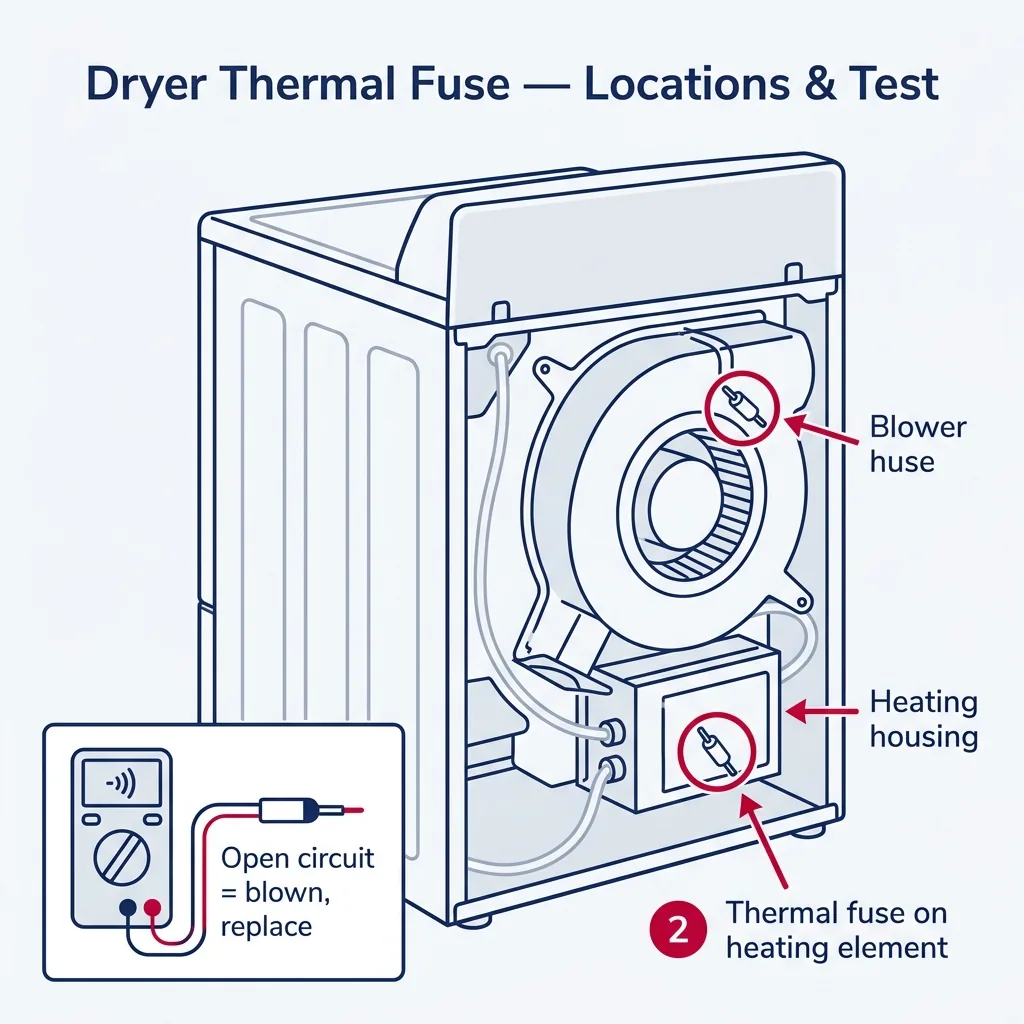
The thermal fuse is almost always located on the blower wheel housing or directly on the heating element assembly (or burner funnel for gas dryers). It is typically a small, white plastic or silver metal component, about an inch long, with two wire terminals protruding from it. You will often see it mounted right next to the cycling thermostat or high-limit thermostat.
Tip: Take a clear photo of the fuse and the wires connected to it before you disconnect anything. This ensures you plug the wires back into the correct terminals later.
Test the Thermal Fuse for Continuity
Set your digital multimeter to the lowest ohms setting (Rx1) or the continuity setting (the icon that looks like a Wi-Fi symbol or sound wave). Gently pull the two wire connectors off the thermal fuse's spade terminals. Touch one multimeter probe to each terminal on the fuse. If the multimeter beeps or reads near zero ohms (0.00 to 1.0), the fuse is good. If it does not beep and reads 'OL' (Open Loop) or infinite resistance, the fuse has blown and must be replaced.
⚠ Warning: You must remove at least one wire from the fuse before testing. Testing the fuse with the wires attached can give a false reading by measuring the rest of the dryer's circuit.
Install the New Thermal Fuse
Use your nut driver to remove the single screw holding the blown thermal fuse in place. Slide the old fuse out of its mounting slot. Take your replacement fuse (which usually costs between $10 and $25) and insert the tab into the slot, then secure it with the mounting screw. Reattach the two wire connectors to the spade terminals. Ensure the connections are tight; if the female spade connectors on the wires feel loose, gently crimp them with pliers so they grip the fuse terminals snugly.
Tip: Always use an OEM (Original Equipment Manufacturer) replacement part. Cheap aftermarket fuses are notorious for blowing prematurely or, worse, failing to blow when they should.
CRITICAL: Clean the Dryer Exhaust Vent
Do not skip this step. A thermal fuse rarely fails on its own; it blows because the dryer overheated due to restricted airflow. Disconnect the flexible transition duct from the back of the dryer and the wall. Use a dryer vent cleaning brush kit attached to a power drill, or a high-powered shop vac, to thoroughly clean the ductwork running from your laundry room to the outside of your house. Check the exterior vent hood to ensure the flapper opens freely and isn't clogged with lint.
⚠ Warning: If you replace the thermal fuse but leave a clogged vent in the wall, the brand new fuse will likely blow within the first 1-2 loads of laundry.
Reassemble and Test the Dryer
Once the vent is clear and the new fuse is installed, reassemble the dryer's panels in the reverse order you removed them. Reconnect the exhaust vent, turn the gas valve back on (if applicable), and plug the dryer in. Run the dryer on a high-heat timed dry cycle for about 5 minutes with no clothes inside. Verify that the drum turns and that the exhaust air blowing outside is hot.
Brand-specific notes
Some brands have known design quirks worth knowing about before you start.
Whirlpool, Maytag & Kenmore
In the classic 29-inch wide models (lint filter on top), the thermal fuse is incredibly easy to reach by removing the rear panel. It's a small white plastic rectangle on the blower housing. These are the most DIY-friendly dryers on the market.
LG
Accessing the fuse usually requires taking off the top panel, control board, and front panel to reach the blower housing at the bottom front. LG electric dryers often have a resettable thermostat on the heater box, but the primary thermal fuse on the blower is a one-shot device that must be replaced.
Samsung
Similar to LG, you're going in from the front. Samsung thermal fuses are often mounted directly on the side of the heating element housing on the right side of the cabinet. Be careful with the drum belt and tensioner pulley when removing and reinstalling the front panel and drum.
GE
On newer GE models, you might find the thermal fuse on the heater assembly in the rear. Watch out for the sharp edges on GE cabinets—they are notorious for slicing fingers if you aren't wearing work gloves.
Bosch
Compact European dryers often have the thermal fuse integrated into the heating element assembly at the rear. You will need a set of Torx (T20) screwdrivers, rather than standard hex nut drivers, to access Bosch components.
What our techs see most often
Here in LA and Orange County, we see blown thermal fuses constantly in hillside homes and condos where the dryer vent runs 20+ feet vertically to the roof. Customers often replace the $15 fuse themselves, skip cleaning the vent, and call us a week later when the new fuse blows because the trapped lint is still baking the machine.
When to call a professional
- → If you smell gas at any point during the repair process or cannot confidently reconnect the gas line.
- → If your dryer vent runs vertically into a wall or roof and you cannot verify that it is completely clear of lint.
- → If you've replaced the thermal fuse and it blows again immediately, which indicates a deeper airflow restriction or a shorted heating element.
- → If the wiring harness connecting to the thermal fuse looks melted, scorched, or the insulation is brittle.
- → If you cannot safely move the dryer out of its tight closet or alcove without straining the gas line or electrical cord.
Related Dryer Troubleshooting
These troubleshooting guides cover problems this task can help solve.
Dryer Drum Not Spinning: Causes and Fixes
Dryer Making Loud Noises: Identify Squeaks, Thumps, and Grinding
Dryer Not Heating: How to Diagnose and Fix
Dryer Overheating and Stopping Mid-Cycle: How to Fix
Dryer Takes Too Long to Dry: Fix Guide
Frequently asked questions
How much does a thermal fuse cost to replace?
The part itself is very inexpensive, usually ranging from $10 to $25 depending on the brand. If you hire a professional, expect to pay between $150 and $250 total for the part, labor, and a proper diagnostic to ensure the vent isn't the root cause.
Can I just bypass the thermal fuse temporarily to dry my clothes?
Absolutely not. Bypassing the thermal fuse removes the primary safety mechanism preventing the dryer from catching fire. Never run the dryer with a bypassed fuse, even for a single load. It is a severe fire hazard.
Why did my thermal fuse blow in the first place?
In about 95% of cases, a blown thermal fuse is caused by restricted airflow due to a clogged dryer vent. Coastal California humidity can make lint sticky, building up faster in the ductwork and trapping dangerous heat inside the machine.
Do I need to replace the thermostat when replacing the fuse?
Not necessarily, but many manufacturers sell the thermal fuse and cycling thermostat together as a $30-$45 kit. If your vent is completely clean and the fuse still blew, a faulty cycling thermostat that failed in the 'closed' position might be causing runaway heating.
How do I know if the fuse is blown without a multimeter?
You can't safely or accurately know without one. A blown thermal fuse looks identical to a working one; there is no visual indicator. A basic digital multimeter costs about $15-$20 at any hardware store and is essential for confirming the fuse lacks electrical continuity.
Related Repair Guides
Dryer Not Heating: How to Diagnose and Fix
A dryer that tumbles but produces no heat is almost always one of three problems: a clogged exhaust vent, a blown thermal fuse, or a failed heating element (electric) or igniter (gas). The vent is the most common cause and the most dangerous to ignore — restricted airflow is the #1 trigger for dryer fires in U.S. homes.
Dryer Overheating and Stopping Mid-Cycle: How to Fix
An overheating dryer is more than just a nuisance—it is a serious fire hazard. If your dryer gets blazing hot to the touch and shuts off mid-cycle, here is how to find the airflow blockage or faulty thermostat causing the issue.
Dryer Won't Start: How to Diagnose and Fix
A dead dryer doesn't always mean a dead appliance. Walk through our step-by-step diagnostic guide to find out if it's a simple power issue, a faulty door switch, or a blown thermal fuse.