
At a glance
Symptoms
- • The dryer tumbles normally but produces absolutely no heat.
- • Clothes take multiple cycles to dry completely, coming out damp.
- • The dryer cabinet feels completely cold to the touch during operation.
- • Visual inspection shows a broken, charred, or separated coil on the element assembly.
- • A multimeter continuity test on the element terminals reads 'OL' (Open Loop) or infinite resistance.
Common causes
- • Restricted airflow from clogged vents (very common in older California hillside homes with long vent runs) causes the element to overheat and burn out.
- • Normal wear and tear over 5-10 years of expanding and contracting thermal cycles.
- • Power surges or frequent voltage fluctuations degrading the coil wire.
- • Running the dryer constantly with oversized loads, which traps heat inside the drum area.
- • Failure of the cycling thermostat or thermal cutoff, causing runaway heating that melts the element wire.
Safety First — Read Before You Start
- •Always completely unplug the dryer from the 240V wall outlet before starting. 240 volts is lethal.
- •Never bypass a blown thermal fuse or high-limit thermostat to make the element work; this is a severe fire hazard.
- •Wear thick work gloves when reaching into the dryer cabinet; interior sheet metal edges will easily slice your hands.
- •If you have a gas dryer, stop immediately. This guide is for electric dryers only. Gas burner assemblies require professional handling.
Tools & supplies you'll need
- Digital Multimeter (capable of measuring resistance/Ohms)
- 1/4-inch and 5/16-inch nut drivers or socket set
- Phillips and flathead screwdrivers
- Work gloves (stamped dryer cabinet edges are notoriously sharp)
- Needle-nose pliers
- Shop-vac or vacuum with a hose attachment (for lint removal)
Step-by-step instructions
Disconnect Power and Prep the Area
Start by unplugging the massive 240V power cord from the wall. Never skip this step. Pull the dryer away from the wall so you have room to work. In tight California garage setups or condo closets, you might need to completely disconnect the flexible vent hose from the back to get enough clearance.
Tip: Take a photo of how the vent hose is routed before you disconnect it, so you can avoid kinks when pushing the dryer back later.
Access the Heating Element Housing
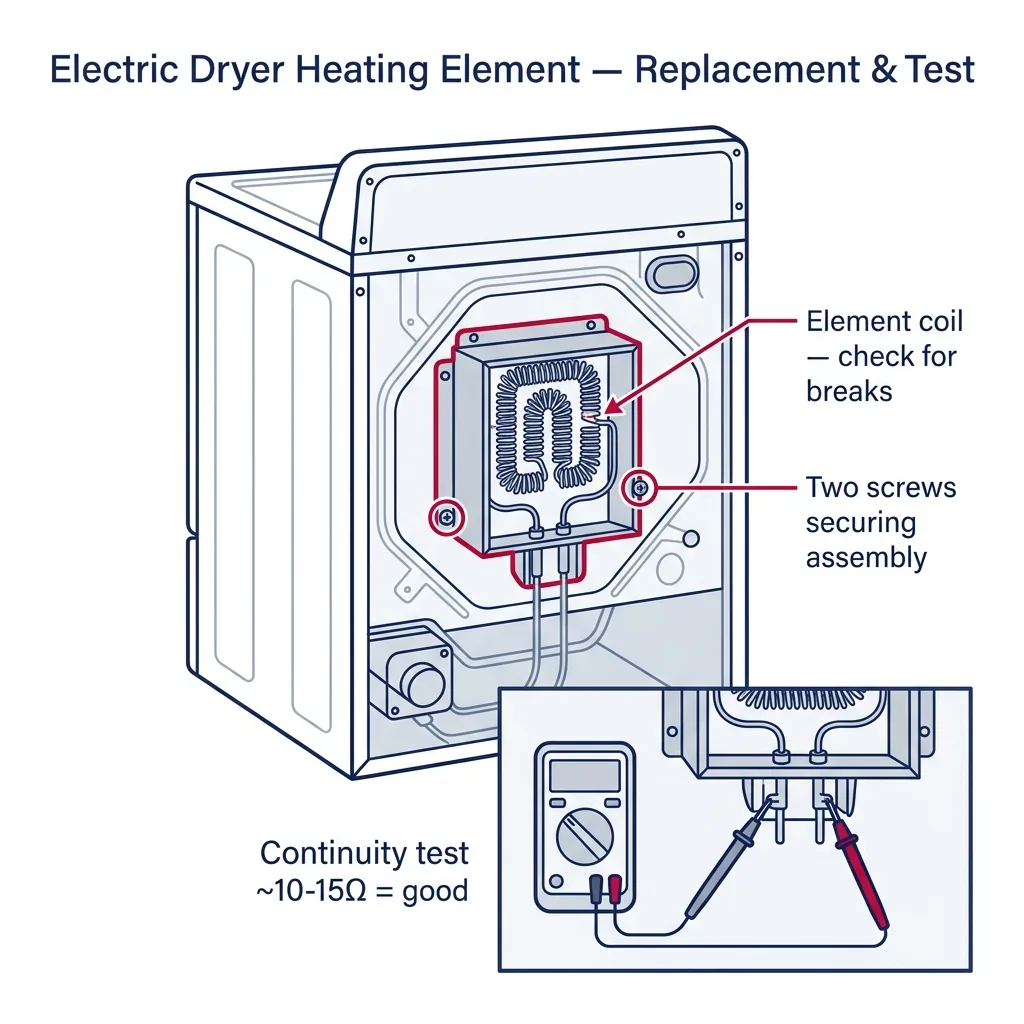
The access method depends entirely on your brand. For classic Whirlpool/Maytag models, remove the 1/4-inch hex screws holding the rear panel in place to expose the right-side heater box. For Samsung, LG, and many GE front-loaders, you will need to remove the top panel, unscrew the control console, and remove the entire front panel (and sometimes the bulkhead) to reach the element tube located at the bottom right or rear.
⚠ Warning: Keep track of your screws! Place them in labeled cups or on a magnetic tray, as front-panel screws often differ slightly in length from top-panel screws.
Test the Old Element with a Multimeter
Before removing the part, confirm it's actually dead. Set your digital multimeter to the lowest Ohms (resistance) setting or the continuity beep setting. Remove the wires from the two terminals on the heating element. Touch one probe to each terminal. A good element will read between 10 and 50 Ohms. If the meter reads 'OL', '1', or does not beep, the internal coil is broken and must be replaced.
Remove the Heating Element Assembly
Take a clear picture of the wire connections. Using needle-nose pliers, gently pull the wire spade connectors off the element and thermostat terminals by gripping the metal connector, not the wire itself. Remove the mounting screws (usually 1/4-inch or 5/16-inch) holding the metal heater housing to the chassis. Carefully pull the entire assembly out of the dryer.
Tip: While the assembly is out, use your Shop-Vac to clean all the accumulated lint out of the dryer cabinet and the blower wheel housing. This is crucial for fire prevention.
Transfer Thermostats and Install the New Element
Examine your new heating element. If you bought a bare coil, you'll need to carefully string it through the ceramic insulators of the old housing (we recommend buying the pre-strung assembly to avoid hot spots). Transfer the high-limit thermostat and thermal cut-off from the old housing to the new one if they weren't included. Slide the new assembly back into the dryer chassis and secure it with the mounting screws.
Reconnect Wires and Reassemble the Cabinet
Refer to the photo you took earlier and push the wire connectors firmly onto the new element's terminals. They must be tight; loose connections will cause electrical arcing and burn the wires. Once wired, reassemble the dryer panels in the reverse order you removed them. Double-check that the door switch is reconnected if you removed the front panel.
Test Run and Vent Check
Reconnect the exhaust vent, plug the dryer back into the 240V outlet, and push it back into place. Turn the dryer on to a timed 'High Heat' setting and let it run for 3-5 minutes. Open the door and feel inside—it should be nice and hot. Finally, go outside and check your exterior vent cap to ensure strong airflow is pushing out.
⚠ Warning: If the exterior vent flap isn't opening fully, your wall vent is clogged. You must clean it, or your brand new heating element will burn out again within weeks.
Brand-specific notes
Some brands have known design quirks worth knowing about before you start.
Whirlpool & Maytag
The classic 29-inch wide Whirlpool-built dryers have the easiest element to replace. Just remove the back panel (about 10-15 1/4-inch hex screws), and the tall, silver heater box is right there on the right side. OEM elements usually run $45-$65.
Samsung
To get to the element on most front-load matching Samsung dryers (like the DV42H series), you have to take off the top, the control board, the front panel, and often the front bulkhead. The element sits in a long tube on the bottom right. Watch out for sharp edges on the drum rollers when reaching in!
LG
Similar to Samsung, LG requires a full front teardown. Their elements are often sold as a complete heater assembly tube containing the element and thermostats, costing around $80-$130. Don't buy cheap aftermarket coils online; they tend to sag when hot and short against the metal housing within months.
GE
Many GE models have the element located behind the drum. You'll need to remove the top and front panels, and sometimes lift the drum out entirely to access the heater pan at the rear. GE OEM coils can be re-strung into the old pan, but buying the whole pan assembly saves an hour of frustrating, tedious work.
Electrolux & Frigidaire
These often use a dual-element system or a large circular heater located behind the rear bulkhead. They require removing the top, front, and drum. Make sure to check the thermal limiter mounted on the heater housing, as it almost always blows out at the exact same time the element shorts.
What our techs see most often
We see blown heating elements constantly here in Southern California, and 80% of the time, the root cause is an exhaust vent packed with lint. If your dryer is stuffed into a tight condo closet in Irvine or a dusty garage in the Valley, that element is going to overheat and snap if it can't breathe properly.
When to call a professional
- → If you have a gas dryer (never attempt to DIY gas valves, igniters, or burner tubes).
- → If your multimeter shows the heating element still has continuity, meaning the no-heat issue is likely a failed control board, timer, or motor centrifugal switch.
- → If the wiring harness connecting to the element is melted, charred, or fused to the terminal.
- → If you are uncomfortable moving a heavy appliance or working around 240V high-voltage electrical systems.
- → If your dryer is stacked on top of a washer in a tight closet and you cannot safely dismount the top unit yourself.
Related Dryer Troubleshooting
These troubleshooting guides cover problems this task can help solve.
Dryer Drum Not Spinning: Causes and Fixes
Dryer Making Loud Noises: Identify Squeaks, Thumps, and Grinding
Dryer Not Heating: How to Diagnose and Fix
Dryer Overheating and Stopping Mid-Cycle: How to Fix
Dryer Takes Too Long to Dry: Fix Guide
Frequently asked questions
How much does it cost to replace a dryer heating element?
If you DIY, the part costs between $30 and $150 depending on if you buy just the bare wire coil or the full OEM metal assembly. Hiring a professional typically costs $180 to $350 including parts, labor, and a warranty.
Can I just buy the coiled wire and re-string it myself?
Yes, re-stringing a bare coil is cheaper (often under $25), but we highly recommend buying the complete pre-strung assembly. Stretching the coil unevenly by hand creates 'hot spots' that will cause the wire to burn out again in a few weeks.
Why did my new heating element burn out after only a month?
The number one cause of premature element failure is poor airflow. If your house vent is clogged with lint, the heat cannot escape, tripping safety limits and eventually melting the new element wire. Always clean your wall vents when replacing an element!
Should I replace the thermostats while I'm replacing the element?
It's a very good idea. Many manufacturers sell a 'heater kit' that includes the element, high-limit thermostat, and thermal cut-off fuse for around $60-$90. Since a restricted vent often damages all three components, replacing them together ensures a reliable, long-lasting repair.
Related Repair Guides
Dryer Not Heating: How to Diagnose and Fix
A dryer that tumbles but produces no heat is almost always one of three problems: a clogged exhaust vent, a blown thermal fuse, or a failed heating element (electric) or igniter (gas). The vent is the most common cause and the most dangerous to ignore — restricted airflow is the #1 trigger for dryer fires in U.S. homes.
Dryer Takes Too Long to Dry: Fix Guide
When your dryer technically works but a single load takes two or three cycles to come out dry, you are not dealing with a broken part — you are dealing with restricted airflow. Lint, kinked vents, and a dirty moisture sensor are responsible for the vast majority of slow-drying complaints, and almost all of them are 30-minute fixes with no parts at all.
How to Clean a Dryer Exhaust Vent (Fire Prevention)
A clogged dryer vent is a major fire hazard and the number one reason your clothes take forever to dry. This step-by-step guide walks you through deep-cleaning your exhaust duct from the back of the dryer all the way to the exterior wall hood.