
At a glance
Symptoms
- • Fan does not turn on at any speed setting
- • Lights work normally but fan stays silent
- • Fan hums but does not spin (or spins very slowly)
- • Fan starts but stops after a few seconds
- • Burnt-electronics smell from the hood
- • Single speed works but other speeds do not
- • Breaker trips when the fan is switched on
Common causes
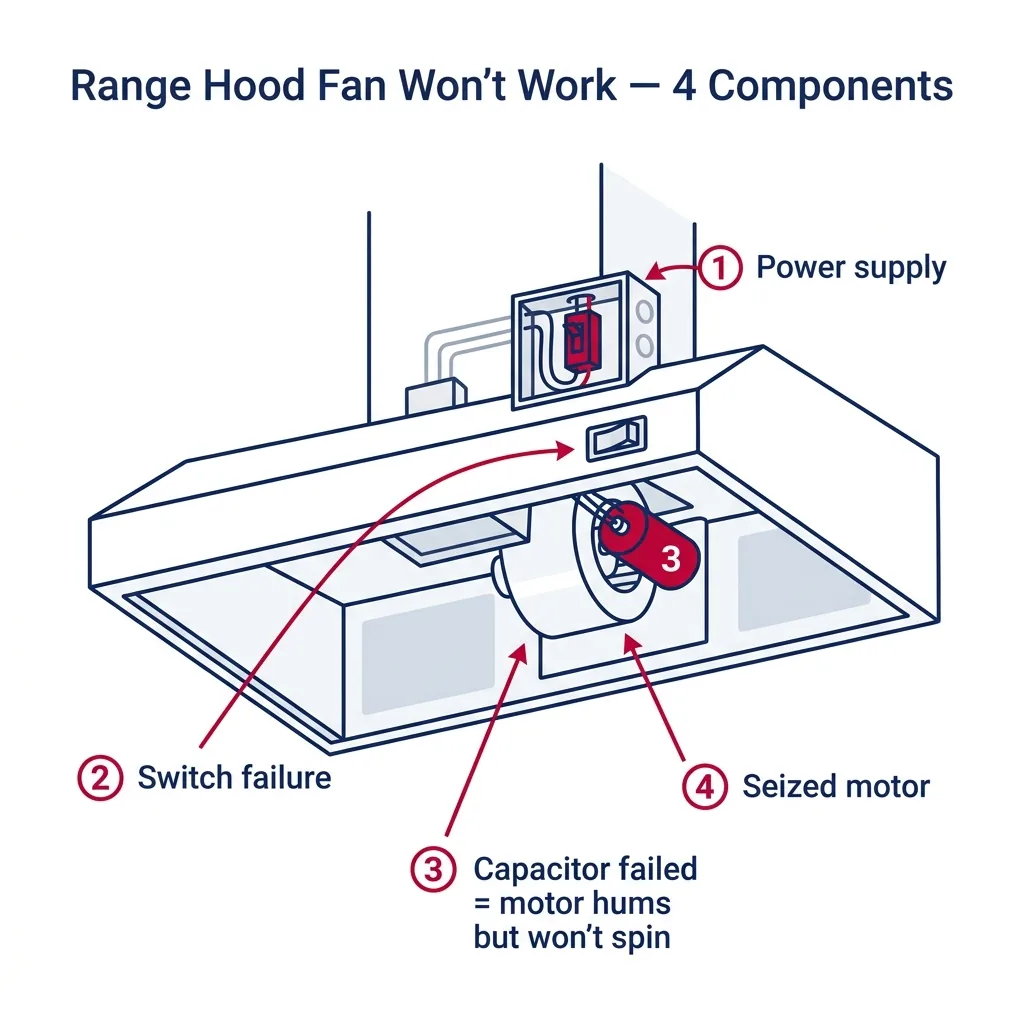
- • Tripped breaker or blown in-line fuse on the hood circuit
- • Failed control switch (mechanical rocker / push-button)
- • Failed run capacitor on single-speed motors
- • Seized fan motor (bearings or windings failed)
- • Loose or burned wiring at the motor or switch
- • Failed control board on electronic-touch hoods
- • Internal thermal cutout has tripped (overheated motor)
- • Damper or fan blade physically jammed by grease buildup
Safety First — Read Before You Start
- •Turn off the breaker for the hood before any internal work. Do not rely on the hood switch — that only breaks the motor circuit, not necessarily all internal wiring.
- •Confirm power is off with a non-contact voltage tester before touching wires.
- •Capacitors store energy even with power off — discharge across the terminals with an insulated screwdriver before testing or removing.
- •Allow the hood to cool fully before working on it. The motor housing can stay warm long after the fan stops.
- •Some hoods are hardwired (not plugged in). Treat these the same as ceiling fixtures — breaker off, voltage verified, then work.
- •Never run the hood with grease filters removed for more than a brief test. The motor depends on filtered intake to avoid grease loading.
Tools & supplies you'll need
- Phillips and flat-head screwdrivers
- Multimeter
- Non-contact voltage tester
- Wire nuts (for any reconnections)
- Replacement capacitor / switch / motor as identified
- Camera or phone (to photograph wiring)
- Ladder
- Flashlight
Step-by-step instructions
Verify power and check the breaker
Confirm the lights still work — they tell you the hood has at least some power. If the lights are also out, this is a different problem (loss of all power) and starts at the breaker. With lights working, flip the breaker for the kitchen / hood circuit off and on once to reset any soft trip. Some hoods have an in-line fuse on the wiring, usually inside the hood near the connection block. With the breaker off, open the hood's electrical compartment and check this fuse with a multimeter. Replace if blown.
Tip: On hoods with electronic touch-controls, a brief power outage or surge can put the control board into a fault state. Cycling the breaker for 30 seconds resets most boards.
Test the control switch
On hoods with mechanical rocker or push-button switches, the switch is the most common failure. With the breaker off, remove the bottom panel or filter to access the switch wiring. Take a photo before disconnecting anything — wires must go back exactly. Set the multimeter to continuity, and test the switch in each position. The switch should make a continuous circuit between common and the corresponding speed terminal as you press each button. A switch that fails any continuity test is the problem. Replacements run $15-40 and are model-specific; match the part number.
⚠ Warning: Switches on hoods carry the full motor current. Do not substitute a low-amp switch — confirm the new switch is rated for the same amperage as the original.
Test the run capacitor (single-speed motors)
Many single-speed range hood motors have a run capacitor — a small cylindrical or rectangular component near the motor wiring. Symptoms of capacitor failure: fan hums but does not start, fan spins slowly, fan needs a hand-spin to start. With the breaker off, discharge the capacitor by shorting its terminals with an insulated screwdriver. Test with the multimeter on capacitance setting. The reading should match the rating printed on the capacitor (typically 2-5 microfarads) within 10%. A capacitor reading well below or in open circuit is failed. Replacement is $5-15 and is a 2-wire swap.
Tip: Even a healthy-looking capacitor can be bad — always test with a meter, do not judge by appearance.
Inspect for jammed blades or seized motor
Remove the grease filters and shine a flashlight up at the fan blade. Try to spin it gently by hand. The blade should turn freely with a small amount of inertia. If the blade is jammed by grease buildup or food debris, clean the area thoroughly with degreaser. If the blade turns but feels gritty or notchy, the motor bearings are failing — the motor will need replacement. If the blade does not turn at all even with firm pressure, the motor is seized.
⚠ Warning: Do not force a stuck fan blade. If grease has hardened into the bearings, forcing the blade can break it. Clean with degreaser and let the cleaner penetrate before trying again.
Test the motor windings
With the breaker off and the wiring photographed, disconnect the motor leads at the connection block. Set the multimeter to ohms. Test resistance between each pair of motor leads. Most single-speed motors have two leads and read 5-30 ohms across them. Multi-speed motors have 3-4 leads with different readings between each pair (consult the wiring diagram on the motor or hood). Open circuit on any pair indicates a burned winding — the motor needs replacement. Also check from each lead to the motor body — should read infinite (no continuity). Continuity to chassis means a shorted motor.
Tip: A burned motor often has a distinct smell that lingers in the hood. If you smell that and the motor reads open, the diagnosis is confirmed.
Replace the motor
Motors on most range hoods are accessed by removing the bottom panel and the fan housing (typically 4-8 screws). Disconnect wiring (photo it first), remove mounting screws, and pull the motor with the blade attached. Transfer the blade to the new motor — note rotation direction and blade orientation. Reinstall, reconnect wiring, and test before closing up. Replacement motors run $50-150 depending on hood. Brand-specific motors are usually direct fit; generic universal motors require careful matching of voltage, RPM, and rotation.
⚠ Warning: When transferring the fan blade, do not over-tighten the set screw. The blade hub is usually plastic or thin metal and will deform. Snug-plus-quarter-turn is correct.
Check the control board (electronic-touch hoods)
Hoods with touch-pad controls have a small control board that interprets button presses and switches the motor. If the board has failed, fan controls are unresponsive but lights may continue to work (they are often on a separate sub-circuit). Look for visible burn marks on the board, swollen capacitors, or a burnt smell. Replacement boards run $80-200 and are accessible from behind the control panel on most models. This is usually the last suspect in the diagnostic order — most other components are cheaper and easier to test first.
Reassemble and verify
Restore the breaker and test the hood at all speeds. The fan should start promptly, run smoothly, and change speed audibly when you switch settings. Test the lights as well to confirm nothing else got disturbed during the repair. If everything works, replace the grease filters and run the hood for 5-10 minutes to confirm sustained operation. If the fan still does not work after replacing the suspect component, you missed an upstream component or there is a wiring issue — re-trace the diagnostic steps.
Brand-specific notes
Some brands have known design quirks worth knowing about before you start.
Broan / NuTone
Broan and NuTone hoods are the most-installed builder-grade hoods in North America. Their rocker switches are a frequent failure on hoods 8-12 years old — a $20 universal switch fits most QS, F40000, and 30-inch under-cabinet models. The fan motors themselves last 15-20 years if filters are kept clean.
Vent-A-Hood
Vent-A-Hood uses dual-blower designs with separate motors. If only one side is silent, that side's motor or capacitor is the issue, not a system-wide problem. Their motors are higher-end and run $150-300 to replace, but the modular design makes the swap straightforward.
Zephyr
Zephyr's electronic-touch models (Tornado, Tempest, Roma) have a control board that fails before the motor on units 6-8 years old. Symptoms: touch panel unresponsive, fan stays off, lights may still work. The board is $100-200 and accessed from behind the bottom panel.
Bosch
Bosch range hoods use European-spec motors that are reliable but harder to source. If a Bosch motor fails, the part is brand-specific and may be back-ordered. Bosch's electronic controls are robust — the more common failure on Bosch hoods is the touch panel itself rather than the underlying control board.
GE / Whirlpool
GE and Whirlpool over-the-range microwaves serve double duty as range hoods. If the fan in one of these stops working, the diagnosis is part-microwave-repair, part-hood-repair — the fan motor and control share components with the microwave's main system. These typically warrant a tech rather than DIY because of the high-voltage microwave components nearby.
What our techs see most often
Range hood fan-not-working calls split roughly: 30% control switches (especially on hoods 5-10 years old), 25% capacitor failures on single-speed motors, 25% seized motors from grease buildup or age, 15% control boards on electronic models, and the rest are wiring or breaker. We always carry universal capacitors and the most common Broan switches on the truck — those two parts cover about half of the calls in a single visit.
When to call a professional
- → Breaker trips repeatedly when the hood is switched on — indicates a short, do not keep resetting
- → You smell burning plastic or see scorched wiring
- → You replaced the motor and capacitor and the fan still does not run
- → The hood is integrated with a microwave (over-the-range microwave) and the issue traces to shared components
- → The hood is a high-end built-in (Wolf, Thermador, Miele) where DIY motor work voids warranty
- → You are not comfortable working with mains wiring inside an overhead fixture
- → The hood is over a high-output gas range — incorrect repair on these critical units affects kitchen ventilation safety
Range Hood Maintenance & Replacement Tasks
Step-by-step guides for individual maintenance jobs related to this appliance.
Frequently asked questions
My range hood lights work but the fan does not — where do I start?
Working lights confirm the hood has power, so the issue is in the fan circuit specifically. Start with the easiest test: check the control switch with a multimeter. If the switch tests good, check the run capacitor (single-speed motors) or the control board (electronic models). The motor itself is the last suspect because it is the most expensive component to replace.
Is it worth replacing a range hood motor or just buying a new hood?
A motor replacement on a builder-grade Broan hood is $80-150 in parts and 30-60 minutes of work. A comparable new hood is $150-250 plus install time. So motor replacement is worth it if the rest of the hood is in good shape. On premium hoods (Vent-A-Hood, Zephyr, Bosch, Faber), the motor is a tiny fraction of the hood cost and replacement is almost always justified.
My fan hums but does not turn — what is wrong?
A humming fan that does not spin is the classic capacitor-failure symptom. The motor is trying to start but cannot generate the rotational push without the capacitor. Less commonly, the fan blade is mechanically jammed (grease, food debris) and the motor is stalled against the obstruction. Try spinning the blade by hand — if it spins freely, replace the capacitor. If it is stuck, clean the area first.
How long should a range hood last?
15-25 years for a quality hood with regular filter cleaning. Builder-grade hoods (the cheapest tier, often installed by default in tract homes) typically last 8-12 years. Premium hoods (Vent-A-Hood, Zephyr, Bosch, Faber) routinely run 25+ years. The fan motor and the control switch are the most common failures across all brands.
Why did my hood suddenly stop working after a power flicker?
Brief power interruptions can put electronic-control hoods into a fault state. Try cycling the breaker off for 30 seconds, then back on. On hoods with mechanical switches, surges can damage the run capacitor. If the fan now hums or runs slowly after a power event, suspect the capacitor first.
Related Repair Guides
Range Hood Not Pulling Smoke: Fix Weak Suction
A range hood with weak suction is rarely a broken hood. The single most common cause is a clogged grease filter — over half of all weak-suction calls. Other causes are clogged ductwork, an undersized hood for the stove, an outdoor vent with a stuck damper, or for ductless models a saturated charcoal filter. Most of this is maintenance, not repair.
How to Clean a Range Hood Grease Filter
Keep your kitchen air fresh and your range hood motor running smoothly. This simple, satisfying chore takes just a few minutes of active work and dramatically improves ventilation.
Range Hood Light Not Working: Fix Guide
Cooking in the dark is no fun, and a broken range hood light is one of the most common kitchen annoyances. Whether it's a simple burnt bulb, a grease-clogged switch, or a failed transformer, this guide will help you diagnose and fix the issue safely.