
At a glance
Symptoms
- • Lingering cooking odors (especially garlic, fish, or heavy spices) hours after cooking
- • Visible grease or dark, oily dust buildup behind the primary metal baffle or mesh filter
- • It has been more than 3 to 6 months since your last filter change
- • The hood sounds like it is working harder, straining, or louder than usual due to restricted airflow
- • Your smoke alarm triggers more easily during normal stovetop cooking
- • A stale, greasy smell emanates from the hood even when it is turned off
Common causes
- • Charcoal granules become fully saturated with odor-causing molecules and volatile organic compounds (VOCs) over time, losing all effectiveness.
- • A fresh carbon filter prevents vaporized grease and moisture from bypassing the primary filter and damaging the internal blower motor.
- • Regular replacement maintains optimal airflow and suction efficiency in recirculating (ductless) setups.
- • Improves overall indoor air quality, which is crucial in tight California condos, apartments, or hillside homes built without exterior kitchen wall vents.
Safety First — Read Before You Start
- •Always turn off the power to the range hood at the breaker panel or unplug it (if the plug is accessible in the cabinet above) before reaching near the internal blower motor.
- •Never attempt to wash and reuse a charcoal filter; water ruins the activated carbon's porous structure and creates a severe mold hazard.
- •Ensure the cooktop is completely cool before leaning over it to access the range hood cavity.
- •Do not operate a recirculating range hood without a carbon filter installed, as grease will quickly coat and ruin the internal motor windings.
Tools & supplies you'll need
- Replacement charcoal/carbon filter (specific to your brand and model, usually $15-$45)
- Screwdriver (Phillips or flathead, depending on your hood's light panel or filter housing)
- Heavy-duty degreaser spray (like Simple Green, Zep, or Dawn Powerwash)
- Microfiber cloths or heavy-duty paper towels
- Stepladder or sturdy step stool
- Work gloves (optional, to keep hands clean from heavy, sticky grease)
- Thick towel or moving blanket (to protect your cooktop from dropped tools or grease)
Step-by-step instructions
Identify Your Model and Source the Correct Filter
Before taking anything apart, locate your range hood's model number. This is almost always found on a manufacturer sticker inside the hood cavity (you may need to remove the metal grease filters to see it). Because charcoal filters are not universal, you must buy the exact OEM (Original Equipment Manufacturer) or a verified compatible aftermarket filter. Expect to spend between $15 and $45. Order the part ahead of time so you can complete the swap in one go.
Tip: Take a photo of the model sticker with your smartphone. It makes reading the tiny print much easier when you're searching for parts online.
Disconnect Power and Prep Your Workspace
Safety first. Even though this is a simple mechanical swap, you will be reaching near electrical components and the blower motor. Unplug the range hood if it plugs into an outlet inside the cabinet above. If it's hardwired, flip the corresponding breaker in your electrical panel. Next, place a thick towel or an old moving blanket over your stove top. This protects delicate glass-top ranges or gas grates from being scratched if you accidentally drop your screwdriver or a slippery, grease-covered filter.
⚠ Warning: Never skip protecting the cooktop. A dropped metal baffle filter can easily shatter a ceramic glass induction or electric cooktop, turning a $20 maintenance task into a $1,000 disaster.
Remove the Outer Metal Grease Filters
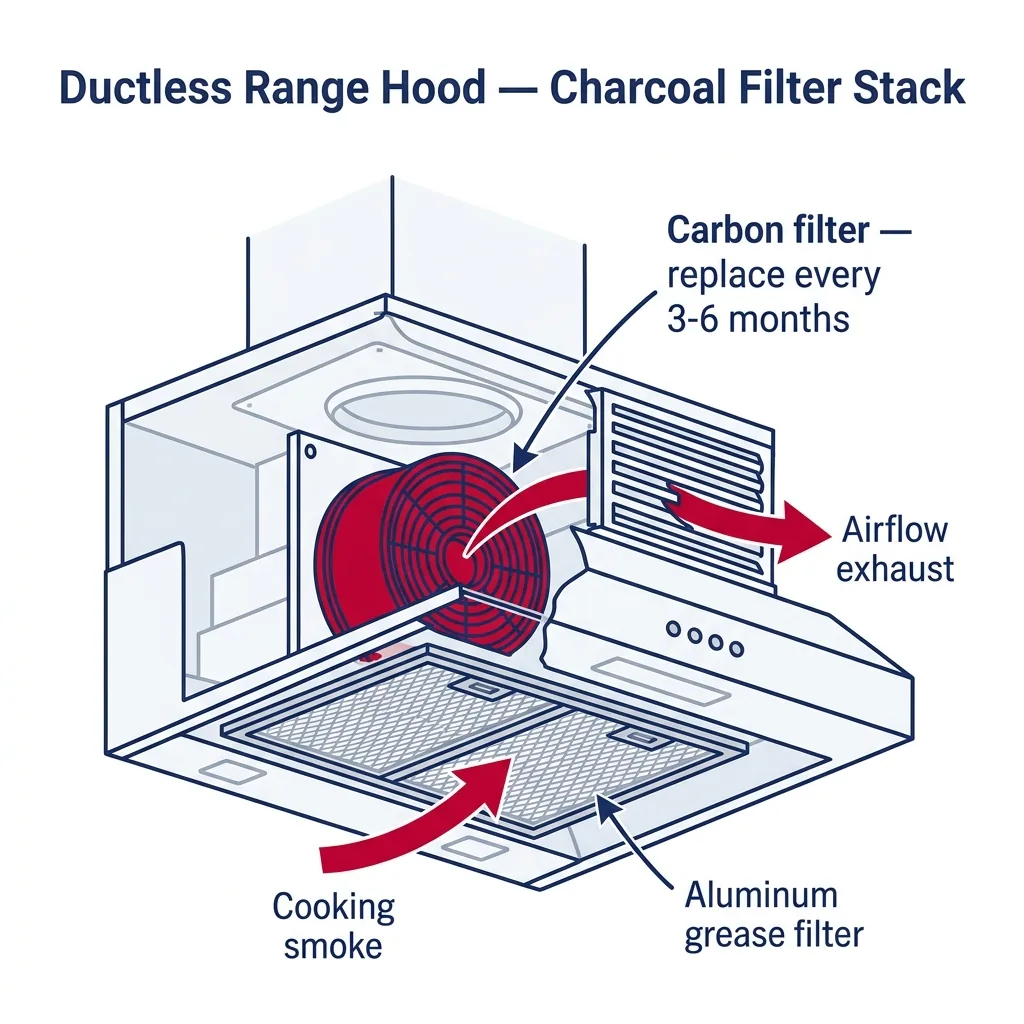
Ductless range hoods use a two-stage filtration system. The first stage is the washable aluminum mesh or stainless steel baffle filter. Locate the latch or pull-tab on these outer filters. Push the latch in to release the tension, pull the front edge down, and slide the filter out of the rear channel. Set these aside. Since you have them out, this is the perfect time to soak them in hot water and a strong degreaser, or run them through your dishwasher if they are dishwasher-safe.
Tip: If the metal filters are stuck due to excessive grease, spray a little degreaser along the tracks and wait 5 minutes before trying the latch again.
Locate and Remove the Old Charcoal Filter
With the metal filters removed, look up into the hood cavity. You will see the blower motor (the fan). The charcoal filter is typically a black, round, or rectangular plastic cassette attached directly to the motor housing or seated right behind the metal filters you just removed. For round filters, press the center tab and twist counterclockwise to unlock them from the motor's sides. For rectangular filters, release the retaining clips or unscrew the small Phillips screws holding the bracket. Pull the old, saturated filter out and discard it in your regular household trash.
⚠ Warning: Charcoal filters can be surprisingly heavy when saturated with months of heavy cooking grease. Handle them carefully to avoid dropping black, greasy dust onto your countertops.
Clean the Filter Housing and Blower Casing
Before installing the new filter, take a moment to clean the internal cavity. Spray your heavy-duty degreaser onto a microfiber cloth or paper towel—never spray directly up into the hood, as liquid can seep into the motor's electrical connections. Wipe down the plastic motor casing, the metal tracks, and the interior walls of the hood. Removing this residual grease will drastically reduce stale odors and give your new filter a clean environment to operate in.
Tip: Dawn Powerwash is excellent for this step. Spray it onto a damp cloth; the alcohol content helps cut through polymerized grease quickly without leaving a sticky residue.
Install the New Charcoal Filter
Unpack your new charcoal filter. If it's the round twist-on style, align the plastic tabs on the filter with the slots on the side of the blower motor. Push in gently and twist clockwise until you feel a firm 'click' or resistance. If it's a rectangular cassette, slide it back into the mounting bracket and secure the clips or replace the retaining screws. Give the filter a gentle tug to ensure it is seated securely. A loose filter will rattle annoyingly when the fan is running on high speed.
Tip: Some high-end hoods require two round carbon filters (one for each side of the dual-squirrel-cage blower). Make sure you replace both at the same time.
Reinstall Grease Filters and Test the Hood
Once the carbon filter is locked in place, retrieve your clean, dry metal mesh or baffle filters. Slide the back edge into the rear channel of the hood, push the latch, push the front edge up, and release the latch to lock them in. Remove the protective towel from your cooktop. Restore power at the breaker or plug the unit back in. Turn the range hood fan on its highest setting. Listen for any rattling or rubbing noises, and hold a piece of paper towel up to the metal filter to ensure the suction is holding it in place.
Brand-specific notes
Some brands have known design quirks worth knowing about before you start.
Broan / NuTone
The most common brand for standard California builder-grade setups. Their carbon filters often use a simple center-screw or a snap-in plastic frame that sits directly over the fan blade intake. They are very affordable; expect to pay $15 to $25 for OEM replacements.
GE / GE Profile
Many GE over-the-range microwaves and under-cabinet hoods use a rectangular charcoal filter that slides into a slotted opening behind the top vent grille. You often have to remove two Phillips screws at the top edge of the unit to access the hidden filter compartment.
Whirlpool / KitchenAid
These models frequently feature a round charcoal filter that twists onto the side of the blower motor. Make sure you align the plastic tabs perfectly before twisting; forcing it can snap the delicate mounting brackets on the motor housing.
Zephyr
A highly popular premium choice in modern California kitchen remodels. Zephyr's recirculating kits usually require removing heavy stainless steel baffle filters first. Their carbon filters are robust and cost around $40 to $60, but they feature excellent odor-scrubbing density and last a bit longer.
Bosch
Bosch ductless setups frequently use a thick cassette-style carbon filter. They are highly effective but must be seated firmly into their tracks until they audibly click. If not fully engaged, they can rattle noticeably when the fan is running on its highest setting.
What our techs see most often
Out here in LA and Orange County, we see a ton of high-end condos and hillside homes where exterior venting just isn't structurally possible. Folks often call us complaining about lingering smells or weak suction, completely unaware their ductless hood has a hidden charcoal filter that hasn't been changed since they bought the place.
When to call a professional
- → If you discover damaged, melted, or frayed wiring inside the hood cavity while changing the filter.
- → If the blower motor makes a grinding, squealing, or ticking noise even after you have removed the old, restricted filter.
- → If the range hood is hardwired and you need to replace the entire blower assembly because years of missing filters caused grease to ruin the motor.
- → If you are unsure whether your hood is vented or ductless and need a professional assessment of your kitchen's airflow.
- → If the mounting hardware for the hood feels loose or unstable when you apply upward pressure to twist the filter into place.
Related Range Hood Troubleshooting
These troubleshooting guides cover problems this task can help solve.
Frequently asked questions
Can I wash and reuse my charcoal range hood filter?
Absolutely not. Activated carbon works by trapping odor molecules and VOCs in microscopic pores. Washing the filter with water fills these pores, rendering the carbon completely useless. Furthermore, moisture trapped in the dense carbon granules creates a perfect breeding ground for mold. Always replace it with a new one.
How much does a replacement charcoal filter cost?
Depending on your brand and the size of the hood, a new charcoal filter typically ranges from $15 to $45. Premium or pro-style brands like Zephyr, Wolf, or Thermador might charge $50 to $80 for their proprietary, high-density recirculating kits.
How often should I really replace the carbon filter?
For average cooking habits, you should replace the carbon filter every 3 to 6 months. However, if you frequently fry foods, sear steaks, or cook with heavy spices (very common in our diverse California food culture), you will likely need to replace it every 2 to 3 months to keep odors at bay.
Why does my range hood still smell bad even after changing the carbon filter?
The primary metal grease filters (mesh or baffle) might be heavily soiled, or past neglect may have allowed grease to bypass the old filter and coat the internal blower motor housing. Try thoroughly degreasing the metal filters and carefully wiping down the interior plastic casing of the blower motor.
Can I convert my vented range hood to a ductless/recirculating one?
Many modern range hoods are 'convertible' and can be switched from vented to ductless by adding a recirculating kit (which includes the charcoal filter and sometimes a diverter plate). These kits usually cost between $40 and $100. Check your user manual to see if your specific model supports a ductless conversion.
Related Repair Guides
Range Hood Not Pulling Smoke: Fix Weak Suction
A range hood with weak suction is rarely a broken hood. The single most common cause is a clogged grease filter — over half of all weak-suction calls. Other causes are clogged ductwork, an undersized hood for the stove, an outdoor vent with a stuck damper, or for ductless models a saturated charcoal filter. Most of this is maintenance, not repair.
How to Clean a Range Hood Grease Filter
Keep your kitchen air fresh and your range hood motor running smoothly. This simple, satisfying chore takes just a few minutes of active work and dramatically improves ventilation.
Range Hood Fan Not Working: Causes and Fixes
A range hood where the lights work but the fan does not is a textbook 'isolate the failed circuit' problem. The fan and lights are usually on shared power but separate switches and motor circuits, so loss of fan with working lights points to the switch, capacitor, motor, or (on electronic models) the control board. Most fixes are under $80 in parts.