
At a glance
Symptoms
- • Smoke and steam linger over the cooktop instead of being pulled up
- • Cooking smells fill the rest of the house
- • Greasy film building up on cabinets near the stove
- • Hood is noticeably louder than it used to be at the same speed
- • Visible airflow at the bottom of the hood is weak or absent
- • Outdoor vent flap is not opening when the hood runs
- • Lights work fine but suction is poor
Common causes
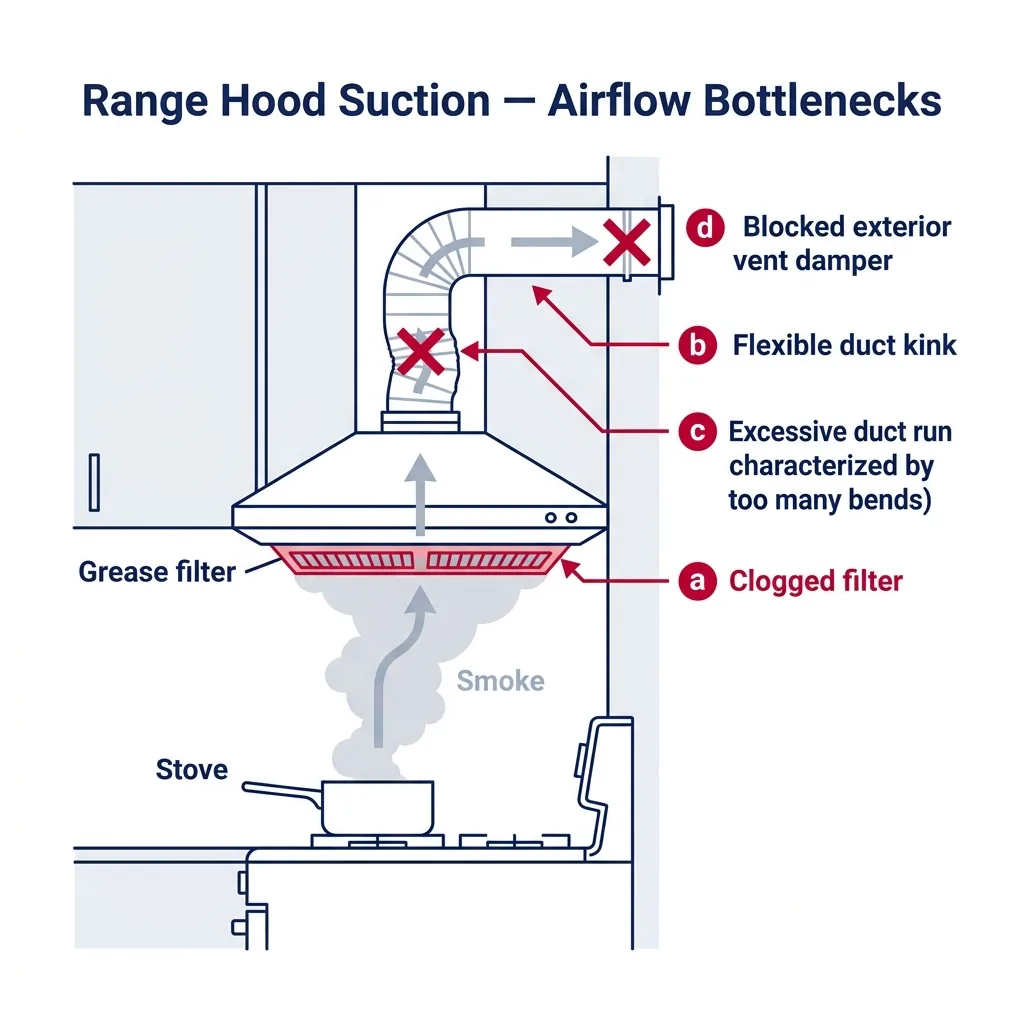
- • Clogged grease filter — most common single cause (mesh or baffle filter)
- • Saturated charcoal filter (ductless / recirculating models only)
- • Clogged or grease-coated ductwork
- • Stuck or damaged exterior vent damper
- • Ductwork run too long, with too many bends, or undersized diameter
- • Hood physically undersized for the stove (CFM rating too low)
- • Fan motor degraded or seized
- • Backdraft damper inside the hood stuck closed
Safety First — Read Before You Start
- •Turn off the hood and cooking surface before removing filters or accessing internals.
- •For wired hoods, turn off the breaker before any internal work beyond filter cleaning.
- •Allow at least 30 minutes after cooking before cleaning — grease filters can be hot enough to burn.
- •When checking the exterior vent on the roof or outside wall, use a stable ladder with a spotter. Never work on a roof in wet conditions.
- •Do not put grease filters in the dishwasher with food dishes — heavy grease can clog the dishwasher pump.
- •Charcoal filters cannot be cleaned and reused. They must be replaced.
Tools & supplies you'll need
- Phillips screwdriver
- Degreaser (commercial kitchen degreaser or hot water + dish soap + baking soda)
- Soft brushes
- Replacement charcoal filter (for ductless models)
- Replacement grease filter if old or damaged
- Ladder
- Flashlight
- Anemometer or candle (to test airflow)
- Vacuum with brush attachment
Step-by-step instructions
Pull and clean the grease filters
Most range hoods have one or two grease filters at the bottom — either a fine wire mesh (older or budget hoods) or aluminum baffles (modern and higher-end hoods). Pop them out (usually a spring clip or pull-tab). Hold them up to a light. Anything other than clear-light through the mesh or baffles means the filter is restricted. Soak in hot water with a generous shot of dish soap and 1/4 cup of baking soda for 20-30 minutes, then scrub with a soft brush. Heavily fouled filters can require two soaks. Dry completely before reinstalling. This single step resolves about half of all weak-suction complaints.
Tip: Aluminum mesh filters are dishwasher-safe, but run them alone on a hot cycle to avoid contaminating other dishes. Replace mesh filters every 2-3 years; baffle filters last 5-10 years with regular cleaning.
⚠ Warning: Do not run a clogged hood under heavy cooking. Grease can build up in the duct or fan housing and become a kitchen-fire risk.
Identify ducted vs. ductless and check the ductwork
Look at the top of the hood (or the back of an under-cabinet hood). Ducted hoods have a metal duct rising into the wall or ceiling. Ductless (recirculating) hoods just blow filtered air back into the kitchen and have no duct. On ducted models, follow the duct as far as you can see. Look for kinks (especially in flex duct), grease coating the inside walls, or sections that are crushed or sagging. If the duct is long, has multiple 90-degree bends, or is smaller than the hood's outlet, that alone may be the problem — the hood's CFM rating is significantly reduced by restrictive ductwork.
Tip: A 6-inch round duct moves about twice the air of a 4-inch duct of the same length. If your hood was downsized to fit a smaller duct during install, you are leaving most of its capacity on the table.
Replace the charcoal filter (ductless models)
If your hood is ductless, a saturated charcoal filter is the most common cause of weak suction (and any cooking smells). Charcoal filters typically need replacement every 3-6 months under heavy cooking, and every 6-12 months under light cooking. They cannot be cleaned and reused — once the carbon is saturated, it stays saturated. Most ductless hoods have one or two charcoal cartridges that twist-lock or clip in behind the grease filters. Replacements run $15-40. If you do not know when yours was last replaced, replace it now.
Tip: In coastal California, salt humidity does not affect charcoal filter life much, but heavy use of high-fat cooking (frying, searing) saturates them faster than steam-heavy cooking does.
Test and clear the exterior vent damper
On ducted hoods, the exterior outlet has a flap (the damper) that opens when air pressure pushes it out. If this damper is stuck closed by accumulated grease, debris, or even a bird's nest, your hood is fighting a closed door. Find the exterior outlet — usually on the roof or the side of the house. With the hood on high, the damper should swing open. If it does not, clean it by hand (a coat hanger and rag work fine). Look for any pest screen that may have clogged with lint. On wall-vent caps, check that no exterior obstruction (vent extender, decorative screen) has been added that restricts flow.
⚠ Warning: Roof access requires safe ladder use and ideally a second person. Do not climb a roof in wet or windy weather.
Check the internal damper
Most range hoods have a small internal damper between the fan and the duct outlet. Take off the grease filters and look up into the housing — you should see a flap that hangs closed when the fan is off. With the hood running, this flap should pivot open. If it is stuck closed, jammed open by grease, or has fallen out of position, suction will be reduced or zero. Clean the damper with degreaser and confirm it pivots freely. A bent or broken internal damper is a $10-30 part.
Test the fan motor
If filters and ducts are clean and dampers move freely but suction is still weak, the fan motor itself may be degrading. Listen at each speed: a healthy motor sounds smooth and changes pitch noticeably between speeds. A failing motor sounds rough, unchanged at different speeds, or notably quieter than it used to be. Hold a single sheet of paper at the bottom of the hood — a working hood at high speed should pull it firmly. Replacement motors run $50-150 and require pulling the fan housing out, but it is straightforward on most under-cabinet and chimney-style hoods.
Tip: On older hoods, a failing capacitor (single-speed motors) presents as weak high-speed performance. The capacitor is a $5-15 part and a quick swap. Check this before condemning the motor.
Confirm the hood is correctly sized for the stove
Some weak-suction complaints turn out to be a hood that was always undersized. Rule of thumb: a residential hood should have at least 100 CFM per linear foot of stove width — so a 36-inch stove needs at least 300 CFM. High-output gas cooktops (any range with a 20,000+ BTU burner) should have 600+ CFM. If your hood is rated 300 CFM and you have a Wolf 36-inch gas range, the hood was always going to struggle. The fix in this case is replacement, not repair — but it is worth confirming before spending on a motor.
Brand-specific notes
Some brands have known design quirks worth knowing about before you start.
Broan / NuTone
Broan and NuTone (same parent company) make most builder-grade and mid-range hoods in North America. The under-cabinet QS series is the workhorse — replacement motors and dampers are widely available and parts are typically under $50. The fan motor capacitor is a frequent failure on units 8+ years old.
Vent-A-Hood
Vent-A-Hood uses a unique "Magic Lung" centrifugal blower that does not use a traditional grease filter — instead, grease is centrifugally separated and drains into a removable cup. Weak suction on these usually means the cup is full or the impeller has accumulated grease. Pull the impeller and clean it; do not use ordinary degreaser as it can attack the bearing seals.
Zephyr
Zephyr hoods (Tornado, Tempest, Roma series) are higher-end and use baffle filters that last for years if cleaned regularly. Weak suction on Zephyr models often traces to the internal damper or to a clogged exterior vent — the motors themselves are reliable. Zephyr's CFM rating is honest, so undersizing is rare.
Bosch
Bosch range hoods use precision-fit baffle filters that should be cleaned every 2-3 months under regular cooking. The hoods include a filter-saturation indicator on most models — if the light is on, clean or replace. The motor itself is reliable; problems trace almost always to filter or duct restriction.
Faber
Faber Italian-made hoods use both grease and charcoal filters even on ducted models. The charcoal filter on ducted Fabers is for odor finishing and still needs periodic replacement (every 12 months) even though the hood is vented outside. Many owners do not realize this and the filter saturates over the years.
GE / Whirlpool
GE and Whirlpool budget over-the-range microwaves with built-in fans (which serve as the range hood) often have weak suction because they are recirculating by default — the outside vent panel must be physically reconfigured during install to actually vent outside. Check whether yours is set to recirculate or vent — that single setting can be the entire problem.
What our techs see most often
Range hood weak-suction calls are about 60% clogged grease filters, 15% saturated charcoal filters on ductless models, 15% ductwork or exterior vent issues, and the remaining 10% genuine motor or capacitor failures. We almost always start with cleaning and walk the customer through filter care — most don't realize the filters are washable until we mention it. In Southern California especially, customers in older homes often have undersized 4-inch ductwork from a 1970s install paired with a modern higher-CFM hood — that ductwork mismatch alone explains the symptom.
When to call a professional
- → Filters are clean, ducts are clear, dampers move freely, and suction is still weak
- → Fan motor is making grinding or burning-smell noises
- → You suspect ductwork was incorrectly run during installation (long runs, multiple sharp bends, undersized diameter)
- → The hood is on a roof exit and the cap, flashing, or pitch needs to be inspected
- → You smell electrical burning from the hood
- → The hood is a high-end built-in (Wolf, Thermador, Miele) where DIY motor work may void warranty
- → Grease has accumulated heavily inside the duct over years of poor maintenance — duct cleaning is a specialized service
Range Hood Maintenance & Replacement Tasks
Step-by-step guides for individual maintenance jobs related to this appliance.
Frequently asked questions
How often should I clean my range hood grease filter?
For light cooking (a few meals a week, mostly steaming and boiling): every 2-3 months. For regular cooking: monthly. For heavy frying or wok cooking: every 2 weeks. A filter that is more than 30% clogged dramatically reduces suction and forces the motor to work harder, shortening its life.
Are charcoal filters in ductless hoods worth it?
They reduce odors but do nothing for steam, heat, or particulate that a vented hood would remove. A ductless hood is always a compromise versus a vented one. If you can route ductwork outside, do it. If not, replace charcoal filters every 3-6 months with heavy use, every 6-12 months with light use — they're not optional, they're consumables.
How big a range hood do I need?
Minimum 100 CFM per linear foot of stove. So a 30-inch stove needs at least 250 CFM, a 36-inch needs 300 CFM, a 48-inch needs 400 CFM. For high-output gas (Wolf, Thermador, Viking), aim for 600-1200 CFM and ensure the kitchen has makeup air, otherwise the hood will struggle to pull air against the negative pressure it creates.
Why does my hood seem weaker in winter?
Two reasons. First, cold dense air outside can hold the exterior damper closed against weak suction. Second, in tightly sealed homes during winter, hood operation creates negative pressure that the home cannot replenish — the hood is essentially fighting itself. Cracking a window slightly while running the hood helps. For higher-CFM hoods, building code may require a makeup-air system.
Is it safe to use a range hood with weak suction?
It is safe in the immediate term but is allowing grease to build up on cabinets, walls, and inside the ductwork. Grease in ductwork is a known fire risk. Address weak suction within a few weeks, not months, especially if you do regular high-heat cooking.
Related Repair Guides
Range Hood Fan Not Working: Causes and Fixes
A range hood where the lights work but the fan does not is a textbook 'isolate the failed circuit' problem. The fan and lights are usually on shared power but separate switches and motor circuits, so loss of fan with working lights points to the switch, capacitor, motor, or (on electronic models) the control board. Most fixes are under $80 in parts.
How to Clean a Range Hood Grease Filter
Keep your kitchen air fresh and your range hood motor running smoothly. This simple, satisfying chore takes just a few minutes of active work and dramatically improves ventilation.
Range Hood Light Not Working: Fix Guide
Cooking in the dark is no fun, and a broken range hood light is one of the most common kitchen annoyances. Whether it's a simple burnt bulb, a grease-clogged switch, or a failed transformer, this guide will help you diagnose and fix the issue safely.