
At a glance
Symptoms
- • The coil burner doesn't heat up at all when the dial is turned on.
- • The element has developed visible blisters, cracks, or deep pitting on its outer surface.
- • You see bright orange sparking, arcing, or hear a loud pop when turning the burner on.
- • The coil only heats up partially, leaving cold spots that cook food unevenly.
- • The burner feels excessively loose or wobbly in its drip pan, failing to sit level.
- • The metal prongs on the burner plug look melted or severely corroded.
Common causes
- • A damaged burner can short out, potentially tripping your breaker or causing a minor electrical fire.
- • Uneven heating ruins expensive cookware and makes cooking meals a frustrating, inconsistent experience.
- • Corroded burner contacts can melt the terminal block receptacle, turning a simple $20 fix into a more involved electrical repair.
- • Ignoring a sparking element is a serious safety hazard, especially in older California homes with aging electrical panels.
- • Rusted or degraded coils drop in efficiency, taking much longer to boil water and wasting electricity.
Safety First — Read Before You Start
- •Always unplug the stove or flip the dedicated 40-50 amp circuit breaker in your electrical panel before starting any work. 240V power is lethal.
- •Wait until the stove has completely cooled down; electric coils retain severe burning heat long after the red glow fades.
- •Never force a burner into a receptacle. If it doesn't slide in easily, the terminal block may be melted or you have the wrong part.
- •Do not use water to clean the terminal block or the plug ends of the burner element, as this can cause a short circuit.
- •If replacing a terminal block, you must use high-temperature ceramic wire nuts, not standard plastic ones, or they will melt.
Tools & supplies you'll need
- New electric coil burner element (matching wattage and size, $15-$35)
- Work gloves (to protect hands from sharp edges or built-up grease)
- Multimeter (optional, to test the old coil for continuity)
- Phillips-head screwdriver (only if replacing the terminal block)
- Wire strippers and ceramic wire nuts (only if splicing a new terminal block)
- Flashlight (to inspect the receptacle contacts)
Step-by-step instructions
Disconnect power to the stove
Safety always comes first, especially when dealing with 240-volt appliances. Either pull the stove away from the wall and unplug the thick power cord, or go to your home's main electrical panel and flip the double-pole breaker labeled 'Stove' or 'Range' to the OFF position. Verify the power is off by attempting to turn on the oven light or the clock display.
⚠ Warning: Never skip this step. Even if the burner switch is turned off, one leg of the 240V circuit may still carry live voltage to the terminal block.
Lift and remove the old coil burner
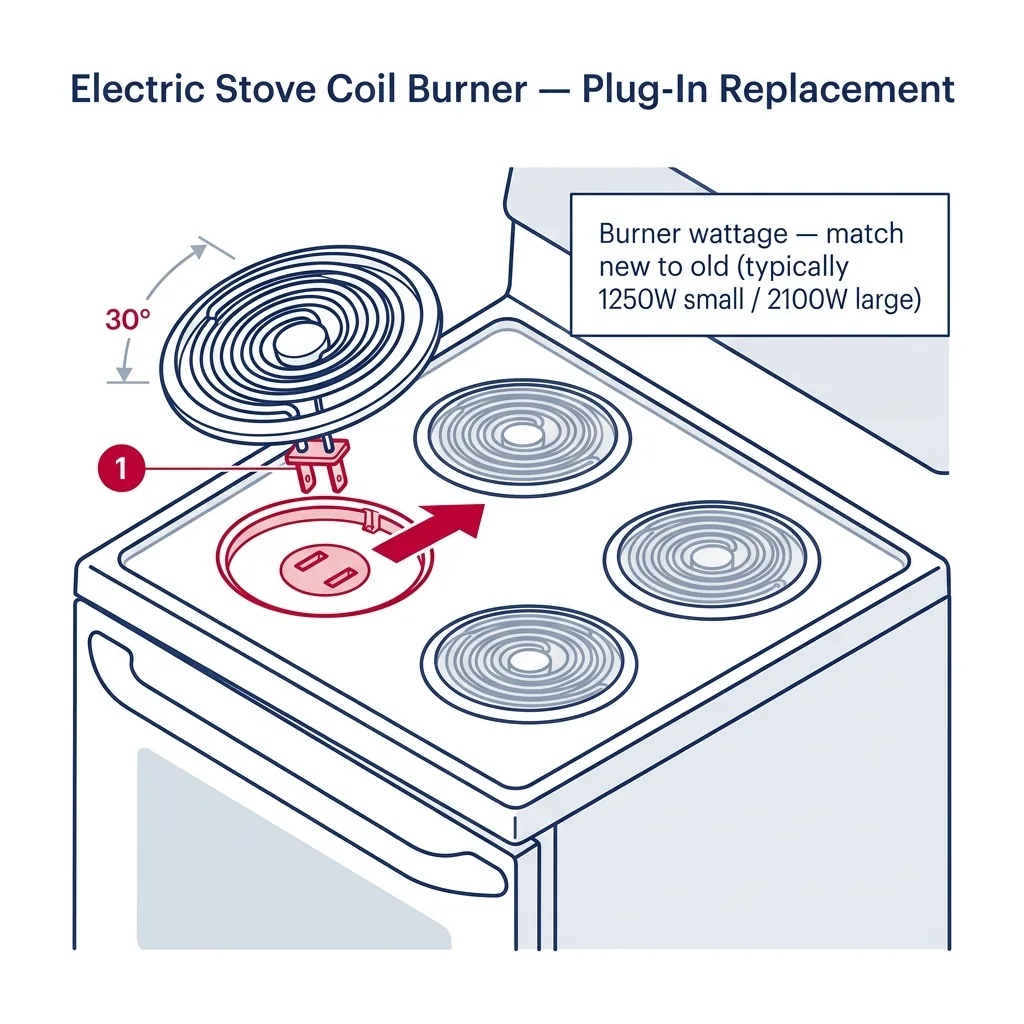
Wait until the stove is completely cool to the touch. Grasp the coil burner on the side exactly opposite of where it plugs into the stove. Gently lift that edge up about 1 to 2 inches. Do not lift it any higher, or you risk cracking the ceramic terminal block underneath the cooktop. Once the edge is slightly elevated, pull the burner straight back toward you to slide the prongs out of the terminal receptacle.
Tip: If the burner is stuck, wiggle it very gently from side to side while pulling. If it absolutely won't budge, the prongs may have melted into the block, meaning you'll need to replace the terminal block as well.
Inspect the terminal block and drip pan
Shine a flashlight into the slot where the burner was plugged in. Look at the terminal block (the plastic or ceramic receptacle). If you see scorch marks, melted plastic, cracked ceramic, or heavily corroded contacts, you must replace the terminal block kit (usually a $10-$20 part) before installing the new burner. This is especially common in coastal California homes where salt air and humidity accelerate corrosion. Also, take this opportunity to remove and clean the drip pan.
⚠ Warning: Do not wrap your drip pans in aluminum foil. Foil can reflect too much heat back up into the element, causing premature burner failure and creating a fire hazard.
Test the old burner with a multimeter (Optional)
If you aren't sure if the burner is the problem, you can test it for continuity. Set your multimeter to the lowest Ohms setting of resistance. Touch one probe to each of the metal prongs on the burner plug. A good coil will show a reading between 15 and 50 ohms (depending on the size and wattage). If the multimeter reads 'OL' (open line) or no change, the internal element is broken and the burner is completely dead.
Tip: If the burner tests fine but won't heat up on the stove, the issue is likely a burnt terminal block or a faulty infinite control switch on the console.
Install the new coil burner
Take your new replacement burner and ensure the metal support frame matches the old one. If your drip pan has indentations, make sure the support feet of the burner align with them. Insert the metal prongs of the new burner directly into the slots of the terminal block. Keep the burner as level as possible while pushing it firmly into place. It should slide in snugly. Press the burner down so it rests perfectly flat in the drip pan.
Tip: Make sure you bought the correct size. Stoves typically use 6-inch (approx. 1500W) and 8-inch (approx. 2100W-2600W) burners. Don't mix them up.
Restore power and perform a burn-off test
Plug the stove back in or flip the circuit breaker back to the ON position. Turn the newly installed burner's control knob to the 'High' setting. The burner should begin to glow red within a minute or two. You will likely see a small amount of smoke and smell a burning odor—this is completely normal. New coils have a protective factory coating that needs to burn off. Let it run on high for about 5 minutes to complete this process.
Tip: Turn on your range hood fan or open a kitchen window during the initial burn-off to vent the smoke and smell outside.
Brand-specific notes
Some brands have known design quirks worth knowing about before you start.
GE
GE and Hotpoint coils often use a specific 'Y' shaped bracket or delta-style terminal. Ensure you buy the exact GE-compatible replacement. Universal coils from big box stores frequently don't fit GE terminal blocks correctly and will sit at an angle.
Whirlpool
Many older Whirlpool and Kenmore freestanding ranges use a standard plug-in coil, but watch out for the terminal block wiring. The high heat over years of use often makes the wire insulation brittle. If you have to replace the block, handle the wires gently to avoid stripping insulation further down the line.
Frigidaire
Frigidaire models frequently feature a unique support crossbar underneath the coil. When replacing, make sure the new coil's support feet align perfectly with the indentations in the drip pan so the burner sits completely level, otherwise your pans will slide.
Samsung
While Samsung is better known for smooth glass tops, their older or budget coil models use highly specific wattage ratings (e.g., 2100W for the 8-inch). Replacing it with a lower wattage 'universal' coil will result in disappointingly slow boil times.
Maytag
Classic Maytag coil stoves are built like tanks, but their terminal blocks are prone to ceramic cracking after years of heavy cast-iron pan use. If the burner wiggles excessively, inspect the ceramic block for hairline fractures.
What our techs see most often
We get a lot of calls from renters in older LA and Orange County apartments thinking their stove is completely dead, when it's really just a burned-out $20 coil. Always check the metal burner contacts for pitting—if they look chewed up or black, you probably need to swap the terminal receptacle too, or the new burner will just burn out again within a month.
When to call a professional
- → If the new burner still doesn't heat up, indicating a faulty infinite switch or burnt internal wiring in the console.
- → If the main wiring harness connecting to the terminal block is melted, scorched, or the insulation is too brittle to safely splice.
- → If turning on the burner repeatedly trips your home's main electrical breaker.
- → If you have a smooth glass-top stove (radiant element) rather than a traditional exposed coil—these require disassembling the cooktop and handling delicate insulation.
- → If you smell burning plastic, ozone, or electrical smoke coming from the control panel when the stove is turned on.
Related Stove Troubleshooting
These troubleshooting guides cover problems this task can help solve.
Electric Stove Burner Not Heating: How to Fix
Gas Stove Keeps Clicking: How to Stop It
Gas Stove Burner Won't Ignite: Causes and Fixes
Cracked Glass Cooktop: What to Do and When to Replace
Frequently asked questions
How much does a replacement electric coil burner cost?
A standard 6-inch or 8-inch coil burner typically costs between $15 and $35. Terminal block receptacle kits, if needed, run about $10 to $20. Buying OEM (Original Equipment Manufacturer) parts is highly recommended over cheaper universal options for longevity and safety.
Can I use a universal burner from the hardware store?
While universal burners claim to fit most brands, they often sit unevenly or have slightly different terminal prong lengths. This can lead to poor connections, electrical arcing, and premature failure. It's best to spend the extra $5-$10 for a brand-specific replacement.
Why did my new burner smoke the first time I turned it on?
This is completely normal. New coils have a protective, oil-based factory coating that burns off during the first use. It usually smokes slightly and smells for about 5 to 10 minutes. Just turn on your range hood or open a window until it stops.
Do I need to replace the drip bowls at the same time?
It's not strictly necessary, but heavily rusted or scorched drip pans (which are common in humid coastal areas like San Diego or Ventura) reflect heat poorly. Replacing them for $15-$25 a set improves heating efficiency and makes the stove look brand new.
How do I know if I need to replace the terminal block too?
If the metal prongs on your old burner are pitted, melted, blackened, or missing chunks of metal, the terminal block is likely damaged inside. If you just plug a new burner into a bad block, the resulting electrical arcing will destroy the new burner in a matter of weeks.
Related Repair Guides
Electric Stove Burner Not Heating: How to Fix
An electric burner that does not heat is one of the simpler appliance failures to diagnose. The most common causes are a burnt-out heating element, a failed infinite switch, a bad burner socket / receptacle, or a loose terminal connection. The diagnosis path differs slightly between coil-element stoves and smooth-top (radiant) ranges. Most repairs are under $50 in parts and under an hour.
How to Clean Gas Stove Burner Caps and Heads
A quick, routine maintenance task to keep your gas stove lighting reliably and burning with a crisp blue flame. We'll show you how to safely soak, scrub, and realign your burner components without damaging the delicate gas ports.
Gas Stove Keeps Clicking: How to Stop It
A gas burner that clicks endlessly without lighting — or one that won't stop clicking even after you turn it off — is usually a moisture or alignment problem, not a broken part. Most fixes are housekeeping and take under 30 minutes. The underlying spark module is rarely the problem on the first complaint, but constant moisture exposure can eventually take it out.