
At a glance
Symptoms
- • One burner does not heat at all while others work normally
- • Burner heats only on high (or only on low)
- • Burner heats intermittently — sometimes works, sometimes does not
- • Burner glows dimly or unevenly compared to other burners
- • Visible burn marks, pitting, or discoloration on a coil element
- • Smooth-top: visible cracks in the glass over a non-working zone
- • Burner stays on at full power and ignores the control knob
Common causes
- • Burnt-out heating element / coil (most common — easy swap)
- • Failed infinite switch (control switch behind the knob)
- • Damaged burner receptacle / socket (the prongs the coil plugs into)
- • Loose or burned terminal connection at the receptacle
- • Faulty internal wiring
- • Smooth-top: failed radiant element under the glass
- • Smooth-top: cracked ceramic glass cooktop
- • Control board failure (electronic models without infinite switches)
Safety First — Read Before You Start
- •ALWAYS turn off the breaker for the stove before opening the cooktop or removing any element. The stove circuit is 240V and shock hazard is significant.
- •Confirm power is off with a non-contact voltage tester before touching internal wiring.
- •Allow the stove to cool fully before any repair — burner elements can stay over 200°F for an hour after use.
- •Never bypass a thermal limit or override a damaged switch with a jumper. Stoves on 240V wiring can cause electrical fires when modified.
- •On smooth-top ranges, do not pry on the glass cooktop with metal tools. The ceramic glass is rigid but cracks easily under point load.
Tools & supplies you'll need
- Phillips and flat-head screwdrivers
- Nut driver set (1/4 inch and 5/16 inch)
- Multimeter
- Replacement element / receptacle / switch as identified
- Needle-nose pliers
- Flashlight
- Camera or phone (to photograph wiring)
- Oven mitt or towel (handling potentially still-warm parts)
Step-by-step instructions
Confirm the symptom and rule out the obvious
Turn the suspect burner to high and wait 60 seconds. On a coil burner, look for any glow at all. On a smooth-top, place your hand a few inches over the burner and feel for heat. Then swap the suspect coil with a known-good coil from another burner of the same size. If the moved coil works in the new spot, the original coil is the problem. If the moved coil also doesn't work in the suspect spot, the problem is in the receptacle, switch, or wiring of that burner. This single swap test is the fastest diagnosis on coil-element ranges and saves you from buying a wrong part.
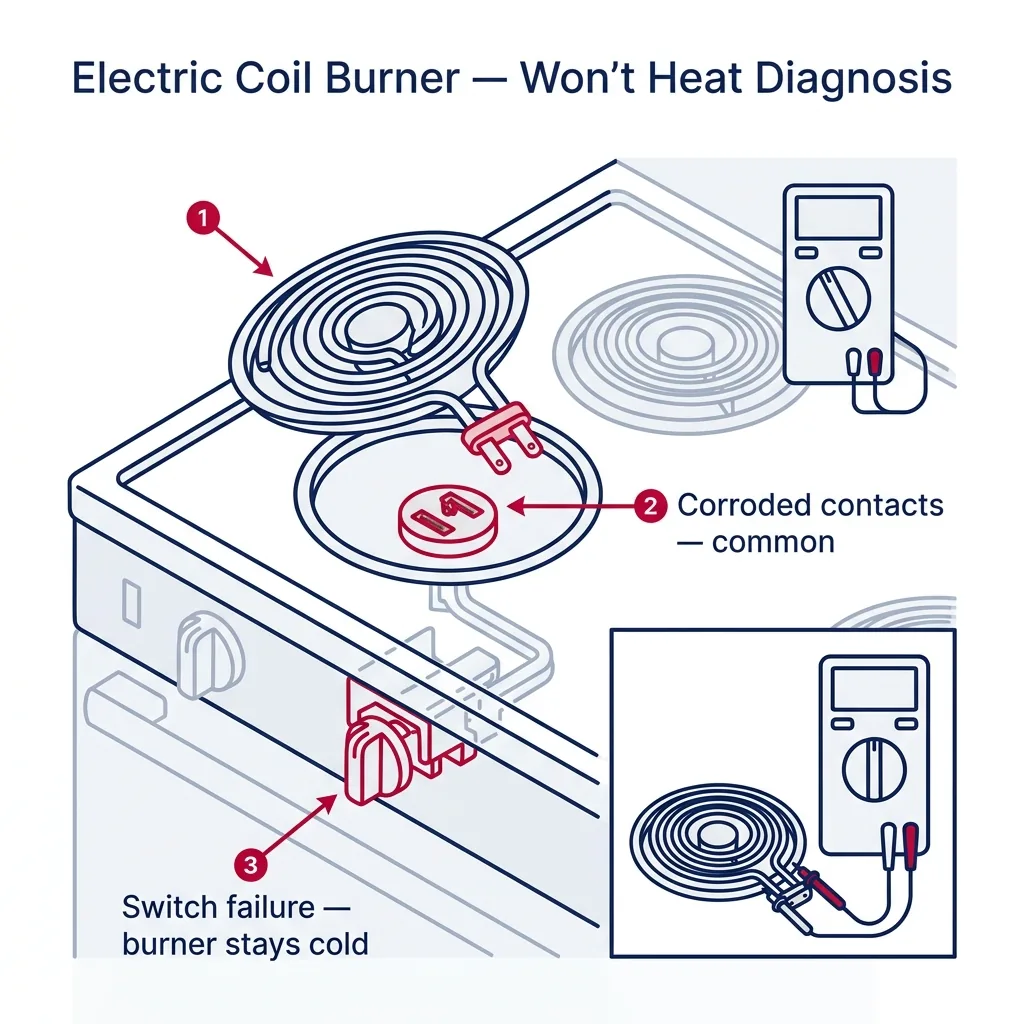
Tip: Smooth-top ranges do not allow the swap test. For smooth-tops, jump to the multimeter steps below.
Inspect the burner coil and receptacle (coil-element stoves)
Lift the suspect coil out of its receptacle. Look at the two prongs at the back of the coil — they should be smooth, not pitted or burnt. Look into the receptacle (the socket on the stovetop) — it should be clean, with two terminals firmly seated. Burned, charred, or arc-pitted contacts are a common cause of intermittent heating. A damaged receptacle costs $10-20 and is a 4-screw, 2-wire swap with the breaker off. Replace both the receptacle and the coil if either side shows burn marks — they damage each other.
⚠ Warning: A receptacle with brown or black burn marks indicates arcing under load. Replace it before continuing to use the stove — continued arcing can damage wiring inside the cooktop.
Test the heating element with a multimeter
Set your multimeter to ohms (lowest range). Touch the probes to the two prongs at the back of the coil. A working 6-inch element typically reads 50-60 ohms; an 8-inch element typically reads 30-40 ohms. Open circuit (infinite ohms) means a burnt-out element — replace it. A working element also has zero continuity to the metal body of the coil itself; if it does, the element is shorted to ground and must be replaced. New coils are $20-40 depending on size and brand.
Tip: Always replace coils as a pair if one fails on a heavily used range. The other one is usually close to failure too, and the small price difference for a second coil is worth not opening the stove again in 6 months.
Test the infinite switch
Lift the cooktop or remove the back panel to access the infinite switches — those are the round switches behind each burner knob. With the breaker still off, set the multimeter to continuity. Each switch should change continuity between its terminals as you turn the knob from off to high. A switch that reads no continuity at any knob position, or stays continuous at all positions, has failed. Replacements are $25-50 and are a 3-4 wire swap. Photograph the wiring before disconnecting — wires must go back exactly as they came off.
⚠ Warning: Infinite switches are model-specific. Match the part number on the back of the original; otherwise you may install a switch with the wrong amp rating, which is a fire hazard.
Smooth-top: test the radiant element
On smooth-top (radiant) ranges, you cannot lift the burner. Instead, with the breaker off, lift the entire glass cooktop — usually retained by 2-4 screws under the front lip and hinged at the back. Look at the radiant element (a coil under the glass for that zone). Test for continuity across its two terminals — readings should be similar to coil elements (30-60 ohms depending on size). Open circuit = failed radiant element, $40-90 depending on brand and size. Reinstallation requires the heat-sink paste between the element and the metal mounting plate to be redone for proper heat transfer.
Tip: When lifting a smooth-top cooktop for the first time, support it carefully — most are held open by a single prop rod. Drop the glass and you are buying a new range.
Check wiring and grounds
If element, receptacle, and switch all test good, the issue is in the wiring. Look for any browned or melted insulation, especially at terminal screws — heat from a loose connection discolors insulation before it fails completely. Tighten any loose terminals. On older ranges, look at the main power-block (the terminal where the 240V supply enters the unit) for burned spots; the block itself can fail on stoves over 15 years old. If you find burned wiring, replace the affected harness or have a tech assess — burned wiring is a fire risk and rarely fixable in place.
Reassemble and test
Restore power at the breaker, turn the suspect burner to medium, and confirm even heating. Test all positions on the knob (low, medium, high). On smooth-tops, watch for even glow under the glass — patchy heating usually means the radiant element is failing or the element-to-glass paste was not applied properly. Check all other burners briefly to confirm the rest of the stove is unaffected. If the suspect burner now works at all settings, the repair is complete.
Brand-specific notes
Some brands have known design quirks worth knowing about before you start.
GE
GE coil ranges (XL44, JBP and similar) use industry-standard 6-inch and 8-inch coils that work across most other GE/Hotpoint/Frigidaire models. The infinite switches are also widely cross-compatible. GE smooth-tops in the JBS and JB series are similarly serviceable — radiant elements clip in with two screws and a wire harness.
Whirlpool
Whirlpool ranges (WFC, WFE, WEE series) use the same coil and receptacle parts as their KitchenAid and Maytag siblings. If you can't find a Whirlpool-branded part in stock, the equivalent KitchenAid or Maytag part will fit.
KitchenAid
KitchenAid smooth-top ranges (KSEB, KSEG series) use heavier-duty radiant elements and can have higher-wattage simmer/dual-zone elements. When replacing, match the wattage exactly — generic substitutes that look identical may have lower power and the dual-ring control will not work correctly.
Frigidaire
Frigidaire smooth-top ranges (FCRE, FFEF series) frequently fail at the surface element control switch rather than the element itself. If a Frigidaire smooth-top burner runs only on high or only on low, suspect the switch first.
Samsung
Samsung electric ranges (NE series and Flex Duo models) use electronic control boards instead of mechanical infinite switches on most models. A non-heating burner that tests good at the element and wiring usually means the relay on the control board has failed — that is a $200-300 part and a more involved repair.
What our techs see most often
Electric burner calls are heavily skewed toward two failures: burnt-out coil elements (about 50% of coil-element calls) and failed radiant elements on smooth-tops (about 60% of smooth-top calls). The receptacle / socket issue runs maybe 20%, infinite switch around 15%, and the rest are wiring or control board. We always carry common 6-inch and 8-inch coils on the truck because they fit nearly every coil range made in the last 30 years.
When to call a professional
- → You see burned wiring, a damaged power-block, or scorched insulation inside the stove
- → The breaker trips when the stove is energized — this indicates a short and is not a DIY repair
- → You have replaced the element and confirmed switch continuity but the burner still does not heat
- → It is a smooth-top with a cracked glass cooktop — the glass alone is $300-600 and replacement is awkward without two people
- → The range is an electronic-control model and the issue traces to the main control board
- → You smell burning plastic when the stove is on — stop using it immediately and call a tech
- → The stove is a high-end induction model (Wolf, Thermador, Bosch induction) — diagnostic equipment is needed
Stove Maintenance & Replacement Tasks
Step-by-step guides for individual maintenance jobs related to this appliance.
Frequently asked questions
Why does only one of my electric burners not work?
The most common cause is a burnt-out heating element. Each burner has its own element, switch, and pair of contacts in the receptacle, so a single-burner failure points right at that burner-and-switch combo. Swap a known-good coil into the dead position to immediately tell whether the problem is the coil or the socket / switch.
How can I tell if the element or the switch is bad?
On coil-element stoves, the swap test is the fastest answer: move a working coil to the dead burner. If the moved coil heats, the original coil was bad. If the moved coil does not heat, the issue is the switch, receptacle, or wiring for that burner. On smooth-top stoves, you need a multimeter — check resistance on the radiant element first, then continuity on the switch.
My burner heats only on high — what does that mean?
An infinite switch that has lost the ability to cycle is the most likely cause. The switch is supposed to pulse the element on and off to maintain a chosen temperature; when the cycling contacts fail welded-shut, the burner just stays full-on. Turn it off at the breaker and replace the switch. Continued use is a fire risk because the burner cannot regulate temperature.
Are heating elements universal across brands?
Coil elements largely are — 6-inch and 8-inch plug-in coils have been industry-standard for decades, and a $25 generic OEM-spec coil fits most GE, Whirlpool, KitchenAid, Maytag, Hotpoint, Frigidaire, and Kenmore coil ranges. Smooth-top radiant elements are not universal; they vary by brand, wattage, and physical mount. Match the model number when ordering.
How long do electric stove burners last?
Coil elements typically last 8-15 years with normal use. Radiant elements under smooth-top glass last 10-20 years. Infinite switches outlast both — failures before 15 years usually mean a one-off bad part. If your range is over 15 years old and one burner fails, others are likely close behind; consider whether ongoing repair is worth it versus replacement.
Related Repair Guides
Gas Stove Keeps Clicking: How to Stop It
A gas burner that clicks endlessly without lighting — or one that won't stop clicking even after you turn it off — is usually a moisture or alignment problem, not a broken part. Most fixes are housekeeping and take under 30 minutes. The underlying spark module is rarely the problem on the first complaint, but constant moisture exposure can eventually take it out.
How to Clean Gas Stove Burner Caps and Heads
A quick, routine maintenance task to keep your gas stove lighting reliably and burning with a crisp blue flame. We'll show you how to safely soak, scrub, and realign your burner components without damaging the delicate gas ports.
Gas Stove Burner Won't Ignite: Causes and Fixes
When you turn the stove knob and hear clicking but see no flame, or hear nothing at all, your gas burner needs attention. We will walk you through diagnosing and fixing the most common ignition failures safely, from simple clogs to electrical faults.