
At a glance
Symptoms
- • Dishes on the top rack are consistently coming out dirty or covered in grit.
- • You notice a white, chalky buildup (calcium scale) around the small holes on the plastic wash arms.
- • The detergent dispenser door opens, but the soap tablet doesn't fully dissolve during the cycle.
- • The dishwasher sounds quieter than usual during the wash cycle, indicating low water pressure.
- • You find small bits of food debris, citrus seeds, or glass trapped inside the spray arm holes.
- • The spray arms do not appear to have changed position after a full wash cycle completes.
Common causes
- • Southern California water (especially in LA and Orange County) often exceeds 300 ppm of hardness, rapidly calcifying the tiny jet holes.
- • Blocked jets prevent the spray arms from rotating, turning your dishwasher into a weak sprinkler rather than a high-pressure washer.
- • Food particles like citrus seeds, popcorn kernels, and eggshells bypass the primary filter and get wedged inside the arms.
- • Labels from jars or paper residue from food packaging disintegrate and clog the water delivery manifold.
- • Neglecting this task forces the circulation pump to work harder against restricted flow, potentially shortening its lifespan.
Safety First — Read Before You Start
- •Always disconnect power to the dishwasher at the breaker before reaching into the tub to prevent accidental starts.
- •Watch out for broken glass or sharp bone fragments that may have settled in the lower sump area beneath the spray arm.
- •Never use metal needles, safety pins, or drill bits to clear the jets—enlarging or scratching the holes will ruin the spray pattern.
- •Allow the dishwasher to cool down completely if it recently ran a heated dry cycle, as the exposed heating element can cause severe burns.
Tools & supplies you'll need
- Distilled white vinegar (at least 1 quart)
- Wooden toothpicks, tweezers, or a thin wire pipe cleaner
- A large baking dish, sink basin, or bucket for soaking
- Old toothbrush or soft-bristled scrub brush
- Nut driver or Torx screwdriver set (for certain upper arm assemblies)
- Flashlight for inspecting the pump sump
Step-by-step instructions
Disconnect Power and Prep the Tub
Before starting, ensure safety by turning off the dishwasher at your home's electrical panel. Open the dishwasher door fully and pull out the bottom dish rack. Set it aside. This is a great time to use your flashlight to inspect the bottom of the tub (the sump area) for any stray pieces of broken glass, popcorn kernels, or bone fragments. Removing these now ensures you won't accidentally cut yourself while working with the lower spray arm.
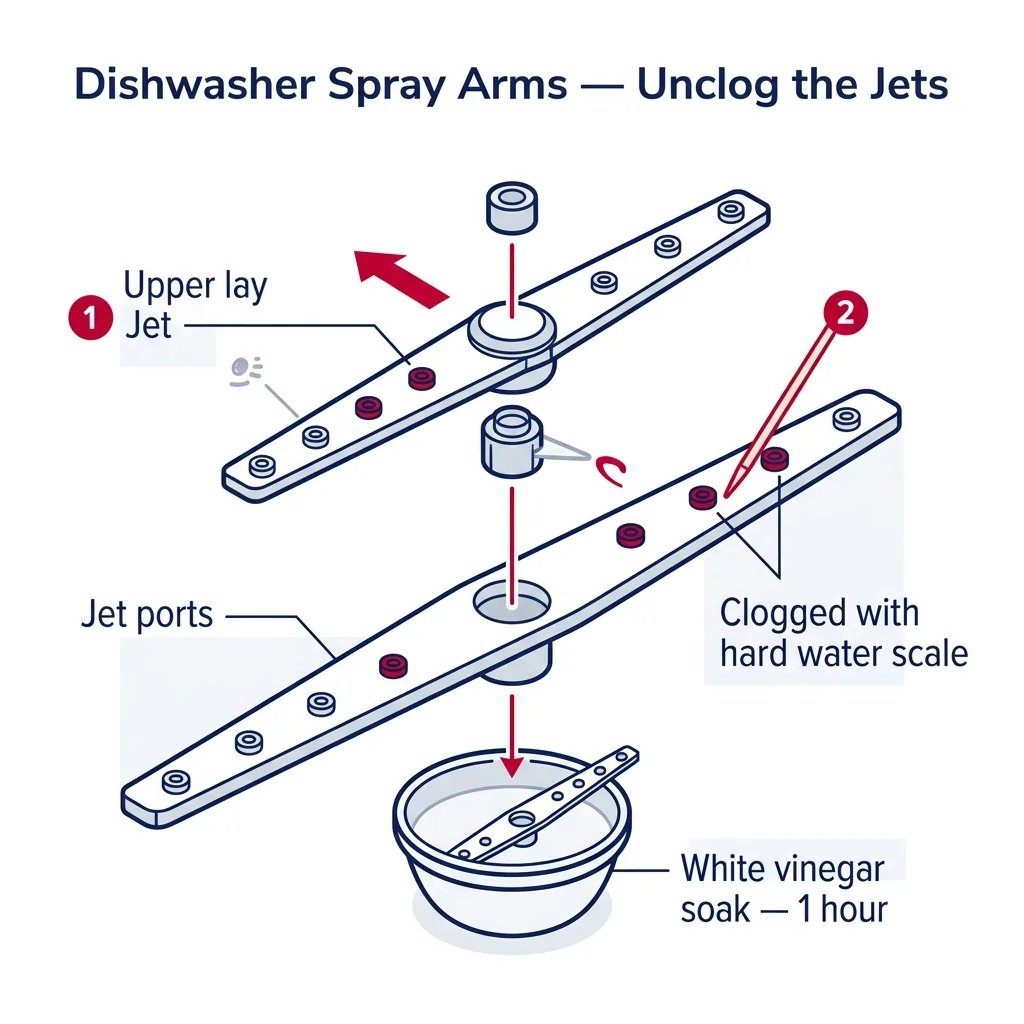
Tip: Place a towel on the floor in front of the dishwasher to catch any drips when you remove the wet spray arms.
⚠ Warning: Do not lean heavily on the open dishwasher door while working inside, as this can bend the door hinges and cause future leaks.
Remove the Lower Spray Arm
The removal method for the lower spray arm depends on your brand, but most are completely tool-less. For many models, you simply grip the center hub of the spray arm and pull straight up firmly until it pops off the pump manifold. Other brands require you to rotate a locking nut or the center hub counter-clockwise a quarter turn before lifting it out. If it feels stuck, do not force it to the point of bending the plastic; check for a central retaining screw or nut.
Tip: If there is a plastic bearing ring beneath the spray arm, make sure to keep track of it so it doesn't fall into the filter or get washed down the drain.
Remove the Upper and Middle Spray Arms
Pull out the upper dish rack to access the middle spray arm (attached to the bottom of the top rack). This arm usually detaches by unthreading a plastic knurled knob in the center, or by pressing a release tab and sliding it off its track. If your dishwasher has a third spray arm at the very top ceiling of the tub, you can usually remove it by twisting the central cap counter-clockwise. Bring all removed spray arms to your kitchen sink.
⚠ Warning: Be careful not to drop the upper spray arm retaining nut; it is easily lost and required for the dishwasher to function properly.
Soak the Arms in Warm Vinegar
To tackle the notorious hard water scale common in California hillside homes and coastal cities, lay the spray arms flat in a large baking dish, roasting pan, or your plugged kitchen sink. Pour enough warm distilled white vinegar over them to submerge the jet holes. Let them soak for at least 30 to 45 minutes. The acetic acid in the vinegar will break down the calcium carbonate buildup safely without degrading the plastic. You will likely see small bubbles forming around the white, chalky areas as the scale dissolves.
Tip: If the scale is extremely thick, you can add a tablespoon of citric acid powder to the vinegar for a stronger, faster-acting descaling solution.
Clear the Jets and Dislodge Debris
After soaking, take a wooden toothpick, a pair of fine tweezers, or a soft pipe cleaner and gently poke into each jet hole on the spray arms. The goal is to loosen any softened scale and dislodge trapped food particles like seeds or grit. If a seed is stuck in a hole, do not push it further in; try to grab it with tweezers or push it sideways so it falls back into the main hollow chamber of the arm. Use an old toothbrush to scrub away the remaining scale on the exterior of the arms.
⚠ Warning: Never use a sewing needle, safety pin, or metal pick. Scratching the inside of the jet hole will alter the water trajectory, causing the arm to stall during a cycle.
Flush the Spray Arms with High Pressure
Once the holes are clear, you need to flush out the loose debris from inside the hollow spray arms. Hold the center hub opening of the spray arm tightly against your kitchen sink faucet. Turn the hot water on full blast. The water should shoot out of all the tiny jet holes forcefully, and any loose seeds or scale should flush out of the center hub or the larger holes. Shake the arm vigorously while flushing to ensure no hidden debris remains trapped in the tips.
Tip: If water isn't shooting straight and forcefully out of a specific hole, repeat the toothpick clearing process for that jet.
Reinstall and Perform a Spin Test
Return the clean spray arms to the dishwasher. Reattach the upper and middle arms, ensuring the locking nuts are hand-tight but not over-torqued. Snap or twist the lower spray arm back onto its base. Crucially, give each arm a gentle flick with your finger. They should spin freely with zero resistance. If you hear grinding or feel binding, the arm is not seated correctly, or debris is caught in the bearing. Restore power to the dishwasher at the breaker and run a short rinse cycle to verify everything is working perfectly.
⚠ Warning: If the arms do not spin freely by hand, do not run the dishwasher. A bound spray arm can cause a localized geyser that may push water past the door seal and flood your floor.
Brand-specific notes
Some brands have known design quirks worth knowing about before you start.
Bosch
On most Bosch models, the lower arm simply snaps out with a firm upward pull. The upper arm usually features a knurled locking ring. While Bosch's triple-filtration system is excellent, we still frequently see citrus seeds bypass the filter and wedge into the very tips of the spray arms. If an arm splits at the seam, a genuine Bosch replacement typically runs $35-$50.
KitchenAid / Whirlpool
Many modern Whirlpool and KitchenAid units feature a lower arm with a central twist-cap—turn it counter-clockwise a quarter turn to release. Be aware that newer top-tier KitchenAid models have a motorized lower arm system. Be very gentle when pulling it off the splined shaft to avoid damaging the stepper motor below.
GE
GE dishwashers often use a retaining nut in the center of the lower arm, requiring a 1/4-inch nut driver or a Torx screwdriver to remove. Pay close attention to the small plastic bearing ring underneath the arm; it is essential for frictionless spinning. If you lose it down the drain, the arm will stall and your dishes won't get clean.
LG
LG uses a 'QuadWash' system featuring four distinct blades. The entire assembly pops off by rotating the center hub. Keep in mind that the oscillating gears inside these arms are water-driven. If hard water scale locks up those internal gears, a thorough vinegar soak is mandatory to get them sweeping side-to-side again.
Samsung
Look out for the 'WaterWall' or 'Linear Wash' mechanisms on high-end Samsung models. Instead of a traditional spinning arm, they utilize a moving deflector bar. You can easily clean the linear manifold jets with vinegar, but if the magnetic drive motor that moves the deflector fails, you're looking at a $150-$250 professional repair.
What our techs see most often
Out here in the San Fernando Valley and Orange County, our water hardness regularly hits 350+ ppm, and it wreaks absolute havoc on dishwashers. Nine times out of ten, when a customer calls complaining that their three-year-old dishwasher 'just doesn't clean anymore,' our techs arrive to find the spray arm jets completely sealed shut with white calcium scale.
When to call a professional
- → The plastic spray arm is physically melted, cracked, or split along the factory seam.
- → The center wash manifold or the vertical water delivery tube at the back of the tub is broken or detached.
- → You've cleaned the arms thoroughly, but they still refuse to spin during a cycle, which often indicates a failing wash circulation pump.
- → The dishwasher begins leaking from the motor shaft seal underneath the tub after you reinstall the arms.
- → You have a high-end built-in unit (like a Sub-Zero/Cove or Thermador) and cannot figure out how to release the specialized wash arms without forcing them.
- → You notice exposed wiring or burning smells coming from the bottom of the tub when the dishwasher runs.
Related Dishwasher Troubleshooting
These troubleshooting guides cover problems this task can help solve.
Dishwasher Not Cleaning Dishes Properly: Fix Guide
Dishwasher Door Won't Latch or Stays Stuck: Fix Guide
Dishwasher Not Draining: How to Fix Standing Water
Dishwasher Soap Dispenser Won't Open or Release
Dishwasher Smells Bad: How to Remove Odors
Frequently asked questions
Can I use bleach instead of vinegar to clean the spray arms?
No. Bleach will not dissolve the calcium carbonate scale caused by hard water, and it can actually degrade the plastic and rubber seals inside your dishwasher over time. Stick to distilled white vinegar or a commercial citric acid descaler, which usually costs about $10-$15.
How often should I clean my dishwasher spray arms in California?
In areas with extremely hard municipal water like Los Angeles or Orange County (250-400 ppm), you should inspect and soak your spray arms every 3 to 4 months. If your home is equipped with a whole-house water softener, inspecting them once a year is usually sufficient.
What if I accidentally enlarge the holes with a metal tool?
If the jet holes are scratched, widened, or deformed, the water pressure will drop, and the spray angle will be permanently altered. This results in poor cleaning performance. You will need to buy a replacement spray arm, which typically costs between $25 and $85 depending on the brand.
Why is there water left in the bottom of the tub when I remove the lower arm?
A small amount of standing water (about a cup or two) underneath the filter area is completely normal. It keeps the rubber pump seals from drying out and cracking. However, if the dirty water completely covers the bottom of the tub, you have a drainage issue, not just a spray arm problem.
The spray arm spins freely by hand, but doesn't spin during the wash. Why?
If the arm isn't physically obstructed, this usually means the water pressure reaching the arm is too low. It could be a clogged chopper blade, a blocked water inlet valve restricting the initial fill, or a failing circulation pump motor—which is typically a $200-$350 professional repair.
Related Repair Guides
Dishwasher Not Cleaning Dishes Properly: Fix Guide
Dishes that come out gritty, filmy, or still flecked with food are usually not a detergent problem — they are a water problem. Hard water mineral deposits, clogged spray arm jets, and a starved water inlet valve cause roughly 80% of these complaints, especially in Southern California where calcium and magnesium levels run high. Most fixes take 30-90 minutes with no special parts.
How to Descale a Dishwasher with Vinegar or Citric Acid
Hard water taking a toll on your dishwasher? Learn the step-by-step process to safely descale your machine using white vinegar or citric acid to dissolve mineral buildup and restore peak cleaning performance.
How to Clean a Dishwasher Filter (All Brands)
A clogged filter is the number one cause of gritty dishes and foul odors. Learn how to locate, remove, and properly scrub your dishwasher's filter assembly to restore peak cleaning performance and protect your drain pump.