
At a glance
Symptoms
- • Standing water at the bottom of the tub after the cycle ends
- • Dirty water with food debris pooling around the filter
- • Dishwasher mid-cycle stops with water remaining
- • Gurgling or humming sound from the drain pump but no water moving
- • Error code (E24, E25, LE, OE depending on brand) for drain fault
Common causes
- • Garbage disposal drain connection clogged or knockout plug never removed (most common on new installs)
- • Drain filter at the bottom of the tub clogged with food, glass, labels, or grease
- • Drain hose kinked behind the dishwasher or clogged with sludge
- • Drain pump impeller jammed by glass shards, fruit pits, or a toothpick
- • Faulty drain pump motor (no hum, no flow)
- • Stuck check valve in the drain pump preventing water from leaving
- • Control board not sending the drain signal (rare, but seen on Samsung NX/DW80 series)
Safety First — Read Before You Start
- •Turn off power at the circuit breaker before reaching into the pump area — even an unplugged dishwasher may have residual power on hardwired models.
- •Shut off the water supply valve under the sink before disconnecting any hoses.
- •Wear cut-resistant gloves when removing the filter or reaching into the sump — broken glass is the single most common cause of jammed impellers and can slice your fingers.
- •Never run the dishwasher with the kick-plate removed and water visible — splashing on the live pump motor can cause shock.
- •Do not use chemical drain cleaners (Drano, Liquid-Plumr) inside a dishwasher — they damage rubber seals and the stainless tub.
Tools & supplies you'll need
- Phillips and flat-head screwdrivers
- Channel-lock pliers or adjustable wrench
- Wet/dry shop vac or large sponge and towels
- Flashlight
- Multimeter (for testing pump motor continuity)
- Coat hanger or zip tie (to fish debris from the drain port)
- Bucket or shallow pan to catch hose water
Step-by-step instructions
Bail out standing water and clear the filter
Open the dishwasher and use a shop vac or sponge and bucket to remove all standing water. Then twist out the cylindrical filter at the bottom of the tub — most modern dishwashers (Bosch, KitchenAid, Whirlpool) have a quarter-turn filter that lifts straight out. Rinse it under hot water with a soft brush. Lift the flat fine-mesh screen underneath as well. Inspect the sump (the well below the filter) with a flashlight and pull out any visible debris — broken glass, lemon seeds, tomato skins, or that tiny piece of plastic that fell off a container.
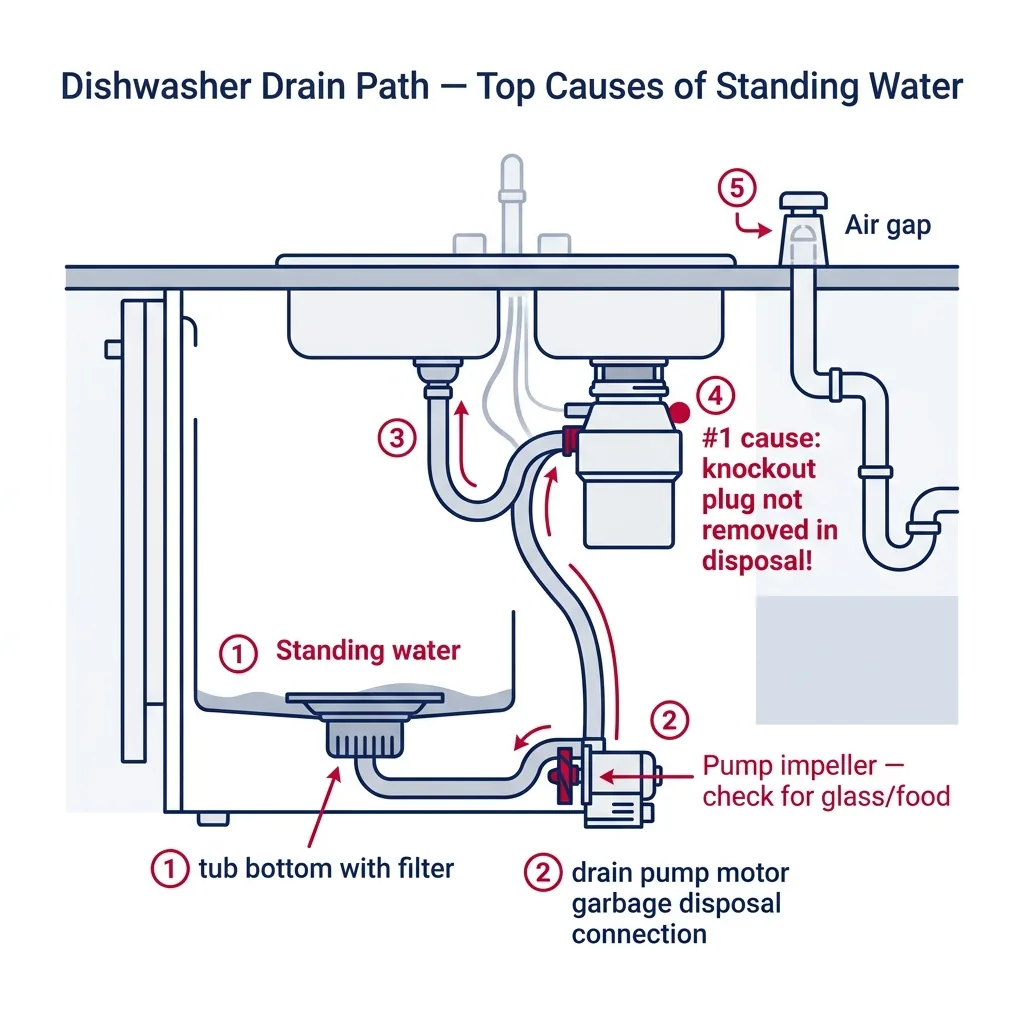
Tip: A clogged filter is the #1 cause of poor draining and poor cleaning. Manufacturers recommend cleaning it monthly, but most homeowners have never touched it. If yours looks like a swamp, that is your problem.
⚠ Warning: Always run gloved fingers around the sump rather than peering in close — there is almost always a glass shard somewhere.
Check the garbage disposal connection
This is the single most common cause when a dishwasher has never drained properly after a new install or a kitchen remodel. Look under the sink at where the dishwasher drain hose connects to your garbage disposal. There is a knockout plug inside the disposal inlet that must be removed during installation — if the installer skipped it, water has nowhere to go. Disconnect the hose, look inside the disposal port with a flashlight, and if you see a solid white plastic disc, knock it out with a screwdriver and a hammer. Fish the plug fragment out of the disposal before reconnecting.
Tip: If you have a disposal but rarely use it, run it for 15 seconds before every dishwasher cycle. Food sludge accumulates in the disposal chamber and backs up into the dishwasher hose.
⚠ Warning: Never reach into the disposal — even unplugged. Use needle-nose pliers or tongs to remove the knockout fragment.
Inspect the drain hose for kinks and clogs
Pull the dishwasher forward (you may need to remove two screws at the top under the countertop). Trace the corrugated drain hose from the back of the dishwasher up to the high loop under the sink and over to the disposal or air gap. Look for sharp kinks where the hose was pinched against the wall — straighten any you find. Then disconnect both ends, hold the hose over a bucket, and blow through it (or run a coat hanger through). Greasy sludge buildup is common after 5+ years.
Tip: The drain hose should rise to a "high loop" at least 32 inches off the floor or be connected to an air gap on the countertop. Without that high loop, dirty sink water siphons back into the dishwasher — California plumbing code requires either an air gap or a high loop.
Clear the drain pump impeller
If the filter and hose are clean and the disposal connection is open, the impeller inside the drain pump is likely jammed. With power and water off, pull the dishwasher out and lay it on its back (towel under the door first). The drain pump is a small motor mounted to the bottom of the tub, usually on the left side. On most models you can twist off the pump cover from inside the tub (after removing the filter and sump cover) and access the impeller directly. Spin it with your finger — it should turn freely. If you find a piece of glass, a fruit-pit pit, or a toothpick wrapped around it, remove the obstruction and the pump will usually run again.
Tip: Bosch SHE/SHX series have a particularly accessible drain pump — pop off the white plastic cover inside the sump with a flat screwdriver and you are looking right at the impeller.
⚠ Warning: Cut-resistant gloves are essential here. Most impeller jams we see are glass shards from a wine glass that broke months ago.
Test the drain pump motor electrically
If the impeller spins freely but the pump still does not run during a drain cycle, test the motor with a multimeter. Disconnect the two pump wires and measure resistance across the terminals — a healthy drain pump reads roughly 50-300 ohms depending on brand (consult your service manual). Open circuit (OL) means a burned-out motor; replacement is $40-120 part, $150-250 with labor. You can also temporarily apply 120V directly to the pump (with the dishwasher unplugged from main power and using a known-good test harness) to confirm — but only do this if you are comfortable with hot wiring; otherwise just replace the pump.
⚠ Warning: Never apply voltage to a pump while it is still mounted with water in the sump — you will get sprayed.
Verify the check valve and run a test cycle
Some pumps have a small flapper or check valve at the discharge port that prevents drain water from flowing back. If the valve sticks open, water siphons back; if it sticks closed, water cannot leave. With the pump cover off, work the flapper with your finger — it should swing freely. Reassemble in reverse order, restore power and water, and run the shortest cycle (often "Rinse Only") to confirm the unit drains. Watch the floor under the sink for any leaks at the hose clamps you removed.
Tip: After any drain repair, run a hot empty cycle with a cup of white vinegar in the upper rack — this clears residual grease from the hose and pump.
If still failing — diagnose the control board signal
On rare cases (Samsung DW80 series, some Bosch 800 series with electronic controls), the pump and drain path are perfectly fine but the control board never sends the drain command. Symptom: pump never hums at any point in the cycle, even at the end. Use a multimeter to check whether 120V is reaching the pump terminals during a drain phase. No voltage = control board failure. Boards run $180-380 and are best replaced by a tech unless you are comfortable with control electronics.
Brand-specific notes
Some brands have known design quirks worth knowing about before you start.
Bosch
Bosch SHE, SHX, and SHP series (300/500/800) collect a surprising amount of sediment in the lower sump and pump cover even though they have a self-cleaning filter design. Pop off the white plastic pump cover at the bottom of the tub once a year — you will almost always find food sludge underneath. The drain pump itself (part 00611332 and similar) is one of the most reliable in the industry; if it has truly failed, the unit is probably 10+ years old.
KitchenAid
KitchenAid KDTM, KDTE, and KDPE series share the Whirlpool platform. The drain hose on these is notoriously skinny and clogs with grease around year 5-7. If clearing the filter does not solve it, blow compressed air through the disconnected drain hose — you will often dislodge a plug of solidified grease. Replacement hose is ~$25.
Whirlpool
Whirlpool WDT, WDF, and WDTA series often throw an "F8 E1" or "F9 E1" error for drain faults. The chopper blade in the sump (a small spinning blade that grinds food before it leaves) gets bound up by labels from canned goods and orange peels. Lift the chopper cover and clear the blade — this is a 2-minute fix that resolves most "drain pump won't spin" errors on these models.
Samsung
Samsung DW80 and DW60 series have well-documented control board failures that present as drain faults — the pump is fine but never gets a signal. Look for an "OE," "5E," or "LE" code. If the pump hums normally during the wash phase but goes silent at drain time, the board is the suspect. Samsung extended warranty on some models covers this; check your serial number on Samsung's site before paying out of pocket.
LG
LG LDF and LDP series use a direct-drive drain pump that is quiet but glass-sensitive. A single shard from a broken wine glass will jam the impeller. The pump on LG models is accessed from the bottom (tip the unit back) rather than from inside the tub — keep towels handy because residual water always drips.
What our techs see most often
On dishwasher no-drain calls in the LA area we run a quick triage on the phone: when did it stop draining, was a disposal recently installed, and have you ever cleaned the filter? About a third of these turn out to be the disposal knockout plug never punched out — usually after a kitchen remodel or fridge swap where a contractor hooked up the dishwasher line and skipped the step. We tell those callers to check the disposal port first before booking; saves them a $90 diagnostic fee.
When to call a professional
- → You have cleared the filter, hose, and disposal connection but standing water remains
- → The drain pump motor is humming but not moving water and the impeller is not jammed
- → Error code points to the control board (E24/E25 on Bosch, OE on Samsung, F9 on Whirlpool with no chopper jam)
- → Water leaks from the bottom of the dishwasher whenever it tries to drain — likely a cracked sump or split hose internal to the unit
- → The unit is hardwired and you are not comfortable working in the breaker panel
- → You smell burnt plastic from the pump area (motor windings burned out — replace, do not run again)
Dishwasher Maintenance & Replacement Tasks
Step-by-step guides for individual maintenance jobs related to this appliance.
How to Clean a Dishwasher Filter (All Brands)
How to Clean Dishwasher Spray Arms (Unclog the Jets)
How to Descale a Dishwasher with Vinegar or Citric Acid
How to Replace a Dishwasher Door Gasket
Frequently asked questions
Why is there standing water in my dishwasher after every cycle?
A small amount (under a cup) at the bottom of the sump is normal on Bosch and other European-style dishwashers — it keeps the pump seal from drying out. But more than that, especially dirty water reaching the heating element, indicates a drain blockage. Start with the filter and the garbage disposal connection.
Can I use vinegar or baking soda to unclog my dishwasher drain?
Vinegar and baking soda will not clear a physical blockage like a glass shard or a knockout plug. They can break down minor grease buildup in the drain hose if poured in and left to sit. Run a cup of white vinegar in the upper rack on a hot empty cycle once a month as preventive maintenance.
How much does it cost to fix a dishwasher that won't drain?
A clogged filter or disposal knockout is free — just your time. A new drain hose runs $25-40 in parts. A replacement drain pump is $150-280 installed. If the control board has failed, expect $280-450. At Axis we charge a $90 diagnostic fee that is credited toward the repair.
Should I run the garbage disposal before starting the dishwasher?
Yes. The dishwasher drains into the disposal chamber on most installations. If the disposal is full of food scraps, the dishwasher water has nowhere to go and backs up into the tub. A 15-second run before each cycle clears the path.
My dishwasher is brand new and has never drained right — what do I do?
Almost certainly the installer forgot to remove the garbage disposal knockout plug. This is so common it is the first thing we check. Look under the sink, disconnect the dishwasher drain hose from the disposal, shine a light into the disposal inlet — if you see a solid white plastic disc, that is your problem. Knock it out with a flat screwdriver.
Related Repair Guides
Dishwasher Not Cleaning Dishes Properly: Fix Guide
Dishes that come out gritty, filmy, or still flecked with food are usually not a detergent problem — they are a water problem. Hard water mineral deposits, clogged spray arm jets, and a starved water inlet valve cause roughly 80% of these complaints, especially in Southern California where calcium and magnesium levels run high. Most fixes take 30-90 minutes with no special parts.
Dishwasher Leaking Water on the Floor: Causes and Fixes
Water on the kitchen floor in front of or beside the dishwasher is one of the more urgent service calls — every cycle that runs makes the damage worse. The good news is that the source is almost always one of five places: the door gasket, the door itself not closing flush, the water inlet valve, a hose connection, or the float assembly. Most leak sources can be diagnosed in 30 minutes and fixed for under $50.
How to Clean a Dishwasher Filter (All Brands)
A clogged filter is the number one cause of gritty dishes and foul odors. Learn how to locate, remove, and properly scrub your dishwasher's filter assembly to restore peak cleaning performance and protect your drain pump.