
At a glance
Symptoms
- • White, chalky residue coating the tub walls and inside of the door
- • Glassware coming out cloudy or with a white film
- • A gritty, sandy texture left on clean plates and bowls
- • Reduced water pressure from the spray arms
- • Musty, damp odors lingering between wash cycles
- • Rust-like or brown stains on the stainless steel tub (often iron deposits mixed with calcium)
- • Detergent not fully dissolving or remaining clumped in the dispenser
Common causes
- • Dissolves calcium and magnesium buildup that blocks the tiny jets on your spray arms
- • Prevents mineral scale from seizing the wash motor impeller, a common failure in hard water areas
- • Extends the life of the heating element by removing insulating mineral crust
- • Improves detergent efficiency, as scale buildup neutralizes the cleaning enzymes in your soap
- • Stops hard water deposits from hardening and tearing the rubber seals around the pump and door
- • Clears the optical soil sensor so the dishwasher can accurately determine cycle length
Safety First — Read Before You Start
- •Never mix white vinegar and bleach, or use them in the same cycle—this chemical reaction creates toxic chlorine gas.
- •Wait for the exposed heating element at the bottom of the tub to cool completely before wiping down the interior.
- •Avoid using abrasive scouring pads, steel wool, or harsh wire brushes that can permanently scratch stainless steel interiors and trigger rust.
- •Always run the dishwasher empty during a descaling cycle; the high concentration of acid can etch or damage your dishes and silverware.
Tools & supplies you'll need
- Distilled white vinegar (2 cups)
- Citric acid powder (3-4 tablespoons, preferred for severe scale)
- Baking soda (1 cup)
- Dishwasher-safe bowl or measuring cup
- Soft-bristle toothbrush or detailing brush
- Microfiber cleaning cloths
- Toothpick or safety pin (for clearing spray arm holes)
Step-by-step instructions
Empty the Dishwasher and Inspect the Tub
Start by completely emptying the dishwasher. Remove all plates, silverware, and pots. Slide the bottom rack completely out and set it aside to give yourself clear access to the bottom of the tub. Take a flashlight and inspect the heating element, the base of the spray arms, and the drain sump area. In Southern California areas like LA and Orange County, where water hardness frequently exceeds 250-300 ppm, you'll likely see a thick white crust around the base of the heating element and inside the filter housing. Use a damp microfiber cloth to wipe up any loose food debris or grease sitting in the bottom before we tackle the hard minerals.
Tip: Check the detergent dispenser door mechanism. If it feels sticky or has white crust around the latch, wipe it down with a damp cloth so it opens properly during the cleaning cycle.
Remove and Clean the Filter Assembly
Descaling won't be effective if the water can't circulate properly. Twist the main cylindrical filter assembly counterclockwise and pull it straight up. Remove the flat mesh screen beneath it if your model has one. Take these components to the sink. You will likely find a mixture of grease, food particles, and calcium scale clogging the fine mesh. Scrub the filter gently with a soft-bristle toothbrush under warm running water. If the scale is heavily caked on the filter, let it soak in a bowl of warm water and a half-cup of white vinegar for 15 minutes before scrubbing. Once clean, lock the filter back into the bottom of the dishwasher.
⚠ Warning: Never run the dishwasher without the filter locked securely in place. A loose filter will allow hard debris to enter the wash pump, potentially destroying the impeller.
Option 1: The Vinegar Descaling Cycle
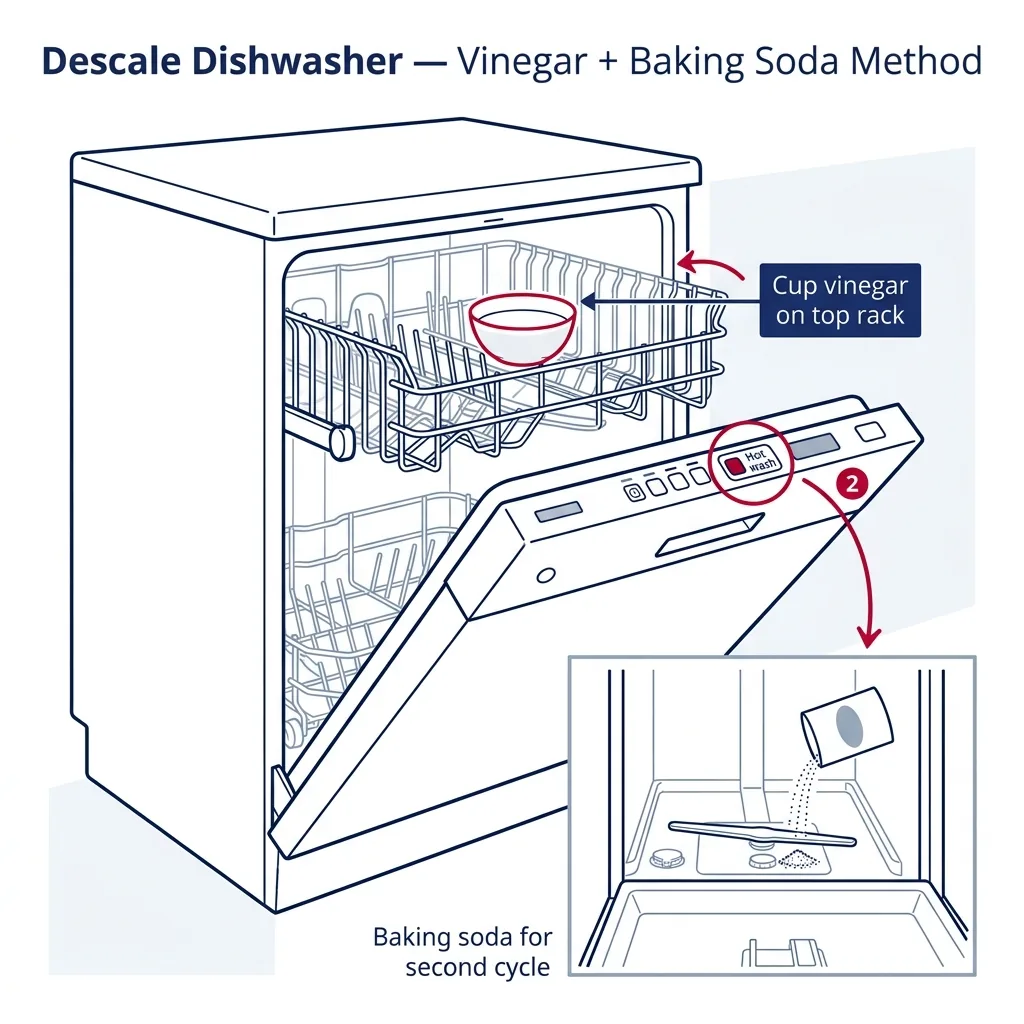
For moderate hard water buildup, distilled white vinegar is an excellent, safe acid. Fill a dishwasher-safe bowl or measuring cup with 2 cups of distilled white vinegar. Place this bowl upright on the top rack of the empty dishwasher. Do not pour the vinegar directly into the bottom of the tub; modern dishwashers run a brief drain cycle at the very beginning of a wash, which would immediately pump all your vinegar down the drain. Close the door and select the hottest, longest cycle available—usually labeled 'Heavy Duty,' 'Pots & Pans,' or 'Sanitize.' The hot water will slowly overflow the bowl, distributing the vinegar evenly throughout the cycle to dissolve the calcium and magnesium deposits.
Tip: If your dishwasher has a 'High Temp Wash' or 'Heated Wash' option, engage it. The hotter the water, the more effectively the acid will break down the mineral bonds.
Option 2: The Citric Acid Deep Clean (For Severe Scale)
If you live in a coastal or hillside area with exceptionally hard water, vinegar might not be strong enough. Citric acid powder is the professional's choice for deep descaling. Fill your dishwasher's main detergent cup with 3 to 4 tablespoons of food-grade citric acid powder and close the dispenser door. Sprinkle an additional tablespoon directly onto the floor of the tub. Run a normal cycle with the hottest water setting. Citric acid is highly effective at dissolving stubborn calcium carbonate and rust stains without damaging rubber seals. It's the primary active ingredient in commercial descalers like Affresh or Lemi Shine, but buying pure citric acid in bulk is much more cost-effective.
⚠ Warning: Do not use citric acid if your dishwasher has a patterned or custom-painted interior, as high concentrations of the acid can cause fading. It is perfectly safe for standard stainless steel and plastic tubs.
The Baking Soda Finish (Odor Neutralization)
Once the vinegar or citric acid cycle has completely finished, open the dishwasher door. The tub should look significantly brighter and free of white residue. However, the machine may smell strongly of vinegar or dampness. To neutralize these odors and provide a final polish, sprinkle 1 cup of baking soda evenly across the bottom of the tub. Run a 'Short,' 'Quick,' or 'Rinse Only' cycle using hot water. The baking soda acts as a mild, non-abrasive scouring agent that eliminates lingering smells and leaves the stainless steel interior gleaming.
Tip: Leave the dishwasher door cracked open for an hour after this final cycle finishes. Allowing the interior to air dry completely prevents the immediate return of musty odors.
Clear the Spray Arm Jets
Even after a chemical descale, physical chunks of calcium can remain lodged in the spray arm jets. Spin both the upper and lower spray arms by hand to ensure they move freely. Inspect the tiny water exit holes along the arms. If you see any white blockages, use a wooden toothpick or a safety pin to carefully dislodge the mineral deposits. Do not use a drill bit or anything that will permanently widen the holes, as this will drop the water pressure and ruin the spray pattern. If the arms are heavily clogged, most can be unclipped or unscrewed easily so you can rinse them out directly under the sink.
Wipe Down the Door Gasket and Edges
The descaling cycles clean the interior of the tub, but they don't reach the outer edges of the door or the rubber door gasket. Take a microfiber cloth dampened with a 50/50 mix of warm water and vinegar. Wipe along the sides and bottom edge of the door, paying special attention to the folds of the rubber gasket. This area is notorious for collecting a nasty slurry of soap scum, hard water scale, and food bacteria. Gently pull back the folds of the seal to clean inside them, being careful not to stretch or pull the gasket out of its track.
Brand-specific notes
Some brands have known design quirks worth knowing about before you start.
Bosch
On Bosch 100, 300, 500, and 800 series dishwashers, severe hard water scale often triggers the dreaded E24 (drain error) code. The scale builds up inside the tiny drain pump impeller housing. Regular descaling keeps this impeller free. Also, Bosch's three-part mesh filter system is highly susceptible to calcium blinding, so scrub it manually before running your descaling cycle.
KitchenAid
KitchenAid KDTM series models feature the ProWash system and heavily engineered, sometimes motorized, dynamic wash arms. These complex arms have tight clearances that get easily jammed by hard water scale. If your KitchenAid wash arms stop spinning, a heavy citric acid soak is the first step before replacing the $80 arm assembly.
Samsung
Samsung's StormWash and WaterWall models have unique moving parts at the bottom of the tub. The WaterWall deflector track, in particular, relies on smooth gliding action. Calcium buildup from hard water will cause the deflector motor to stall, resulting in an error code. Descale monthly to keep the track slick and operational.
LG
LG QuadWash systems utilize multi-motion spray arms with small internal gears that allow the arms to pivot back and forth. These gears absolutely hate calcium. If your QuadWash arms feel stiff or grind when you spin them by hand, the internal mechanisms are calcifying. Use a citric acid descale immediately.
Whirlpool
Whirlpool and Maytag dishwashers rely heavily on an OWI (Optical Water Indicator) soil sensor located in the sump. Hard water scale coats the lens of this sensor with a cloudy film, 'blinding' the machine and causing it to run excessively long cycles because it thinks the water is always dirty. Descaling clears this lens automatically.
What our techs see most often
Out here in the Valley and OC, our water hardness regularly hits 300 ppm, which absolutely wrecks dishwasher pumps. A monthly citric acid run is the cheapest preventative maintenance you can do to avoid a $300 wash motor replacement. I see perfectly good machines die in 3 years just because they choked on calcium.
When to call a professional
- → The dishwasher is leaking from underneath the unit; hard water scale may have permanently destroyed the wash motor shaft seal.
- → The wash motor simply hums but no water sprays, even after descaling (the calcium may have permanently locked the impeller, requiring motor replacement).
- → Water is not draining out of the tub at all, and the filter is completely clean.
- → The heating element is visibly blistered, cracked, or has white powder bursting from inside the metal tube.
- → You receive persistent leak detection error codes (like Bosch E15 or Samsung LC) that do not clear after a reset.
Related Dishwasher Troubleshooting
These troubleshooting guides cover problems this task can help solve.
Dishwasher Not Cleaning Dishes Properly: Fix Guide
Dishwasher Door Won't Latch or Stays Stuck: Fix Guide
Dishwasher Not Draining: How to Fix Standing Water
Dishwasher Soap Dispenser Won't Open or Release
Dishwasher Smells Bad: How to Remove Odors
Frequently asked questions
How often should I descale my dishwasher?
In Southern California areas with hard water (over 200 ppm), you should descale your dishwasher once a month. It costs about $1 in vinegar or $2 in citric acid per month, which is a massive saving compared to a $250-$400 wash pump replacement caused by calcium damage.
Can I use CLR or commercial descalers instead of vinegar?
Yes, commercial appliance descalers like Affresh or Lemi Shine work great and generally cost $8-$12 for a multi-pack. However, the active ingredient in most of these is just citric acid. Buying a 1lb bag of food-grade citric acid powder for $10 online is much more cost-effective for regular maintenance.
Why are my glasses still cloudy after descaling the machine?
If your glasses are still cloudy after a vinegar wash, they may be suffering from 'etching' rather than hard water scale. Etching is permanent micro-scratches in the glass caused by using too much detergent in soft water, or by excessively hot water. If a drop of vinegar on the glass doesn't clear the cloudiness, it's etched and cannot be fixed.
Does using rinse aid help prevent hard water buildup?
Absolutely. Rinse aid (like Jet-Dry, which costs about $10 a bottle) lowers the surface tension of the water, causing it to sheet off the dishes and the tub walls rather than sitting in droplets and baking on as hard water spots. It is essential for modern dishwashers, especially in hard water regions.
Is it safe to put bleach in the dishwasher to clean it?
You should generally avoid using bleach in a dishwasher, especially if it has a stainless steel tub, as bleach can cause pitting and rust. Furthermore, if bleach mixes with any residual vinegar or acidic food soils, it can create dangerous chlorine gas. Stick to vinegar or citric acid for descaling.
Related Repair Guides
Dishwasher Not Cleaning Dishes Properly: Fix Guide
Dishes that come out gritty, filmy, or still flecked with food are usually not a detergent problem — they are a water problem. Hard water mineral deposits, clogged spray arm jets, and a starved water inlet valve cause roughly 80% of these complaints, especially in Southern California where calcium and magnesium levels run high. Most fixes take 30-90 minutes with no special parts.
How to Clean Dishwasher Spray Arms (Unclog the Jets)
Are your dishes coming out with baked-on food or gritty residue? In Southern California, our extremely hard water loves to clog dishwasher spray arm jets with calcium scale, but unclogging them is an easy DIY task that instantly restores wash performance.
Dishwasher Smells Bad: How to Remove Odors
A stinky dishwasher usually means trapped food, a clogged filter, or hard water biofilm. Learn how to diagnose the root cause and banish those stubborn odors for good with basic household supplies.