
At a glance
Symptoms
- • Oven powers on and shows preheat but never reaches temperature
- • Oven runs but stays cold or only mildly warm
- • Bake mode does nothing, broil mode works (or vice versa)
- • Gas oven: igniter glows orange but burner never lights
- • Gas oven: no glow, no click, no flame at the burner tube
- • Electric oven: top half of the display lights but cooktop also dead (half-tripped 240V breaker)
- • F1, F2, F3, F7 error codes on the display
Common causes
- • Electric: broken bake element (visible blister, burn-through, or open circuit)
- • Electric: failed broil element (broiler stops, bake sometimes still works)
- • Electric: drifted or open oven temperature sensor (most common cause of "won't reach temp")
- • Electric: failed thermostat / temperature limiter
- • Electric: blown thermal fuse (after a runaway temperature event)
- • Electric: half-tripped 240V breaker — one leg dead, control board lights but no heat
- • Electric: control board (ERC) failure — no relay click on bake call
- • Gas: weak or failed igniter (does not draw enough current to open the safety valve)
- • Gas: broken bake or broil burner tube (rust-through, cracked weld)
- • Gas: failed gas safety valve (rare — usually misdiagnosed igniter)
- • Gas: gas supply shut off, manual valve closed, or LP/natural-gas regulator issue
- • Gas: control board not energizing the igniter circuit
Safety First — Read Before You Start
- •ELECTRIC: Trip the dedicated 240V double-pole breaker before removing the back panel or any element. Test with a voltage pen — both legs must be dead.
- •GAS: Shut off the gas supply at the appliance shutoff valve before opening the bottom of the oven or replacing the igniter. Do not work on gas with the supply live.
- •NEVER bypass the gas safety valve. It exists to prevent unburned gas from filling your kitchen if the burner fails to light.
- •If you smell gas at any point, stop work, leave the gas supply off, ventilate the kitchen, and call your gas utility before continuing.
- •Heating elements are extremely hot for hours after use. Confirm cool-to-touch before reaching in.
- •On wall ovens or built-ins, do not pull the unit out unsupported — they are heavy and can tip; have a helper or use a furniture dolly.
Tools & supplies you'll need
- Multimeter with continuity and resistance modes
- Phillips and 1/4-inch nut driver
- Clamp meter (for measuring igniter current draw on gas models — the gold-standard test)
- Flashlight
- Replacement oven thermometer (independent of the oven's sensor) for sanity-check
- Cordless drill (for oven removal on some built-in models)
- Voltage tester or non-contact pen (for confirming 240V live legs at the breaker)
Step-by-step instructions
Identify whether it is gas or electric and verify power/gas supply
On an electric oven, go to the breaker panel and find the dedicated 240V double-pole breaker (usually labeled "Range" or "Oven"). Trip it fully off and back on — sometimes one of the two legs trips internally without visibly moving the handle. With the oven powered, use a voltage pen at the back terminal block to confirm both 120V legs are live. On a gas oven, confirm the manual gas shutoff valve behind the oven is fully open (handle parallel to the pipe) and that other gas appliances in the home are working — if the cooktop also will not light, the issue is upstream.
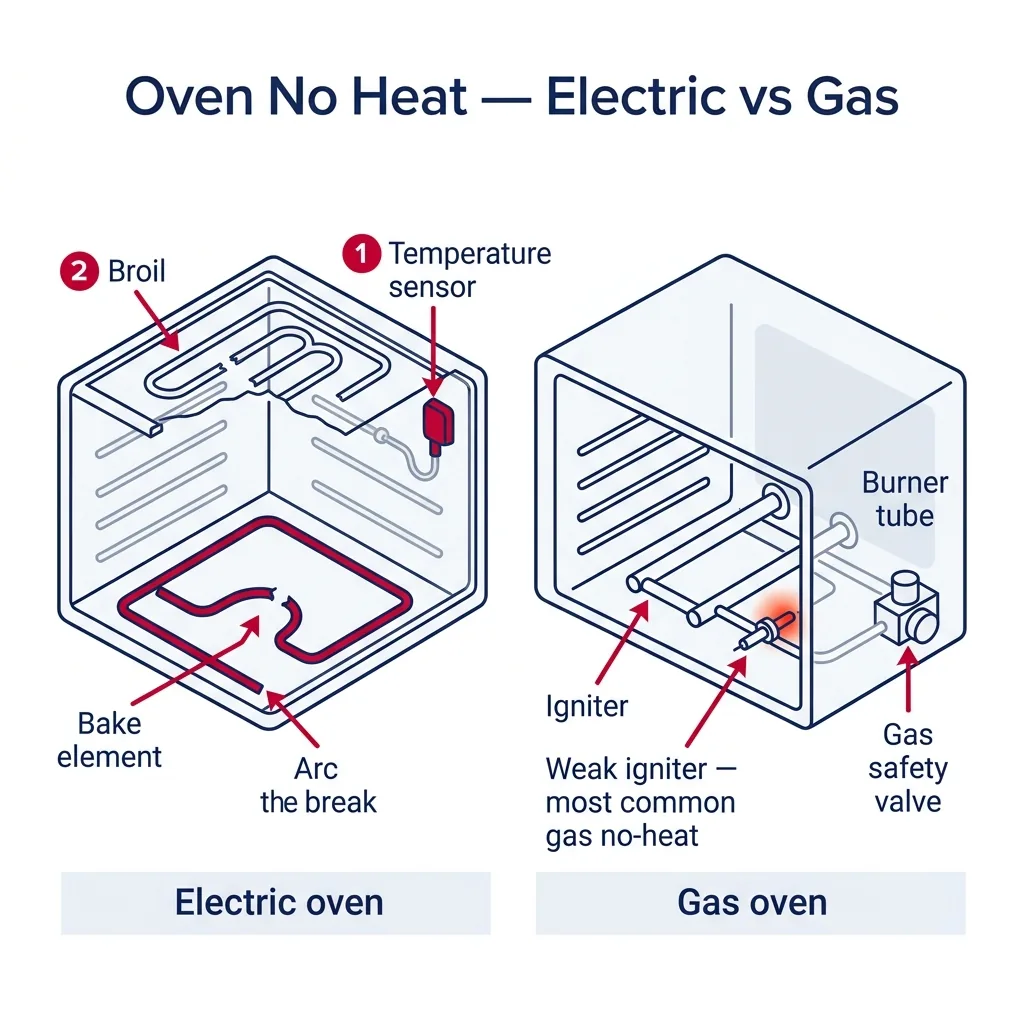
Tip: On built-ins where the breaker is shared between the oven and the cooktop, a half-tripped breaker is the single most common "no heat" call we get — and embarrassing for the customer when we charge a $90 trip fee for a breaker reset.
⚠ Warning: Never assume "the breaker is on" because the display lights up. The clock and controls run on 120V; the heat needs both 120V legs.
ELECTRIC — visually inspect the bake and broil elements
With power off, look at the bake element (bottom of the oven, U-shaped tube) and the broil element (top, ribbon or tube). A failed element almost always shows visible damage: a blistered spot, a burn-through hole, or a crack with the white insulation visible. Run a cycle in bake mode and watch the bottom element through the door window — it should glow uniformly orange within 60-90 seconds. If only one section glows, the element is partially shorted. If neither glows, move to the multimeter test in step 3. Replacement bake element: $30-90. Broil element: $40-110. Both swap from inside the oven cavity by removing two screws and pulling forward — pure 10-minute job.
⚠ Warning: Always replace an element the moment you see a burn-through. Continuing to use it can short to the oven cavity and trip the breaker — or worse, arc to a rack.
ELECTRIC — multimeter-test the bake element, broil element, and sensor
With power off and elements disconnected (one wire each), measure resistance across the element terminals. A healthy bake element reads 19-115 ohms (depending on wattage); a healthy broil element reads roughly 13-35 ohms. Open circuit (OL) = element is dead. Then measure the oven temperature sensor (RTD) — a thin metal probe near the back of the cavity, usually two screws to remove. At room temperature it should read approximately 1080 ohms. If it reads open or wildly out of spec, replace it ($25-55 part). A drifted sensor is the #1 cause of "oven only reaches 200°F" complaints — the controller thinks it has hit setpoint when it has not.
Tip: When in doubt, swap a $30 sensor before you spend hours chasing the control board. We do this preemptively on every "low temperature" call.
ELECTRIC — check thermal fuse and thermostat
If both elements and the sensor test good but the oven still does not heat, check the thermal fuse on the back panel. Pull power, remove the rear sheet metal cover, and locate a small disc-shaped fuse with two wires — there are typically one or two of them. With a multimeter, test for continuity. Open = blown, replace ($15-30 part). Thermal fuses blow when an actual overheat event occurred (often during self-clean cycles), so investigate why before assuming a one-off failure. Same approach for the high-limit thermostat. On older mechanical-thermostat ovens (pre-2005), the entire thermostat assembly may be the failure point — typically $60-130 part.
⚠ Warning: A repeatedly blowing thermal fuse means an underlying overheat issue (stuck relay, shorted element). Do not just keep replacing the fuse.
GAS — observe the igniter on a bake call
Open the oven door, turn on the bake setting at 350°F, and watch the burner tube at the bottom (you may need to lift out the bottom oven panel to see). Within 60-90 seconds the igniter should glow bright orange-white, and within 90 seconds gas should release and ignite with a soft whoosh. Three failure modes: (a) igniter never glows at all = bad igniter, broken wire, or no signal from the board; (b) igniter glows weak orange (not bright white) and gas never releases = igniter has aged, no longer drawing the 3.2-3.6 amps required to open the safety valve; (c) igniter glows brightly but no gas = failed safety valve. Outcome (b) is by far the most common — we replace these every week. Replacement igniter: $40-110 part, 30 minutes labor.
Tip: A weak igniter test without a clamp meter: if the igniter takes more than 90 seconds to reach full orange, replace it. They go weak before they go fully open.
⚠ Warning: Never strike a match or lighter to "help" the burner light. If the igniter is not opening the safety valve, no gas is flowing, and adding a flame is pointless. If gas is flowing but not igniting, an open flame causes a flash.
GAS — clamp-meter the igniter current draw
The definitive igniter test is current draw, measured with a clamp-meter on one of the two igniter wires during a bake call. Healthy carborundum igniters draw 3.2-3.6 amps; healthy flat ceramic (Norton-style) draw 2.5-3.0 amps. Anything below the spec range means the igniter has aged enough that it cannot pull the safety valve open even though it still glows. This is the single most-misdiagnosed gas oven failure — homeowners see a glowing igniter and assume it is fine. Replace and re-test.
Tip: Igniters are the wear-out part of a gas oven. On most brands they last 4-8 years. If your oven is over 5 years old and showing intermittent ignition, just replace it.
Reassemble, calibrate, and verify with an independent thermometer
After any repair, run an empty bake cycle at 350°F for 30 minutes with an independent oven thermometer placed on the center rack. Door closed. Check at 30 minutes — actual temperature should be within 25°F of setpoint. If it reads consistently low or high by more than 25°F, the oven needs calibration (most modern ovens have a calibration mode in the menu — typically Settings > Oven Calibration > +/- 35°F). If a brand-new sensor still reads low, the control board is suspect. For ovens older than 12 years where the board has failed, board replacement ($280-480) often does not pencil out vs. a new range.
Brand-specific notes
Some brands have known design quirks worth knowing about before you start.
GE Profile / Cafe
GE Profile (PT, PB, PHB) and Cafe (CTS, CT) wall ovens have a known issue with the oven sensor reading low after years of self-clean cycles cooking the probe. Symptom: oven reaches 250°F instead of 350°F. Sensor replacement is $30-55 and is the first thing to swap on these. GE control boards (the ERC under the front bezel) are also a known failure point on 2017-2021 production — if a new sensor and elements do not solve it, the board is next.
Whirlpool / KitchenAid
Whirlpool (WOS, WFE) and KitchenAid (KOSE, KFEG) gas ovens use a common Norton flat ceramic igniter that goes weak around years 4-7. Symptom: oven works fine in summer, refuses to light in winter when ambient is colder. We replace these by the case. Bake element on the electric versions of these ranges is also a common burnout — visual inspection usually catches it.
Samsung
Samsung NX, NE, and NV series have a high control-board failure rate — much higher than the rest of the industry. F1E1, F1E2, and SE error codes on these models almost always point to the board. Boards are $280-450. Before condemning the board, confirm that the sensor and elements check out, because Samsung will sometimes throw board errors when a sensor opens. NX58 gas range igniters are also a frequent fail point (4-5 years).
LG
LG LRE, LRG, and LSE series often throw an "F19" or "F9" code for sensor / heating fault. The sensor is buried at the back of the oven cavity behind a cover plate; replacement is $40-70 part. LG ovens calibrate easily through the menu — after a sensor swap, expect to dial in +5 to +15°F adjustment.
Frigidaire / Electrolux
Frigidaire (FFGF, FGGF) and Electrolux (EI, EW) electric models have a known thermal-fuse-on-the-back-cover issue: the fuse sits very close to the broil element vent and trips itself during normal high-heat cooking. If your Frigidaire ranges work fine for a while then suddenly stop heating after a high-broil session, the thermal fuse is the culprit. $20-30 part, 15 minutes. Repeated trips suggest the fuse needs to be relocated slightly during reinstall — common service bulletin item.
What our techs see most often
On gas ovens we hear the same story every week: "the igniter glows so it must be fine — must be the gas valve." Almost never. The igniter is doing its visual job (glowing) but failed its real job (drawing enough current to physically pull the bi-metallic safety valve open). We replace 30+ igniters a month across LA and OC; we have replaced maybe 4 actual gas safety valves total in the last two years. If you have a gas oven that wont heat and the igniter glows, just replace the igniter — it is a $40-90 part and a 30-minute job, even if the diagnostic feels uncertain.
When to call a professional
- → Gas smell at any point during diagnosis or repair — stop and call utility
- → Suspected gas safety valve failure (igniter is confirmed good with clamp meter, no gas flow)
- → Control board (ERC) replacement on a built-in or high-end unit — wiring is unforgiving
- → Wall oven that requires removal — these are heavy, often 100+ lbs, and tip easily
- → Repeatedly blowing thermal fuse despite element and sensor replacement — there is an underlying short
- → Burnt or melted wiring at the back terminal block (240V faults are not DIY territory)
- → Oven is under manufacturer warranty — DIY voids most coverages on heating components
Oven Maintenance & Replacement Tasks
Step-by-step guides for individual maintenance jobs related to this appliance.
Frequently asked questions
My oven preheats but never reaches the set temperature — what is wrong?
On an electric oven, this is almost always a drifted oven temperature sensor reading higher than the actual temperature, which causes the controller to shut off heating early. Replace the sensor ($25-55) before you replace anything else. Less commonly, a partially-shorted bake element produces less heat than rated.
How do I know if my gas oven igniter needs replacing?
Two signs: (1) it takes more than 90 seconds to glow bright orange-white, or (2) it glows but the burner never lights with a whoosh. The definitive test is a clamp meter on the igniter wire during a bake call — healthy units pull 3.2-3.6 amps. Anything less means the igniter is too weak to open the safety valve and needs replacement.
Is it safe to use my oven if only the bake or only the broil works?
Short-term yes, but plan to fix it. A failed broil element does not affect bake safety. A failed bake element with a working broil can be used for top-down cooking, but the burned-out element can short to the oven cavity and trip the 240V breaker. Replace within a few weeks.
How much does it cost to fix an oven that is not heating?
Bake element: $30-90 part, $180-260 installed. Oven temperature sensor: $25-55 part, $150-220 installed. Gas igniter: $40-110 part, $200-300 installed. Thermal fuse: $15-30 part, $140-200 installed. Control board: $280-480 part, $480-700 installed. At Axis our $90 diagnostic fee is credited toward the repair.
Why does my oven heat but the food still comes out raw or undercooked?
If the oven heats some but undercooks, it is reaching a lower temperature than displayed. This is a sensor calibration issue 90% of the time. Place an independent oven thermometer inside, run the oven at 350°F for 30 minutes, and compare. If the actual reading is more than 25°F low, replace the sensor or use the oven's built-in calibration adjustment.
Related Repair Guides
Oven Heats Unevenly: Why and How to Fix
Cookies darker on one side of the sheet, cakes that rise lopsided, casseroles bubbling on the back but pale at the front — uneven oven heating is one of the most frustrating issues to diagnose because the oven still "works." The cause is usually a convection fan, a drifted temperature sensor, a weak bake element, or simple operator factors like preheating habits and pan choice. Most fixes are under an hour and many cost nothing at all.
Oven Broiler Not Working: Causes and Fixes
When your oven's broiler refuses to heat, searing steaks and melting cheese becomes impossible. Discover the common culprits—from burnt-out electric elements to faulty gas igniters—and learn how to troubleshoot the problem safely.
How to Calibrate Your Oven Thermostat
Stop burning your cookies or serving undercooked roasts. Calibrating your oven's thermostat is a simple, no-tools-required tweak that ensures the temperature on your display matches the actual heat inside.