
At a glance
Symptoms
- • White, chalky residue visible on the washer drum or agitator.
- • Clothes coming out feeling stiff, scratchy, or looking unusually dingy.
- • A musty, damp odor coming from the washer tub that clings to your laundry.
- • Slow draining or frequent unbalanced load errors caused by sensor buildup.
- • Visible crusty scale deposits on the door boot seal of front-load machines.
- • Detergent not fully dissolving or leaving powdery streaks on dark clothing.
Common causes
- • Los Angeles and Orange County tap water averages 250-400 ppm (very hard), depositing calcium and magnesium with every single wash cycle.
- • Mineral scale coats the internal heating element, forcing it to work harder and increasing your LADWP or SCE energy bill.
- • Calcium buildup destroys rubber seals and hoses over time, leading to sudden, catastrophic leaks and expensive home water damage.
- • Scale buildup inside the drain pump housing can seize the impeller, resulting in a $150-$300 pump replacement.
- • Detergent binds with hard water minerals instead of cleaning clothes, forcing you to use more soap and fabric softener than necessary.
- • Trapped moisture inside the porous mineral scale creates a perfect breeding ground for mold and mildew in coastal areas like San Diego and Ventura.
Safety First — Read Before You Start
- •Never mix white vinegar directly with liquid bleach; doing so creates highly toxic chlorine gas.
- •Always unplug the washer before manually scrubbing deep inside the drum, around the agitator, or removing any panels.
- •Do not use abrasive scouring pads like steel wool on the washer drum, as this will scratch the stainless steel and promote rapid rusting.
- •If using cleaning-grade vinegar (10-30% acidity), ensure the room is well-ventilated and wear gloves to protect your skin.
Tools & supplies you'll need
- 4 cups of distilled white vinegar (5% acidity minimum)
- 1 cup of baking soda
- Microfiber cleaning cloths
- Old toothbrush or small soft-bristle detailing brush
- Spray bottle (for spot treating seals and dispensers)
- Flashlight (to inspect the drum and gasket folds)
Step-by-step instructions
Prep and Spot Clean the Problem Areas
Before running a descaling cycle, tackle the areas where hard water minerals and mold hide from the main wash water. Mix a 50/50 solution of white vinegar and water in a spray bottle. Spray the rubber door gasket (boot seal) heavily—especially pulling back the bottom fold where stagnant water sits. Use an old toothbrush to gently scrub away the chalky white calcium deposits and any black mildew spots. Next, pull out the detergent dispenser drawer (usually there is a push-tab in the back to release it) and soak it in a sink of warm water and vinegar. A replacement dispenser drawer can cost anywhere from $40 to $80, so keeping it clean prevents the siphon tubes from clogging with encrusted fabric softener and hard water scale.
Tip: Use a flashlight to check the drain holes at the bottom of the rubber gasket. If they are clogged with lint and scale, use a toothpick to clear them so water can drain properly.
⚠ Warning: Be gentle when scrubbing the rubber gasket. Puncturing or tearing the boot seal will result in a $150-$250 replacement part cost plus labor.
Add the Distilled White Vinegar
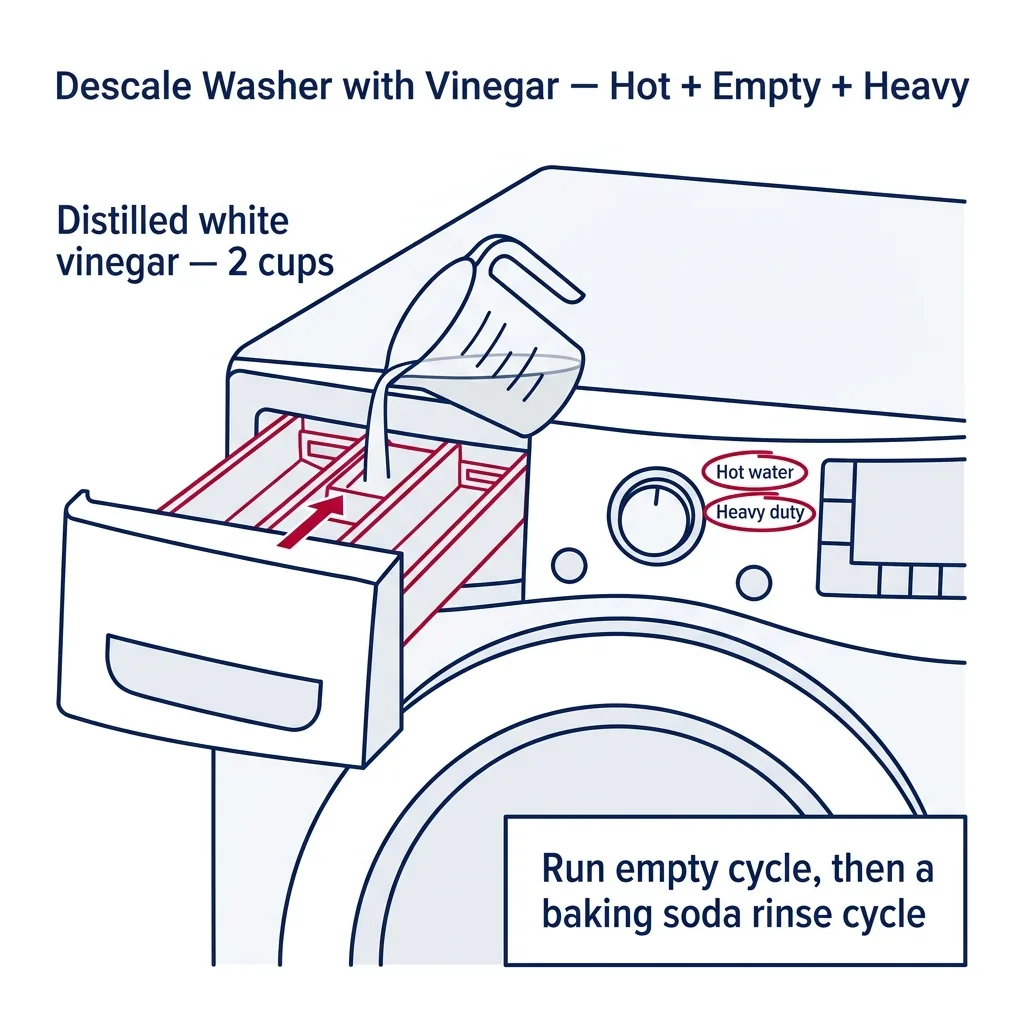
Ensure the washer drum is completely empty. Pour 4 cups of plain, distilled white vinegar directly into the bottom of the drum. If you have a front-loading machine, you can also pour half a cup of vinegar into the liquid detergent compartment of the dispenser drawer to help descale the inlet hoses and valves as the water flushes through. Do not add any clothes, laundry detergent, or fabric softener. The acetic acid in the vinegar is the active ingredient that naturally breaks down the stubborn calcium carbonate left behind by our hard Southern California water.
Tip: Buy cheap, standard 5% acidity white vinegar in gallon jugs (usually around $3-$4) from the grocery store. Avoid apple cider or colored vinegars as they can leave behind sugars or stains.
Run the Hottest, Longest Cycle Available
Turn on your washing machine and select its hottest water setting. Look for a 'Sanitize', 'Allergen', 'Tub Clean', or 'Heavy Duty' cycle. You want the water temperature as high as possible to activate the vinegar and accelerate the dissolution of the scale. If your washer has an 'Extra Rinse' option, turn it on to ensure all loosened minerals are flushed out. Let the machine run the entire cycle uninterrupted. As the drum spins and agitates, the hot acidic water will break down the crusty mineral layers on the hidden outer tub, the back of the stainless steel basket, and the internal heating element.
Tip: If you have a top-loader, let the machine fill with hot water and agitate for 5 minutes, then pause the cycle and let the vinegar water soak in the tub for an hour before letting it finish.
Follow Up with a Baking Soda Chaser
Once the vinegar cycle has completely finished and drained, it is time to neutralize the environment. Sprinkle 1 cup of plain baking soda directly into the empty drum. Run another hot water cycle (a 'Quick Wash' on hot is fine here if a full 'Tub Clean' takes too long). The baking soda acts as a very mild, safe abrasive to scrub away any remaining loosened scale. More importantly, it neutralizes any leftover acetic acid from the vinegar. Baking soda is also a fantastic deodorizer, absorbing the sour, musty smells that plague so many front-load washers in humid coastal homes.
⚠ Warning: Do not add the baking soda and vinegar at the same time. They will immediately react, fizz up, and neutralize each other, rendering the descaling properties of the vinegar completely useless.
Wipe Down and Air Dry
After the baking soda cycle finishes, take a dry microfiber cloth and wipe down the inside of the drum, the inside of the glass door, and the rubber gasket. Pay special attention to the folds of the gasket to ensure no standing water remains. Leave the washer door wide open to let the interior air dry completely. In Southern California's dry inland climates like the San Fernando Valley, this usually only takes an hour or two. However, if you live in a more humid coastal area, leaving the door cracked permanently between washes is the absolute best way to prevent mold and scale from returning.
Tip: Keep a small microfiber towel draped over the washer specifically for wiping the door and gasket after your last load of laundry for the day. It takes 10 seconds and extends the life of your machine significantly.
Brand-specific notes
Some brands have known design quirks worth knowing about before you start.
LG
LG front-load washers (WM series) have a dedicated 'Tub Clean' cycle and specifically recommend running it every 30 washes. If you ignore descaling, the tiny air tube connected to the water level pressure switch can get clogged with calcium scale, causing the machine to overfill or throw an 'OE' (drain) or 'IE' (inlet) error code.
Samsung
Samsung's 'Self Clean+' technology flashes a reminder LED on the control board after 40 washes. Because Samsung uses a specialized silver-ion or steam heating element in many of their premium models, heavy scale buildup can cause the heater to overheat and burn out prematurely, resulting in an 'HE' error code and a $150-$200 element replacement.
Whirlpool
On Whirlpool Duet and Maytag Maxima front-loaders, the drain pump filter is notoriously difficult to access, often requiring the removal of the bottom front panel with a Torx driver. Descaling regularly prevents large calcium chunks from forming and clogging this hard-to-reach filter, saving you a frustrating teardown.
GE
GE's newer front-loaders feature the 'UltraFresh Vent' system with Microban blue rubber components. While this does an excellent job preventing mold, it does absolutely nothing to stop hard water scale. GE top-loaders with the infusor (impeller) plate are prone to scale buildup underneath the plate, which can cause a loud grinding noise during agitation. Vinegar dissolves this before it damages the drive splines.
Bosch
Bosch compact 24-inch washers heat their own water to very high temperatures internally, making them highly susceptible to rapid scale buildup on the heating element. Bosch sells a proprietary chemical descaler for about $15-$20, but regular vinegar maintenance works incredibly well to extend the life of these premium European units.
What our techs see most often
Out here in LA and Orange County, our water is essentially liquid rock at 300+ parts per million hardness. I'd estimate that 40% of the drain pump failures our techs see aren't from coins or hairpins, but from massive chunks of calcium scale breaking off the tub and jamming the impeller. A $3 jug of vinegar once a month saves a $250 repair bill.
When to call a professional
- → The washer is leaking from underneath the chassis, which could indicate that hard water scale has already eaten through the main tub seal or a critical internal hose.
- → The machine is making a loud roaring, grinding, or jet-engine noise during the spin cycle, meaning scale and water have bypassed the seal and ruined the main tub bearings.
- → The washer refuses to drain even after you have completed the descaling process, indicating the drain pump is likely seized with scale or permanently damaged.
- → Error codes related to heating elements (like HE, TE, or E05) persist, meaning the element has likely burned out due to scale encasement and requires professional electrical testing.
- → You smell burning rubber or electrical smoke during operation, which requires immediate professional diagnosis.
- → The machine trips your home's electrical breaker when it attempts to heat the water or spin.
Related Washer Troubleshooting
These troubleshooting guides cover problems this task can help solve.
How to Decode Washing Machine Error Codes (LG, Samsung, Whirlpool, GE)
Washing Machine Shaking and Vibrating: Causes and Fixes
Washing Machine Leaking from Bottom: Find and Fix the Source
Washing Machine Not Spinning: How to Fix It
Washing Machine Smells Bad: How to Eliminate Mold and Mildew
Frequently asked questions
Can I use bleach instead of vinegar to clean my washer?
No. Bleach is excellent for killing mold and bacteria, but it does absolutely nothing to dissolve hard water minerals. In fact, bleach can sometimes react with heavy scale to create a worse smell. Use vinegar for scale, and if you need to use bleach for mold, do it in a completely separate cycle on a different day to avoid creating toxic chlorine gas.
How often should I descale my washer in Southern California?
Because Los Angeles and Orange County have incredibly hard water (often exceeding 300 ppm), you should proactively descale your washer every 30 to 45 days. If you have a whole-home water softener system installed, you can stretch this maintenance to every 3 to 6 months.
Will vinegar damage the rubber hoses or door seals?
Occasional use of standard 5% white vinegar (once a month) diluted in a tub full of water is perfectly safe for your washer's synthetic rubber seals (EPDM). However, soaking seals in undiluted, high-concentration cleaning vinegar (10-30%) for extended periods can dry them out and cause premature cracking.
Is it worth buying commercial washing machine cleaners like Affresh or OxiClean?
Commercial tablets like Affresh (about $10-$15 for a pack of 6) are very convenient and contain sodium percarbonate, which is fantastic for lifting organic grime and eliminating odors. However, plain white vinegar is actually more acidic and often much more effective at dissolving heavy calcium scale for a fraction of the cost (around $3 a gallon).
Related Repair Guides
Washing Machine Smells Bad: How to Eliminate Mold and Mildew
A musty, swampy smell coming from your washing machine usually means mold, mildew, or a buildup of detergent biofilm. This guide walks you through deep-cleaning the gasket, clearing the drain pump filter, and flushing the tub to eliminate odors for good.
How to Clean a Washing Machine Drain Pump Filter
Cleaning your front-load washer's drain pump filter is one of the easiest and most effective maintenance tasks you can do. Grab some towels and a shallow dish, and let's clear out those trapped coins, lint, and bobby pins to get your washer draining perfectly again.
How to Remove Mold from a Front-Load Washer Gasket
Banish that swampy smell and black sludge from your front-load washer. This easy DIY guide walks you through safely cleaning your rubber door gasket and keeping mold away for good.