
At a glance
Symptoms
- • Washer rocks side-to-side or front-to-back during the high-speed spin
- • Loud banging or thumping sound that gets faster as the spin ramps up
- • Washer physically walks several inches across the floor over a few cycles
- • A persistent metallic "ringing" sound during spin (often shipping-bolt related on new installs)
- • Cabinet vibrates against the wall, dryer, or pedestal hard enough to chip paint or crack tile grout
Common causes
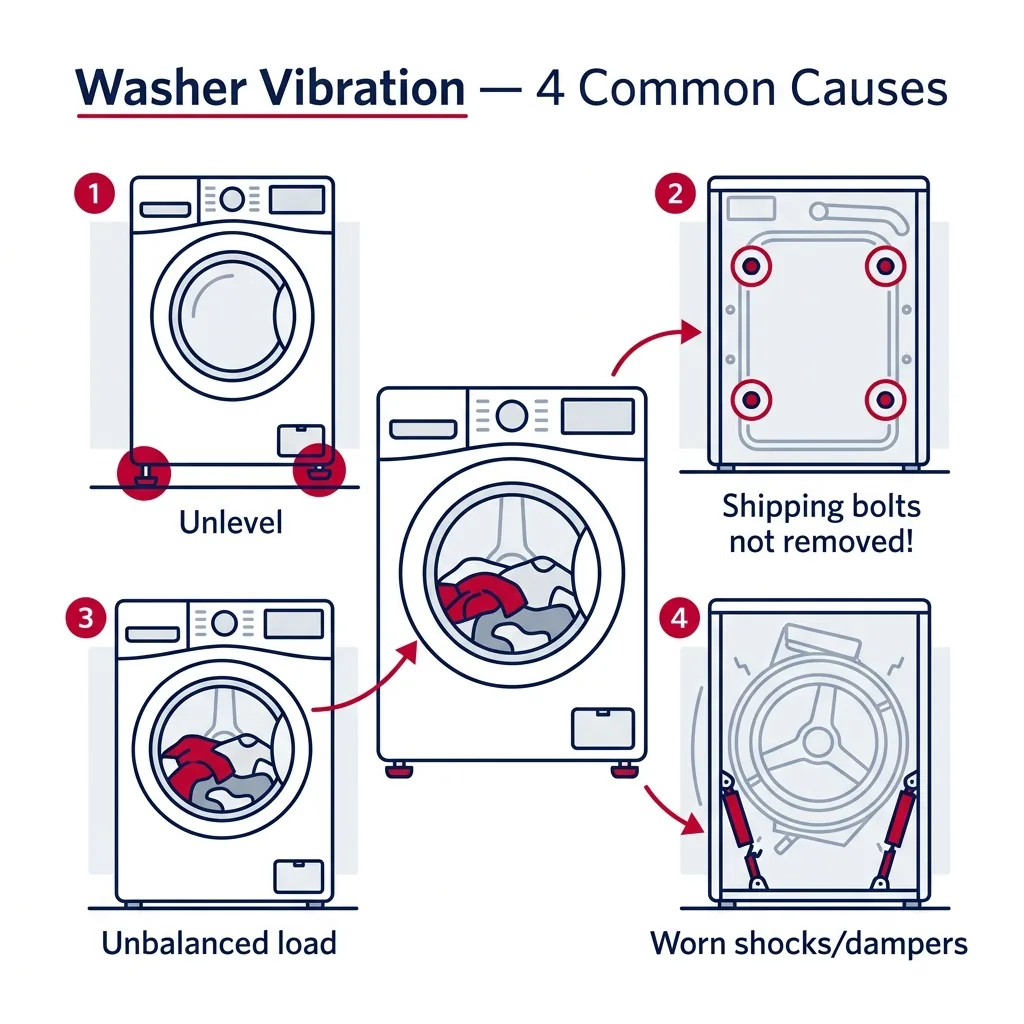
- • Washer is not level — feet are uneven or the floor itself is sloped (very common in older California homes built on hillside grades)
- • Shipping bolts were never removed after delivery — the bolts hold the drum rigidly and bypass the suspension
- • Unbalanced load (single heavy item like a comforter on one side of the drum)
- • Worn or leaking shock absorbers / dampers (front-load) failing to dampen drum motion at 1000+ RPM
- • Broken or stretched suspension springs (top-load) letting the inner basket swing freely
- • Worn tub bearing on a front-loader — drum has play and clatters during spin
- • Pedestal not anchored to the washer or to the floor, allowing the whole assembly to walk
Safety First — Read Before You Start
- •ALWAYS unplug the washer before tipping, leveling, or accessing internal suspension components.
- •Front-load washers are heavy (180-250 lb) and top-heavy when tipped. Always work with a partner, especially when adjusting rear feet.
- •Do not run the washer with the cabinet open or the front panel removed to "watch" the drum spin — moving suspension components can pinch fingers.
- •If your laundry room has tile, lay down cardboard before tipping the washer — porcelain feet will chip tile.
- •Turn off both water supply valves before pulling the washer out from the wall to avoid stressing the fill hoses.
Tools & supplies you'll need
- Adjustable wrench or open-end wrench set (typically 13mm, 17mm, or 19mm for shipping bolts and feet)
- Bubble level (or a smartphone level app)
- Flashlight
- Pliers and channel-lock pliers
- Phillips and flat-head screwdrivers
- Work gloves
Step-by-step instructions
Confirm shipping bolts are removed (new installs only)
Every front-load washer ships with 3-4 large bolts (typically marked with red or yellow caps) on the rear panel that hold the drum rigid for transport. If yours was recently delivered and now shakes violently, this is almost certainly the cause. Look at the back of the washer — you will see large bolt heads or red plastic caps. Use a 17mm or 19mm wrench to remove all of them, then snap the supplied plastic plugs into the empty holes. Save the bolts in a labeled bag — you will need them if you ever move the washer.
Tip: About 1 in 10 self-installed washers we see in LA/OC have at least one shipping bolt still installed. If a delivery crew installed it but skipped removing the bolts, photograph the bolts and contact the retailer — many will refund the install fee.
⚠ Warning: Running a front-load washer even one full cycle with shipping bolts installed can damage the suspension permanently and void the warranty. If you suspect bolts were never removed, stop using the washer until you check.
Level the washer with a bubble level
Place a bubble level on top of the washer — first front-to-back, then side-to-side. The bubble should sit dead-center. If not, locate the four threaded feet at each corner of the cabinet. The front feet typically thread up and down by hand or with a wrench on the locknut; the rear feet on most modern washers are self-leveling (they ratchet down when the washer is tipped forward). Adjust the front feet first, lock the nut against the cabinet, then tip the washer forward 6 inches and let the rear feet self-set.
Tip: After leveling, push down on each corner of the washer in turn. If any corner rocks even slightly, repeat the adjustment — a perfectly level but loose-footed washer will still shake during spin.
Test load balance and laundry distribution
Open the washer and inspect the load. A single comforter, blanket, bath mat, or pair of jeans on one side of a 4.5 cu ft drum is enough to cause severe vibration on any modern washer. Redistribute the load evenly around the perimeter — for very heavy single items like a comforter, add 2-3 towels for balance. Close the door and run a spin-only cycle to confirm. If the washer now spins quietly, the issue was load balance, not hardware.
Tip: On front-loaders, wash large single items on the "Bulky Bedding" or "Comforter" cycle if available — these cycles use a slower max spin (around 800 RPM instead of 1200) and tolerate imbalance better.
Inspect the floor and consider an anti-vibration pad
California homes — especially older bungalows in LA, the Westside, and hillside neighborhoods like Echo Park or Silver Lake — frequently have sloped or springy laundry-room floors. Even a properly leveled washer will walk on a wood-frame floor over a crawl space if the joists flex. Check the floor with your level next to the washer feet. If the floor itself is off, place a 1/2-inch rubber anti-vibration mat (around $30-50) under the washer, or add a sheet of 3/4-inch plywood spanning multiple joists. Plywood + rubber pad together solves about 80% of "walking washer" cases on raised-foundation homes.
Tip: If you are in a high-rise condo (DTLA, Marina del Rey, Long Beach), check whether your building HOA requires anti-vibration pads — many do, and the right pad also reduces noise transmission to neighbors below.
Inspect the shock absorbers / dampers (front-load)
Front-load washers use 2 or 4 shock absorbers (also called dampers or struts) connecting the outer tub to the cabinet base. Over 5-10 years they wear, leak hydraulic fluid, or simply lose their damping force. Tip the washer forward and look up underneath — you will see two angled cylinders running between the cabinet floor and the tub. If they are oily, loose, or you can compress them by hand without resistance, they need replacement (~$25-50 each, sold in pairs). On most models, the shock pin slides out with pliers and the new shock snaps in within minutes.
⚠ Warning: Replace shocks in pairs (or all four), even if only one looks bad. Mismatched damping causes the tub to oscillate diagonally and can shred a brand-new shock within months.
Check suspension springs (top-load)
Top-load washers have 3-4 suspension rods or springs at the top corners that support the inner basket. Open the top of the cabinet (most have spring clips you release with a putty knife under the front edge) and inspect — broken springs are obvious, and stretched springs let the basket sit lower than the others. Replace the full set (~$30-60) for even suspension. On Whirlpool/Kenmore direct-drive vintage top-loaders, a single bent suspension rod is often the culprit and a $20 fix.
Tip: If the basket leans noticeably to one side when pressed down, even with a full set of new springs, the underlying tub support may be cracked — at that point the repair cost approaches replacement and a tech consult is wise.
Verify pedestal anchoring (stacked or pedestal-mounted units)
Many LG, Samsung, Whirlpool, and GE washers sold in California come with a separately purchased pedestal that adds 12-15 inches of height (and a storage drawer). The washer must be bolted to the pedestal with the supplied brackets, and the pedestal's feet must be leveled and locked. Skipping either step turns the whole assembly into a wobbly tower. Check that all 4 bracket bolts are snug, and that the pedestal feet are locked against the floor. For stacked LG WashTower units, confirm the dryer-to-washer locking bracket on the rear is fully engaged — a loose bracket lets the dryer rock on top of a vibrating washer.
Brand-specific notes
Some brands have known design quirks worth knowing about before you start.
Samsung
Samsung VRT (Vibration Reduction Technology) front-loaders, WF42 and WF45 series, are marketed as low-vibration but still throw "uE" (unbalance) errors when shocks degrade. Samsung uses a unique 4-shock design — replace all four together, not in pairs, to keep the VRT algorithm calibrated.
LG
LG WashTower and stacked WM/DLEX combos are extremely intolerant of unlevel floors because the dryer multiplies any rocking motion at the top. If your WashTower walks or shakes, level the entire pedestal or anti-vibration base first, then verify the rear locking bracket between washer and dryer is fully engaged. LG also publishes a dedicated leveling procedure in the manual that uses a torque sequence on the rear self-leveling feet.
Whirlpool / Kenmore (Cabrio, Duet)
Whirlpool Cabrio top-loaders use a unique "shifter and gearcase" design where heavy-loaded vibration accelerates wear on the gearcase mounts. If your Cabrio has a knocking sound during spin (not just shaking), check the bolts on the gearcase before assuming spring or shock issues. Duet front-loaders use a 4-spring counterweight system — broken concrete counterweights are a known issue and look like cracks in the 30-lb block on top of the tub.
Maytag
Older Maytag MVWC top-loaders use mechanical springs that stretch noticeably after year 7-8. The fix is a $30 spring kit and 30 minutes. Maytag MHW front-loaders share Whirlpool Duet hardware — same shock and counterweight failure modes.
GE
GE GTW top-loaders and GFW front-loaders use a single-piece tub suspension that is cheap but sensitive to off-level installs. If you have a GE that walks, level it twice — once with the level on top of the cabinet, once with the level on the agitator (top-load) or door rim (front-load). Tech sheets specify both checks.
What our techs see most often
In our LA and OC service area, "walking washer" calls split roughly: 35% unleveled or springy floors (very common in pre-1970 hillside homes and raised-foundation bungalows), 25% unbalanced loads, 20% worn shocks or springs on washers 7+ years old, 15% forgotten shipping bolts on recent self-installs, and 5% miscellaneous (loose pedestal bolts, tub bearings, broken counterweights). When customers describe a sudden onset of vibration on an older washer, we arrive ready with a shock-absorber kit. When the washer is brand new, we bring a wrench for shipping bolts.
When to call a professional
- → The washer continues to shake violently after leveling, redistributing loads, and confirming shipping bolts are removed
- → You hear metallic grinding or scraping during spin in addition to vibration — likely a failed tub bearing requiring a full drum teardown
- → You see hydraulic fluid (oily black streaks) leaking from shock absorbers and you are not comfortable tipping a 200+ lb washer to replace them
- → A concrete counterweight on top of the tub is cracked or has fallen off (visible by removing the top panel)
- → The washer is a stacked LG WashTower, Samsung FlexWash, or built-in unit where servicing the suspension requires uninstalling the dryer or surrounding cabinetry
- → The vibration cracks tile, baseboard, or wall finishes — this is a sign of dangerously high force and the unit should not be used until repaired
Washer Maintenance & Replacement Tasks
Step-by-step guides for individual maintenance jobs related to this appliance.
How to Clean a Washing Machine Drain Pump Filter
How to Remove Mold from a Front-Load Washer Gasket
How to Descale a Washing Machine with Vinegar (Hard Water Fix)
How to Level a Washing Machine to Stop Vibration
How to Replace a Washing Machine Drive Belt
Frequently asked questions
Why does my washer shake so badly during the spin cycle?
In order of frequency: an unbalanced load, an unlevel washer or floor, forgotten shipping bolts (new installs), or worn shock absorbers / springs. Modern front-loaders spin at 1000-1400 RPM, so even small balance issues become very visible vibration. Start with the easy checks (load distribution, leveling, shipping bolts) before assuming hardware failure.
My washer walks across the floor — is that dangerous?
It can be. A walking washer can rip the fill hoses off the supply valves (causing flooding), tip over against you or a child, or snap the drain hose. Stop using it and diagnose immediately. The top causes are an unlevel floor and worn rear feet — both fixable in under an hour.
What is an anti-vibration pad and do I need one?
An anti-vibration pad is a 1/2-inch thick rubber-and-cork mat that sits between the washer feet and the floor. They cost $30-50 and are recommended for any wood-frame floor over a crawl space, any second-floor laundry room, and any high-rise condo. They reduce vibration transmitted to the structure by 60-80% and significantly cut noise. They will not fix an actually broken suspension.
How long should washer shock absorbers last?
Typical lifespan is 7-12 years on a moderately used family washer. Heavy use (daily loads) can shorten this to 5-6 years. The first sign is increasing vibration during spin, often accompanied by a slight thump as the drum reaches max speed. Replacement is a 30-60 minute DIY job on most front-loaders.
Can a washer damage the floor or my house?
A severely vibrating washer can chip tile grout, crack vinyl flooring at the seams, separate baseboards, and over time loosen drywall screws on adjoining walls. We have also seen vibrating washers rip galvanized fill hoses, leading to floods that cost thousands. If your washer is shaking the room, treat it as urgent — it almost always gets worse, not better.
Related Repair Guides
Washing Machine Not Spinning: How to Fix It
A washer that fills and agitates but won't spin is one of the most frequent calls our dispatch handles. In most cases the cause is an unbalanced load, a failed lid switch or door lock, a broken drive belt, or a worn motor coupling — and roughly two out of three of those you can fix yourself in under an hour.
Washing Machine Won't Drain: Step-by-Step Fix
A washer that fills but never empties is the most fixable major washer fault we see — about 70% of these calls are resolved by clearing a clogged pump filter, a kinked drain hose, or a coin lodged in the impeller. Most homeowners can complete this repair in under an hour with basic tools.
How to Clean a Washing Machine Drain Pump Filter
Cleaning your front-load washer's drain pump filter is one of the easiest and most effective maintenance tasks you can do. Grab some towels and a shallow dish, and let's clear out those trapped coins, lint, and bobby pins to get your washer draining perfectly again.