
At a glance
Symptoms
- • Drum agitates or tumbles but never enters the spin phase
- • Cycle finishes but clothes come out soaking wet
- • You hear the motor humming but the drum does not turn
- • Front-load door will not lock or shows a "dL" / door error
- • Washer pauses indefinitely before spin and may show a drain or balance error
Common causes
- • Unbalanced load triggering the auto-balance sensor and stalling the spin
- • Failed lid switch (top-load) or door lock assembly (front-load) preventing spin start
- • Broken or stretched drive belt slipping off the motor pulley
- • Worn motor coupling on direct-drive top-load washers (a $15 plastic part)
- • Clogged drain pump — most washers refuse to spin until water is drained
- • Faulty motor control board (MCU) or main control board not signaling the motor
Safety First — Read Before You Start
- •ALWAYS unplug the washer before removing any panel, accessing the pump, or testing components.
- •Never bypass the lid switch or door lock — these prevent the drum from spinning at 800-1200 RPM with the lid open and can cause serious injury.
- •The motor control board carries high-voltage DC capacitors that can hold a charge for several minutes after unplugging. Do not probe live boards.
- •Front-load washers are heavy (180-250 lb) and unstable when tipped. Always work with a partner or use proper appliance dollies.
- •Turn off both hot and cold water supply valves before disconnecting any hoses to avoid flooding.
Tools & supplies you'll need
- Phillips and flat-head screwdrivers
- 1/4-inch and 5/16-inch nut drivers or socket set
- Multimeter (for switch and motor continuity testing)
- Pliers and channel-lock pliers
- Flashlight
- Shallow pan and towels for residual water
- Putty knife or trim tool (for prying front-load top panels and clips)
Step-by-step instructions
Redistribute the load and run a spin-only cycle
Before any teardown, open the washer and rearrange the laundry. A single heavy item like a comforter or bath mat on one side will trigger the out-of-balance sensor on every modern washer and cancel the spin. Pull everything out, untangle, and re-load loosely around the perimeter. Close the lid or door and run a "Spin Only" or "Drain & Spin" cycle. If the washer now spins, the issue was load balance — not a hardware fault.
Tip: Front-load washers are far more sensitive to balance than top-loaders. Two bath towels in a 4.5 cu ft drum can be enough to abort the spin on an LG or Samsung front-load.
Confirm the washer drained completely
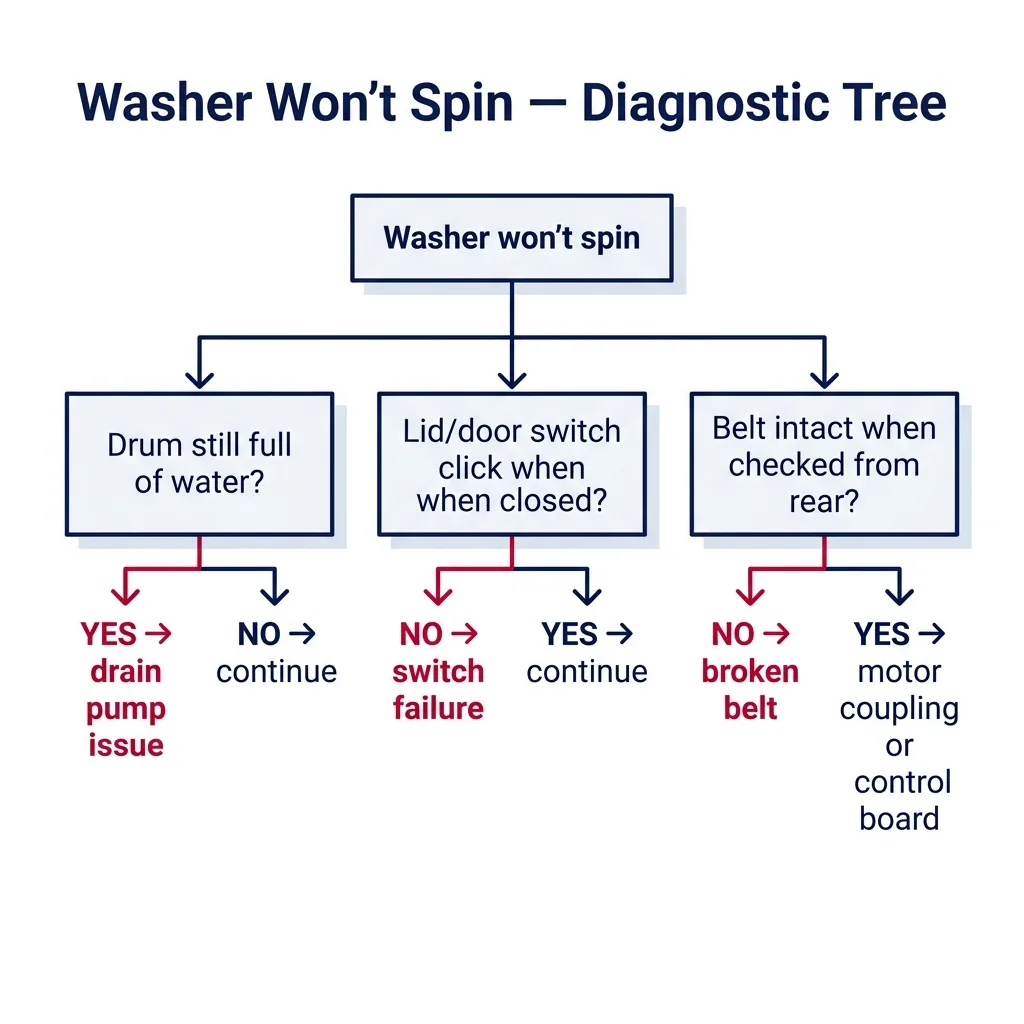
Open the door or lid. If you see standing water in the drum, the washer never finished the drain phase, and 100% of modern washers will refuse to spin while wet. Locate the drain pump filter (front-load: small access door at the lower-front; top-load: usually no user-accessible filter — pump is under the tub) and place a shallow pan beneath it. Slowly unscrew the filter and let the water drain out. Pull out coins, hairpins, baby socks, and lint. Reseat the filter hand-tight, then run a Drain & Spin cycle.
Tip: If the pump filter is clean but the washer still will not drain, the pump impeller may be jammed. See our companion guide on washer drainage.
⚠ Warning: A 4.5 cu ft front-load can hold 3-5 gallons of water. Drain in stages by partially loosening the filter — never yank it open.
Test the lid switch (top-load) or door lock (front-load)
Top-load: Lift the lid and find the small plastic switch on the rim of the cabinet — usually under a tab the lid presses down. Press it manually with the lid up and listen for a click. Use a multimeter on the two terminals to confirm continuity when pressed. A failed lid switch is the #1 reason older Whirlpool, Maytag, and GE top-loaders refuse to spin (~$20-35 part). Front-load: The door lock assembly sits behind the door boot, near the latch. If the door will not click locked or the "Door Locked" light never illuminates, the latch solenoid or its wiring harness has failed (~$40-90 part).
⚠ Warning: Do not tape down or wedge the lid switch closed to "test" the spin. This bypasses the safety interlock and is illegal to leave in service.
Inspect the drive belt (belt-drive models)
Unplug the washer, slide it forward, and remove the rear panel (top-load) or front panel (front-load). Look at the wide rubber belt that wraps the motor pulley and the large drive pulley on the back of the tub. A broken belt will be lying in the bottom of the cabinet — easy to spot. A glazed, cracked, or stretched belt will slip during the spin transition. Replace with the OEM part number stamped on the old belt (typically $15-30). Reseat carefully, ensuring the belt sits centered in both pulleys.
Tip: Most belts have a directional tread. Photograph the routing before removal so you can match the orientation on reinstall.
Check the motor coupling (direct-drive top-loaders)
On Whirlpool/Kenmore/Maytag direct-drive top-loaders (the iconic "agitator" design from the 90s through Cabrio-era), a small three-piece plastic-and-rubber coupling sits between the motor and the transmission. When the washer is overloaded repeatedly, the rubber coupler shears off — you will hear the motor spinning freely with no drum rotation. Tip the washer back, remove the two motor clips, slide the motor out, and inspect. If you see chewed black rubber or two plastic stubs no longer connected, replace the coupler kit (~$15-25). This is the single most common DIY top-load repair we see.
⚠ Warning: Wear gloves — the plastic spider on top of the basket can have sharp edges, and the motor itself is heavier than it looks (around 12-15 lb).
Verify the motor and motor control board
If the belt and coupling are intact, the lid switch passes continuity, and the washer drained correctly, the next suspect is the drive motor or its control board (MCU). Pull the wiring harness off the motor and use a multimeter to read resistance across the windings — typically 2-12 ohms depending on model (check the tech sheet, often tucked into the front panel). Open windings or shorted readings mean a failed motor (~$150-300). On front-loaders, the MCU mounted near the motor is a more common failure than the motor itself — look for burn marks or a chemical smell on the board.
Tip: On most Samsung and LG front-loaders, the tech sheet is folded behind the lower kick-plate or inside the pump access door. Use it — guessing at resistance values will mislead you.
Run a calibration cycle and final test
After any repair involving the motor, MCU, or main control board, run the manufacturer's calibration / test mode (often called "Tub Clean" combined with a key sequence — search the model number for the exact procedure). This empty-tub cycle re-learns the drum weight and resets the balance algorithm. Then run a real load: 4-5 lb of evenly distributed laundry on a Normal cycle. Listen for any new noises during the spin ramp-up to 1000+ RPM.
Brand-specific notes
Some brands have known design quirks worth knowing about before you start.
Samsung
Samsung VRT (Vibration Reduction Technology) front-loaders, particularly the WF42H and WF45 series, have a documented VRT brake assembly failure that causes the drum to lock during spin. You will see a "tE" or "uE" error. The brake pad assembly is a $35-60 part but requires pulling the rear of the drum — many customers opt for a tech on this one.
LG
LG WashTower and stacked WM/DLEX combos commonly throw "LE" (locked rotor) errors when the hall sensor on the rear of the motor fails. The sensor is a $25 part but requires removing the rear panel, which on a stacked WashTower means uninstalling the dryer first. LG also covers the direct-drive motor under a 10-year warranty — check before paying out of pocket.
Whirlpool / Kenmore (Cabrio top-load)
The Whirlpool Cabrio, Kenmore Oasis, and Maytag Bravos top-loaders share a common motor coupling and shifter assembly. The shifter (~$80) fails almost as often as the coupling and produces an "F7-E1" or "F7-E5" error. If the drum spins by hand but motor will not engage in spin, replace the shifter, not the motor.
Maytag
Older Maytag MVWC and MVWB top-loaders with the mechanical lid switch are notorious for the switch contacts wearing out around year 5-7. The replacement switch is $20-30 and takes 15 minutes — pop the top of the cabinet, unclip the harness, swap, and reseat.
GE
GE front-loaders (GTW and GFW series) frequently fail at the door latch strike — the metal hook on the door bends slightly over time and stops triggering the latch microswitch. Replace the door strike (~$15) before assuming the entire latch assembly is bad. Also check for the "no spin after drain" firmware bug on GFW650 models — a control board reflash from GE service may be needed.
What our techs see most often
Across our Los Angeles and Orange County dispatch logs, the breakdown for "won't spin" calls is roughly: 30% drain-pump clog (washer is full of water and customers do not realize it), 25% motor coupling on Whirlpool Cabrio and Kenmore direct-drives, 20% lid switch or door lock failure, and the rest split between belts, MCU boards, and plain unbalanced loads. If the customer mentions hearing a humming sound but no drum movement, our techs almost always arrive ready to replace a coupling or pump.
When to call a professional
- → You hear a loud grinding or metallic scraping during the spin attempt — likely a failed tub bearing requiring a full drum teardown
- → The motor windings test open or shorted on a multimeter and the washer is over 8 years old
- → You see burn marks, melted connectors, or smell scorched plastic on the MCU or main control board
- → Your front-loader is leaking water from the door boot or underneath during spin attempts (related but different repair)
- → The washer is a stacked LG WashTower or Samsung FlexWash and accessing components requires uninstalling the dryer
- → You've replaced the obvious parts (lid switch, belt, coupling) and the washer still will not spin
Washer Maintenance & Replacement Tasks
Step-by-step guides for individual maintenance jobs related to this appliance.
How to Clean a Washing Machine Drain Pump Filter
How to Remove Mold from a Front-Load Washer Gasket
How to Descale a Washing Machine with Vinegar (Hard Water Fix)
How to Level a Washing Machine to Stop Vibration
How to Replace a Washing Machine Drive Belt
Frequently asked questions
Why does my washer agitate but not spin?
On a top-loader, this almost always points to a worn motor coupling (direct-drive models) or a broken drive belt (belt-drive models). The motor still has power to drive the agitator gears but the link to the spin basket is severed. On a front-loader, agitation and spin use the same motor, so this symptom is usually a control issue or a drain failure preventing the spin from starting.
Can I bypass the lid switch on my washer?
No. The lid switch (and door lock on front-loaders) is a UL-required safety interlock that prevents a drum spinning at 1000+ RPM from being accessible. Bypassing it is illegal in California for any technician and dangerous for any homeowner. If your switch tests bad, replace it — they are $20-35 and take 15 minutes.
How much does it cost to fix a washer that will not spin?
For DIY: motor coupling kits run $15-25, drive belts $15-30, lid switches $20-35, drain pumps $40-90, and door lock assemblies $40-90. With a tech, a typical Axis service call for a non-spinning washer in LA/OC runs $180-350 including parts. Motor or MCU replacement on premium front-loaders can reach $400-600. Our $90 diagnostic fee applies toward the repair.
Is it worth fixing a 10-year-old washer that will not spin?
Usually yes if the fix is a coupling, belt, lid switch, or pump (all under $100 in parts). For a failed motor, MCU, or tub bearing repair on a 10+ year old machine, the labor and parts often exceed 50% of replacement cost — at that point, replacing is the better call. High-end models (Speed Queen, Miele) are worth fixing well past 10 years.
Why does my washer stop mid-cycle and refuse to spin?
Three usual culprits: (1) the auto-balance sensor detected an off-center load and the washer is in "redistribute" mode — open the door, untangle, and restart; (2) the drain pump is partially clogged and the pressure switch will not signal "empty" so spin never starts; (3) the door lock or lid switch is intermittent. Run a Drain & Spin first to isolate which it is.
Related Repair Guides
Washing Machine Won't Drain: Step-by-Step Fix
A washer that fills but never empties is the most fixable major washer fault we see — about 70% of these calls are resolved by clearing a clogged pump filter, a kinked drain hose, or a coin lodged in the impeller. Most homeowners can complete this repair in under an hour with basic tools.
Washing Machine Shaking and Vibrating: Causes and Fixes
A washer that shakes the laundry-room floor or 'walks' across it during the spin cycle is almost always a setup or balance issue, not a failed component. The four leading causes — uneven floor, forgotten shipping bolts, unbalanced loads, and worn shock absorbers — are all DIY-fixable, and most calls we run get resolved in well under an hour.
How to Clean a Washing Machine Drain Pump Filter
Cleaning your front-load washer's drain pump filter is one of the easiest and most effective maintenance tasks you can do. Grab some towels and a shallow dish, and let's clear out those trapped coins, lint, and bobby pins to get your washer draining perfectly again.