
At a glance
Symptoms
- • The washer motor hums or runs, but the drum does not agitate or spin.
- • A distinct burning rubber smell during the spin cycle.
- • Loud, high-pitched squealing or chirping noises when the drum tries to move.
- • The drum spins completely freely by hand with zero resistance.
- • The washer stops mid-cycle and displays a motor or spin error code.
- • Finding black rubber dust or a snapped belt under the machine.
Common causes
- • Normal wear and tear causes rubber belts to dry rot, stretch, and snap over thousands of cycles.
- • Chronic overloading of the washer (especially with heavy items like wet California beach towels or denim) puts immense strain on the belt.
- • A seized drain pump or motor pulley creates extreme friction, burning right through the belt.
- • Replacing a worn belt prevents motor burnout and saves you between $150 and $300 in professional repair bills.
- • Ignoring a squealing belt can eventually lead to damage to the plastic drum pulley, turning a $20 fix into a $100+ repair.
Safety First — Read Before You Start
- •Always unplug the washing machine from the wall outlet before starting any disassembly to prevent electrical shock.
- •Shut off the hot and cold water supply valves and disconnect the hoses. Have a bucket ready, as residual water will spill out.
- •Washing machines are incredibly heavy. If you need to tip the machine back or move it out of a tight laundry closet, use an appliance dolly or get a helper.
- •Beware of sharp sheet metal edges inside the washer cabinet. Wearing sturdy work gloves is highly recommended.
- •If you find oil leaking onto the belt or motor, do not just replace the belt. This indicates a failing transmission or tub seal, which requires professional attention.
Tools & supplies you'll need
- 1/4-inch and 5/16-inch nut drivers
- Socket wrench set (typically 1/2-inch or 9/16-inch)
- Phillips and flathead screwdrivers
- Heavy-duty zip ties (crucial for installation)
- Work gloves and safety glasses
- Flashlight or headlamp
- Putty knife (for top-load cabinet clips)
Step-by-step instructions
Disconnect Power and Water
Safety comes first. Unplug the washing machine from the wall outlet. Next, turn off the hot and cold water supply valves behind the washer. Disconnect the fill hoses from the back of the machine, using a bucket to catch the residual water that will inevitably drain out. If your washer is installed in a tight Southern California garage or a narrow condo closet, carefully pull the unit forward so you have at least two to three feet of working clearance behind and around it. Tape the lid or door shut so it doesn't flop open while you work.
Tip: Mark your hot and cold hoses with a piece of masking tape before disconnecting them so you don't cross them during reassembly.
Access the Drive Belt (Front-Load vs. Top-Load)
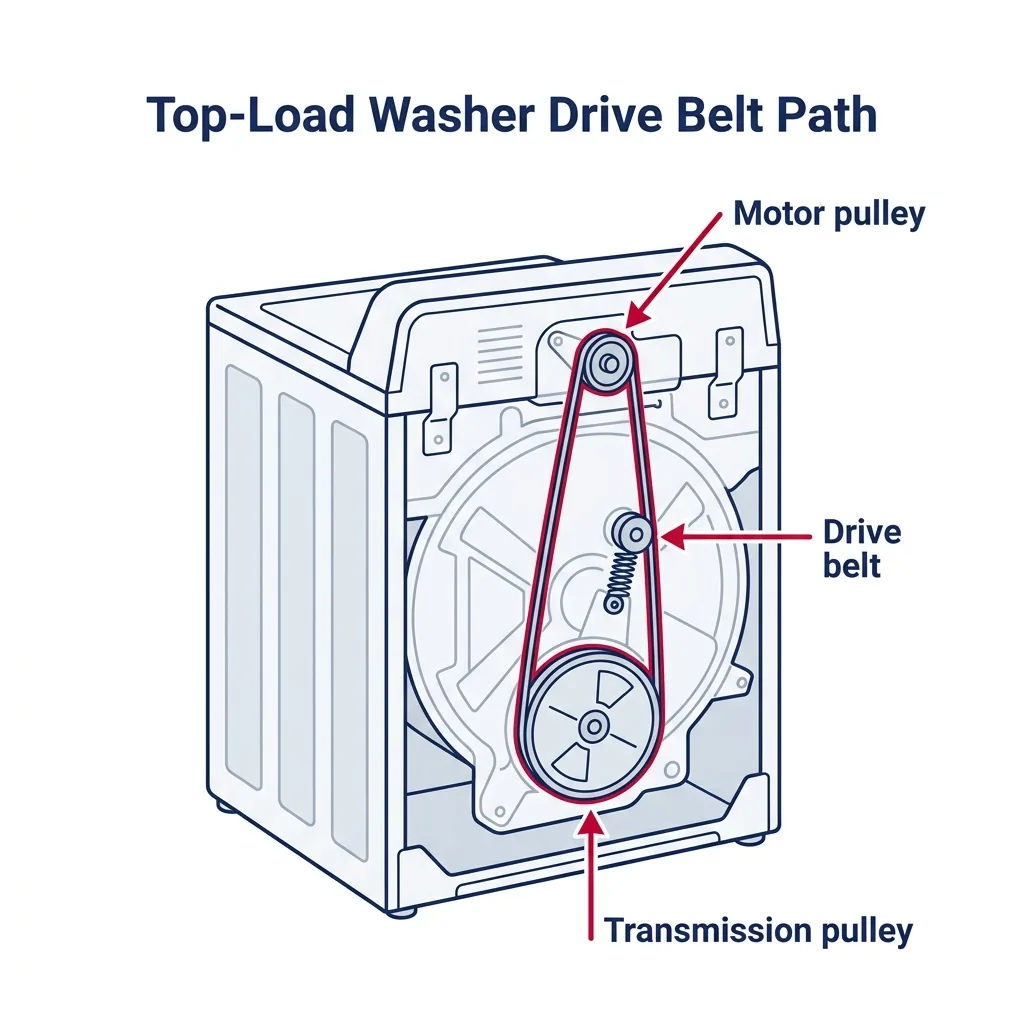
The access method depends entirely on your washer type. For most front-load washers, the belt is located behind the rear access panel. Simply remove the perimeter screws (usually 1/4-inch hex head) and lift the panel away. For newer top-load washers (like Whirlpool VMW models), the belt is located underneath the machine. You will need to carefully tip the washer backward against a wall or have a helper hold it at a 45-degree angle. Older top-loaders may require you to remove the entire outer cabinet by popping the spring clips under the control console. Once accessed, locate the belt connecting the smaller motor pulley to the large drum pulley.
⚠ Warning: Never tip a washer onto its front face, as this can crush the delicate control board and user interface.
Remove the Old Belt and Inspect the Area
If your belt has completely snapped, simply pull the broken pieces out of the cabinet. If the belt is still attached but slipping or frayed, you'll need to remove it. Grab the belt firmly, pull it slightly toward you, and slowly rotate the large drum pulley. The belt should walk itself right off the edge of the pulley. Once the belt is out, use your flashlight to inspect the area. Look for excessive black rubber dust, which indicates a severe alignment issue or a seized component. Spin the large drum pulley and the motor pulley by hand; both should rotate smoothly without grinding or heavy resistance.
Tip: Use a damp rag to clean out any accumulated rubber dust from the pulleys before installing the new belt to ensure maximum grip.
Thread the New Belt onto the Motor Pulley
Take your new OEM replacement belt and examine it. Most modern washer belts are ribbed on one side and flat on the other. Ensure the ribbed side faces inward, matching the grooves on the motor pulley. Carefully thread the belt around the small motor pulley first. Make sure the belt is seated perfectly within the grooves. If the belt sits off-center on the motor pulley, it will immediately jump off or shred itself when the washer enters its high-speed spin cycle.
⚠ Warning: Do not use automotive fan belts. Washer belts are specifically engineered to stretch and slip at certain torque thresholds to protect the motor from burning out.
Stretch the Belt onto the Drum Pulley (The Zip Tie Trick)
This is often the hardest part of the job, as modern 'stretch fit' belts are extremely tight and do not use a tensioner arm. Pull the belt tight and hook it over one edge of the large drum pulley. To prevent the belt from slipping off as you stretch it, loop a heavy-duty zip tie through the pulley spokes and over the belt, locking it tightly in place. With the belt secured to the pulley by the zip tie, carefully rotate the large pulley clockwise. As the pulley turns, the belt will be forced to stretch and seat itself into the groove. Once it's fully seated, carefully cut and remove the zip tie.
Tip: If the belt is incredibly stiff, soaking it in warm water for 10 minutes prior to installation can make the rubber slightly more pliable and easier to stretch.
Test the Fit and Alignment
With the new belt installed and the zip tie removed, rotate the large drum pulley manually for five to six full revolutions. Watch the belt closely as it travels around both pulleys. It should stay perfectly centered on the large pulley and remain fully seated in the grooves of the motor pulley. If the belt tries to walk off the edge, gently push or pull it into alignment while continuing to rotate the pulley until it finds its natural center. A properly installed belt will feel very taut, with less than half an inch of deflection when pressed firmly with your thumb.
⚠ Warning: Keep your fingers clear of the pinch points between the belt and the pulleys while rotating them to avoid a painful crushing injury.
Reassemble and Run a Test Cycle
Once you are satisfied with the belt alignment, reinstall the plastic belt shield (if your top-loader had one) or reattach the rear access panel for front-loaders. Carefully lower the washer back to the floor or push it back into its space. Reconnect your hot and cold water hoses, turn the water valves back on, and check for any drips. Plug the washer back into the electrical outlet. Run a quick 'Rinse and Spin' cycle while the machine is empty. Listen for a smooth ramp-up to high speed without any squealing, thumping, or burning smells.
Tip: Running the first test cycle empty ensures that if something is wrong, you don't have to deal with a drum full of soaking wet clothes.
Brand-specific notes
Some brands have known design quirks worth knowing about before you start.
Samsung
Samsung VRT front-load models use an exceptionally tight ribbed stretch belt. You will almost certainly need to use the 'zip tie trick' mentioned in the steps to force the new belt onto the large drum pulley. Don't be afraid to use some muscle.
LG
Important: LG 'Direct Drive' (Inverter Direct Drive) models do NOT have a drive belt! The motor is attached directly to the back of the wash tub. If your LG says Direct Drive on the front panel and isn't spinning, you likely have a stator, rotor, or clutch issue—not a belt problem.
Whirlpool
Older Whirlpool and Kenmore direct-drive top loaders (pre-2010) use a rubber and plastic motor coupling instead of a belt. Newer Whirlpool VMW (Vertical Modular Washers) use a splined stretch belt located under the machine, protected by a plastic shield that requires a 5/16-inch nut driver to remove.
GE
Many GE top-loaders utilize an 'elastic' style stretch belt with no adjustable tensioner bracket. You have to walk it onto the pulley manually. If you hear a loud squealing during agitation on a GE, the belt is usually the culprit.
Speed Queen
Speed Queen washers are built like tanks, but when a belt does go, you'll usually access it by removing the front panel rather than the back. They use heavy-duty v-belts that cost a bit more ($30-$40) than standard ribbed belts but last significantly longer.
What our techs see most often
We get a lot of calls from families in the Valley whose washers suddenly smell like burning tires and stop spinning. Nine times out of ten, they've been washing massive loads of heavy pool towels, which puts so much strain on the drive belt that it literally melts or snaps.
When to call a professional
- → If the motor pulley or the large drum pulley is completely seized and will not turn by hand.
- → If you find oil or rusty water leaking onto the belt, which indicates a failing tub seal or transmission.
- → If the large drum pulley is cracked, warped, or the center mounting bolt is stripped out.
- → If your washer is stacked in a tight laundry closet and you cannot safely unstack the heavy dryer on top.
- → If the motor itself smells burnt out or is making a loud electrical buzzing noise without turning.
- → If the appliance is still covered by a manufacturer warranty or an extended home warranty plan.
Related Washer Troubleshooting
These troubleshooting guides cover problems this task can help solve.
How to Decode Washing Machine Error Codes (LG, Samsung, Whirlpool, GE)
Washing Machine Shaking and Vibrating: Causes and Fixes
Washing Machine Leaking from Bottom: Find and Fix the Source
Washing Machine Not Spinning: How to Fix It
Washing Machine Smells Bad: How to Eliminate Mold and Mildew
Frequently asked questions
How much does a replacement washer drive belt cost?
A new OEM (Original Equipment Manufacturer) drive belt typically costs between $15 and $35 depending on the brand. We strongly recommend buying OEM belts rather than cheap $8 generic versions online, as generics often stretch out or snap within a few months.
Why did my brand new washer belt break immediately?
If a new belt shreds or snaps right away, it usually means there is an underlying mechanical issue. The most common culprits are a seized tub bearing, a jammed drain pump, or the belt not being seated properly in the motor pulley grooves.
Can I use an automotive fan belt from an auto parts store?
No. While they look similar, washer belts and automotive belts are engineered differently. Washer belts are designed to stretch and slip at specific torque loads to protect the washer's motor from burning out if the tub gets jammed.
How long should a washing machine drive belt last?
Under normal conditions, a quality OEM drive belt should last 5 to 10 years. However, chronic overloading, washing heavy items like rugs frequently, or running multiple loads every single day can shorten a belt's lifespan to 3 to 5 years.
Related Repair Guides
Washing Machine Not Spinning: How to Fix It
A washer that fills and agitates but won't spin is one of the most frequent calls our dispatch handles. In most cases the cause is an unbalanced load, a failed lid switch or door lock, a broken drive belt, or a worn motor coupling — and roughly two out of three of those you can fix yourself in under an hour.
How to Clean a Washing Machine Drain Pump Filter
Cleaning your front-load washer's drain pump filter is one of the easiest and most effective maintenance tasks you can do. Grab some towels and a shallow dish, and let's clear out those trapped coins, lint, and bobby pins to get your washer draining perfectly again.
How to Remove Mold from a Front-Load Washer Gasket
Banish that swampy smell and black sludge from your front-load washer. This easy DIY guide walks you through safely cleaning your rubber door gasket and keeping mold away for good.