
At a glance
Symptoms
- • Washer 'walks' or shifts across the floor during the high-speed spin cycle.
- • Loud banging, thumping, or machine-gun noises when the washer accelerates.
- • Excessive vibration felt through the floorboards or in adjacent rooms.
- • Uneven gaps between the washer and the dryer or adjacent cabinetry.
- • Constant out-of-balance error codes (like UE or UB) that pause the wash cycle.
- • The machine visibly rocks back and forth when you push firmly on opposite diagonal corners.
Common causes
- • Prevents premature wear on internal shock absorbers and suspension springs, which can cost $150-$300 to replace.
- • Protects the expensive drum bearings and spider arm assembly from catastrophic eccentric rotation damage.
- • Prevents structural floor damage, scratched ceramic tiles, or gouged linoleum caused by the heavy machine walking.
- • Relieves stress on hot and cold water supply hoses and drain lines, drastically reducing the risk of a flooded laundry room.
- • Ensures cycles finish on time without forcing you to constantly pause the machine to manually redistribute wet, heavy clothes.
Safety First — Read Before You Start
- •Always unplug the washer before tipping or moving it to avoid electrical shock or accidentally starting a cycle while your hands are underneath.
- •Never tilt a front-load washer forward; always tilt it backward or side-to-side. Tilting it forward can crush the door latch, crack the glass, or dent the front panel.
- •Have a helper available. Modern front-load washers have heavy concrete counterweights and can weigh well over 200 lbs, posing a serious crushing hazard to fingers and toes.
- •Ensure the washer is completely empty of water and clothes before attempting to move or lift it. A tub full of water adds over 100 lbs of unstable, sloshing weight.
Tools & supplies you'll need
- Standard carpenter's bubble level (24-inch preferred)
- Adjustable wrench or channel-lock pliers
- Pry bar or a sturdy wooden block (to safely prop up the machine)
- Thick rubber anti-vibration pads (optional but recommended)
- Flashlight or headlamp
- Penetrating oil like WD-40 (if leveling legs are rusted or seized)
Step-by-step instructions
Check for and Remove Shipping Bolts (New Installations Only)
If your washing machine is brand new or recently moved from another house, the very first step is ensuring the shipping bolts have been removed. These are 4 or 5 large bolts located on the rear panel of front-load washers that lock the suspension in place for transit. If you run the machine with these installed, it will bounce violently and can literally tear itself apart. Use a wrench to back these bolts out completely, pull out the attached plastic sleeves, and plug the holes with the caps provided by the manufacturer. Keep the bolts in a safe place in case you move again.
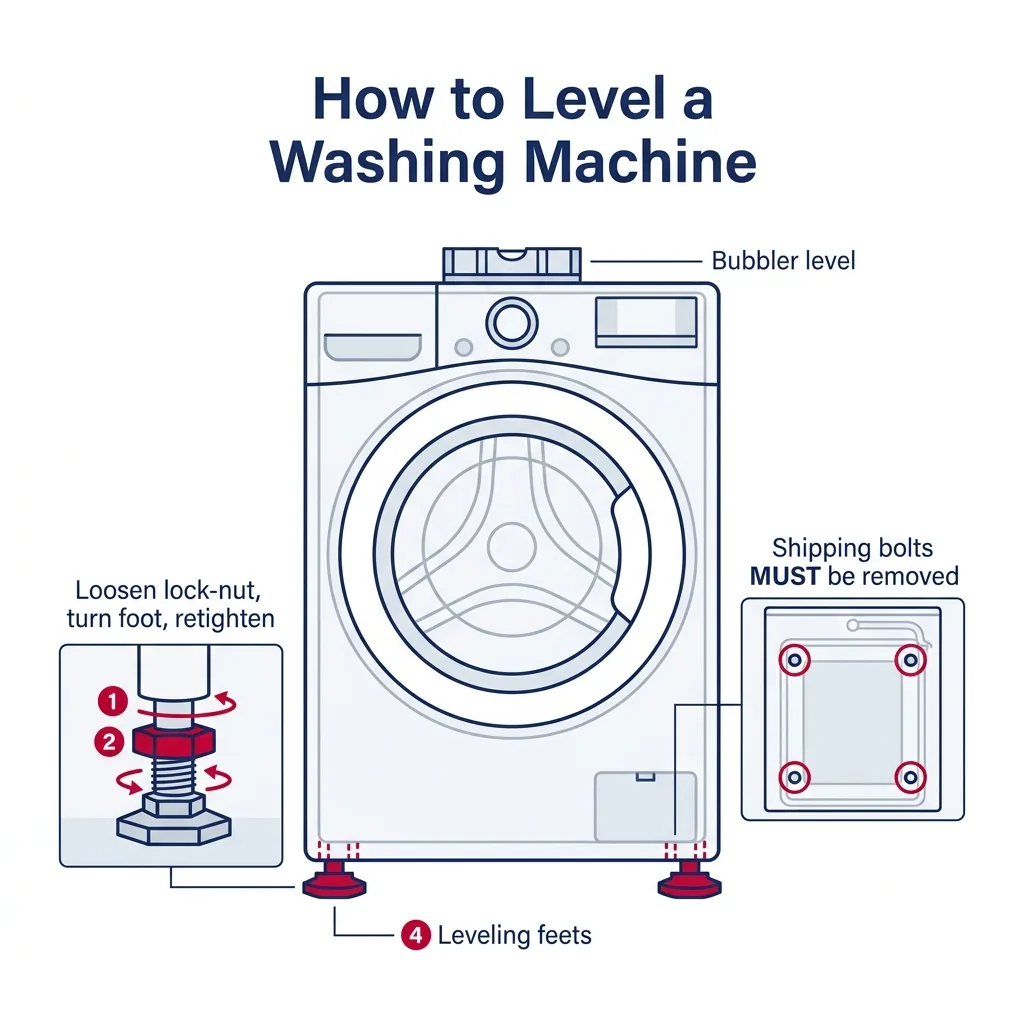
⚠ Warning: Running a washer with shipping bolts installed will void your warranty and can cause catastrophic damage to the drum and outer tub within a single cycle.
Assess the Floor and Foundation
Before adjusting the machine, check the floor underneath. In many older California homes—especially raised-foundation bungalows in Los Angeles or hillside properties—the subfloor itself may be bouncy or sagging. Place your bubble level directly on the floor where the washer sits. If the floor has significant give or rot, leveling the machine won't solve the vibration. For weak floors, you may need to cut a piece of 3/4-inch thick plywood to fit under both the washer and dryer. Screw the plywood directly into the floor joists to create a rock-solid base before proceeding.
Tip: If your laundry room is on a second floor, adding thick rubber anti-vibration pads under the feet after leveling can dramatically reduce noise transfer through the framing.
Level the Washer Side-to-Side
Place your 24-inch bubble level across the top front edge of the washing machine. Note which side is lower. Have a helper gently tilt the washer backward to take the weight off the front legs, or carefully use a pry bar and a wooden block to prop it up. Using your adjustable wrench or channel-lock pliers, loosen the locknut on the leg that needs adjusting. Turn the leg clockwise (screwing it in) to lower that corner, or counter-clockwise (unscrewing it out) to raise it. Lower the machine back down and check the level again. Repeat until the bubble is perfectly centered.
Tip: If the threads on the legs are rusted and won't turn, spray them with penetrating oil, wait 15 minutes, and try again. Don't force them with excessive leverage, or you risk snapping the leg off inside the frame.
Level the Washer Front-to-Back
Move your bubble level so it sits along the side edge of the washer, pointing from the front to the back. Check both the left and right sides. If you are working on a front-load washer, you will need to adjust the rear legs using the same method as the front legs. However, if you have an older top-load washer (like many classic Whirlpool or Maytag models), it likely features self-adjusting rear legs. To set self-adjusting legs, simply tilt the entire machine forward about 3 to 4 inches until the rear legs lift off the floor, then gently set it back down. The internal springs will automatically snap the rear legs to the correct height.
⚠ Warning: Never use wood shims or folded cardboard to level a washer. The intense vibration of the spin cycle will quickly compress, splinter, or spit out temporary shims.
Tighten the Locknuts Securely
This is the most frequently skipped step, and failing to do it means your washer will be out of level again within a month. Once the machine is perfectly level both side-to-side and front-to-back, you must lock the legs in place. Take your adjustable wrench and turn the locknut on each leg upwards until it is jammed tightly against the bottom base frame of the washer. The nut prevents the threaded leg from slowly vibrating loose and unscrewing during high-speed spin cycles.
Tip: Hold the bottom of the foot with pliers while tightening the locknut with a wrench to ensure you don't accidentally change the height of the leg while tightening the nut.
Perform the Diagonal Rock Test
With the machine flat on the floor and all locknuts tightened, place your hands on the top right front corner and the top left rear corner. Push and pull firmly to see if there is any play or rocking. Switch your hands to the opposite diagonal corners (top left front, top right rear) and repeat. The machine should feel like it is glued to the floor. If there is even a millimeter of rocking, one of the legs is slightly too short. Identify the short leg, loosen its locknut, extend it just a hair until it meets the floor firmly, and re-tighten.
Tip: A machine can technically be 'level' according to the bubble, but still rock if the floor is slightly warped. The rock test is the ultimate indicator of stability.
Run a Calibration and Test Cycle
Many modern digital washing machines have a calibration mode that allows the internal computer to measure the exact weight of the empty drum to better detect out-of-balance loads. Check your owner's manual to see if your model has a calibration sequence (usually involving holding a combination of buttons). Once calibrated, throw in three or four heavy bath towels, get them wet on a rinse cycle, and run a high-speed spin. Watch the machine carefully. It should hum smoothly without walking, banging, or visibly shaking the outer cabinet.
Brand-specific notes
Some brands have known design quirks worth knowing about before you start.
LG
LG front-loaders are notorious for having hyper-sensitive out-of-balance sensors. If an LG unit is off by even a fraction of an inch, it will throw a 'UE' (Uneven) error code and refuse to spin out the water, leaving your clothes soaked. Perfect leveling is non-negotiable for these models.
Samsung
Samsung washers are frequently installed on matching storage pedestals. It is critical that you level the pedestal to the floor first, and then ensure the washer is tightly secured to the pedestal using the provided metal brackets. If the screws connecting the washer to the pedestal are loose, the whole tower will sway violently.
Whirlpool
Many older Whirlpool and Kenmore top-load models feature self-leveling rear legs. You don't need a wrench for the back—just tilt the entire machine forward about 3-4 inches and gently set it back down. The rear mechanism will auto-adjust to the floor angle.
GE
GE front-loaders utilize heavy internal concrete counterweights. Ensure the rubber anti-skid pads on the bottom of the leveling legs are intact. If they've worn off or fallen out, the bare metal foot will slide effortlessly on slippery tile floors, causing the machine to walk even if it is perfectly level.
Bosch
Compact 24-inch Bosch washers, highly popular in tight coastal condos in Santa Monica or San Diego, spin at incredibly high speeds (up to 1400 RPM). Because of their small footprint and high RPM, perfect leveling is absolutely critical to prevent them from vibrating right out of their closets.
What our techs see most often
Here in Southern California, we get a flood of calls for 'exploding' washers in second-story laundry closets or older raised-foundation homes in Pasadena and Long Beach. Nine times out of ten, the machine isn't broken—it just needs the locknuts tightened and a solid piece of 3/4-inch plywood underneath to reinforce a bouncy subfloor.
When to call a professional
- → The washer still bangs violently even after perfect leveling, indicating broken internal shock absorbers or a snapped suspension spring.
- → The inner stainless steel drum moves independently of the outer plastic tub, or you hear a roaring jet-engine sound, which are signs of a broken spider arm or rear bearing failure.
- → The leveling legs are completely rusted or sheared off inside the base frame, requiring the machine to be lifted and the frame repaired.
- → The floor structure is severely damaged, sagging, or rotting from a previous leak, requiring a licensed contractor to rebuild the subfloor.
- → You are dealing with a heavy stacked washer/dryer unit in a very tight closet where you cannot safely reach the rear legs or pull the unit out without risking injury.
Related Washer Troubleshooting
These troubleshooting guides cover problems this task can help solve.
How to Decode Washing Machine Error Codes (LG, Samsung, Whirlpool, GE)
Washing Machine Shaking and Vibrating: Causes and Fixes
Washing Machine Leaking from Bottom: Find and Fix the Source
Washing Machine Not Spinning: How to Fix It
Washing Machine Smells Bad: How to Eliminate Mold and Mildew
Frequently asked questions
How much does it cost to replace broken washer shock absorbers if I ignored the vibration too long?
If the suspension is shot from years of out-of-level operation, replacing the shock absorbers on a front-loader typically costs between $150 and $250 for parts and pro labor. However, if you are handy, DIYing the shocks can drop that cost to just $40-$80 for the OEM parts.
Do anti-vibration pads actually work?
Yes, thick rubber anti-vibration pads (which cost about $15-$30 for a set of four) are excellent for absorbing high-frequency micro-vibrations. They are highly recommended for raised wooden foundations or second-floor laundry rooms common in California condos.
Why does my washer only vibrate during the final spin cycle?
The final spin cycle reaches extreme speeds of 800 to 1400 RPM to extract water from the clothes. At these high speeds, any slight imbalance in the leveling legs or the load itself is magnified exponentially by centrifugal force.
Can I use wood shims to level my washing machine?
No, you should never use wood shims under a washing machine. Wood shims will eventually splinter, compress, or simply slide out from under the machine due to the intense vibration. Always use the built-in threaded metal leveling legs.
Related Repair Guides
Washing Machine Shaking and Vibrating: Causes and Fixes
A washer that shakes the laundry-room floor or 'walks' across it during the spin cycle is almost always a setup or balance issue, not a failed component. The four leading causes — uneven floor, forgotten shipping bolts, unbalanced loads, and worn shock absorbers — are all DIY-fixable, and most calls we run get resolved in well under an hour.
How to Clean a Washing Machine Drain Pump Filter
Cleaning your front-load washer's drain pump filter is one of the easiest and most effective maintenance tasks you can do. Grab some towels and a shallow dish, and let's clear out those trapped coins, lint, and bobby pins to get your washer draining perfectly again.
How to Remove Mold from a Front-Load Washer Gasket
Banish that swampy smell and black sludge from your front-load washer. This easy DIY guide walks you through safely cleaning your rubber door gasket and keeping mold away for good.